QUESTION IMAGE
Question
question 22
2 pts
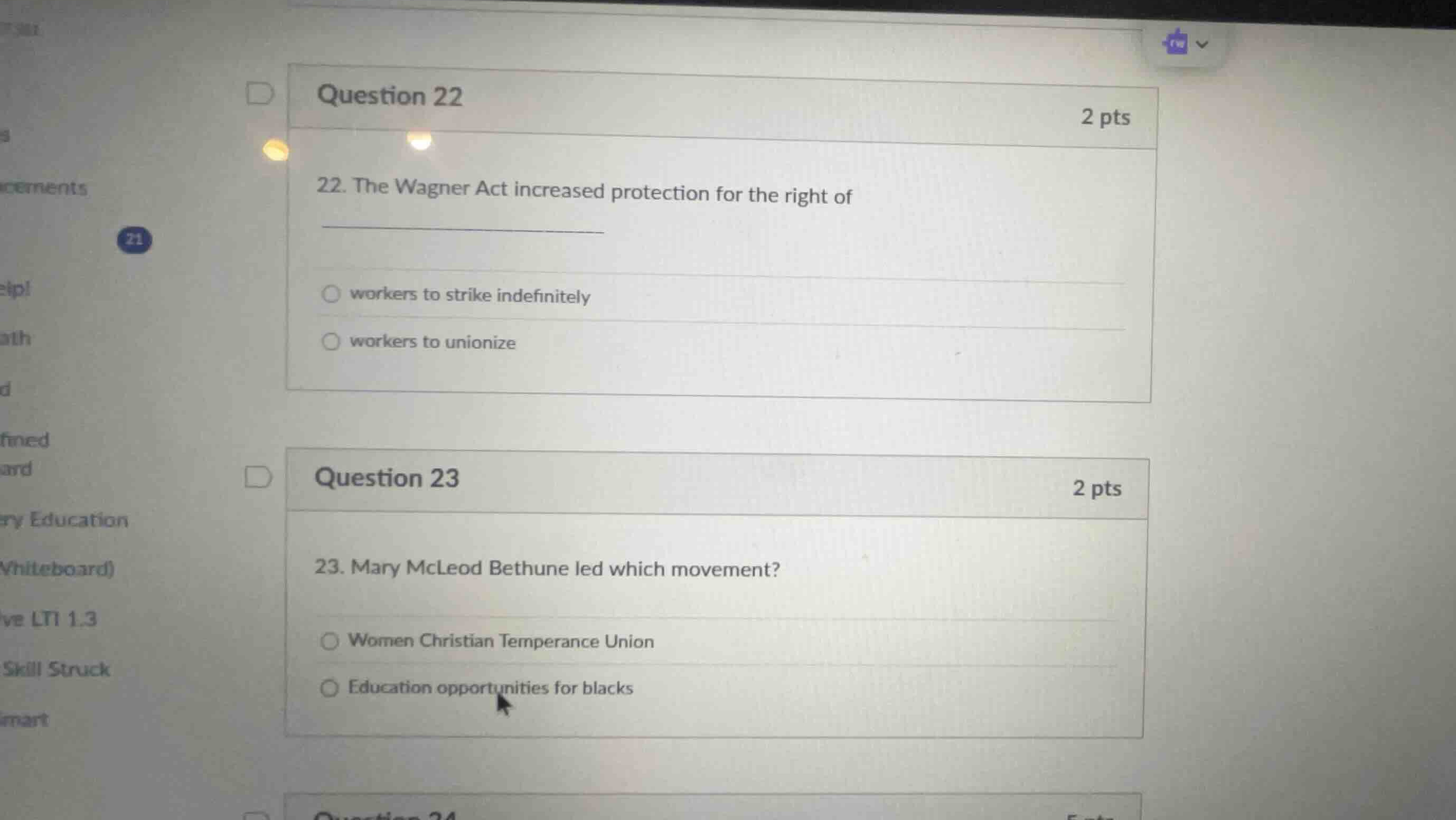
- the wagner act increased protection for the right of
workers to strike indefinitely
workers to unionize
question 23
2 pts
- mary mcleod bethune led which movement?
women christian temperance union
education opportunities for blacks
<pre_analysis>
{
"quality": "clear",
"question_count": 2,
"skills_matched": [
"direct_cot",
"multiple_choice_formatter",
"explain_then_answer",
"tutor"
],
"needs_drawing": false,
"concepts_used": [
"New Deal Labor Legislation"
],
"new_concepts": [
"Mary McLeod Bethune",
"African American Education History"
],
"current_concepts": [
"New Deal Labor Legislation",
"Mary McLeod Bethune",
"African American Education History"
]
}
</pre_analysis>
<reasoning>
Analyze the Wagner Act
The Wagner Act of 1935, also known as the National Labor Relations Act, is a key piece of New Deal Labor Legislation. It guaranteed the right of private sector employees to organize into trade unions, engage in collective bargaining, and take collective action such as strikes. However, it did not protect the right to strike indefinitely without regulation. Thus, it protected the right of workers to unionize.
Analyze Mary McLeod Bethune
Mary McLeod Bethune was a prominent African American educator, philanthropist, humanitarian, feminist, and civil rights activist. She is best known for starting a private school for African American students in Daytona Beach, Florida, which later became Bethune-Cookman University, and for advising President Franklin D. Roosevelt as part of his "Black Cabinet." Her primary leadership was in promoting education opportunities for Black Americans.
</reasoning>
<answer>
Question 22
<mcq-option>workers to strike indefinitely</mcq-option>
<mcq-correct>workers to unionize</mcq-correct>
Question 23
<mcq-option>Women Christian Temperance Union</mcq-option>
<mcq-correct>Education opportunities for blacks</mcq-correct>
</answer>
<post_analysis>
{
"subject": "Social Science",
"question_type": "Multiple Choice",
"knowledge_point": [
"Social Science",
"U.S. History",
"The New Deal Era"
]
}
</post_analysis>
Snap & solve any problem in the app
Get step-by-step solutions on Sovi AI
Photo-based solutions with guided steps
Explore more problems and detailed explanations
<pre_analysis>
{
"quality": "clear",
"question_count": 2,
"skills_matched": [
"direct_cot",
"multiple_choice_formatter",
"explain_then_answer",
"tutor"
],
"needs_drawing": false,
"concepts_used": [
"New Deal Labor Legislation"
],
"new_concepts": [
"Mary McLeod Bethune",
"African American Education History"
],
"current_concepts": [
"New Deal Labor Legislation",
"Mary McLeod Bethune",
"African American Education History"
]
}
</pre_analysis>
<reasoning>
Analyze the Wagner Act
The Wagner Act of 1935, also known as the National Labor Relations Act, is a key piece of New Deal Labor Legislation. It guaranteed the right of private sector employees to organize into trade unions, engage in collective bargaining, and take collective action such as strikes. However, it did not protect the right to strike indefinitely without regulation. Thus, it protected the right of workers to unionize.
Analyze Mary McLeod Bethune
Mary McLeod Bethune was a prominent African American educator, philanthropist, humanitarian, feminist, and civil rights activist. She is best known for starting a private school for African American students in Daytona Beach, Florida, which later became Bethune-Cookman University, and for advising President Franklin D. Roosevelt as part of his "Black Cabinet." Her primary leadership was in promoting education opportunities for Black Americans.
</reasoning>
<answer>
Question 22
<mcq-option>workers to strike indefinitely</mcq-option>
<mcq-correct>workers to unionize</mcq-correct>
Question 23
<mcq-option>Women Christian Temperance Union</mcq-option>
<mcq-correct>Education opportunities for blacks</mcq-correct>
</answer>
<post_analysis>
{
"subject": "Social Science",
"question_type": "Multiple Choice",
"knowledge_point": [
"Social Science",
"U.S. History",
"The New Deal Era"
]
}
</post_analysis>