QUESTION IMAGE
Question
question 21 of 26
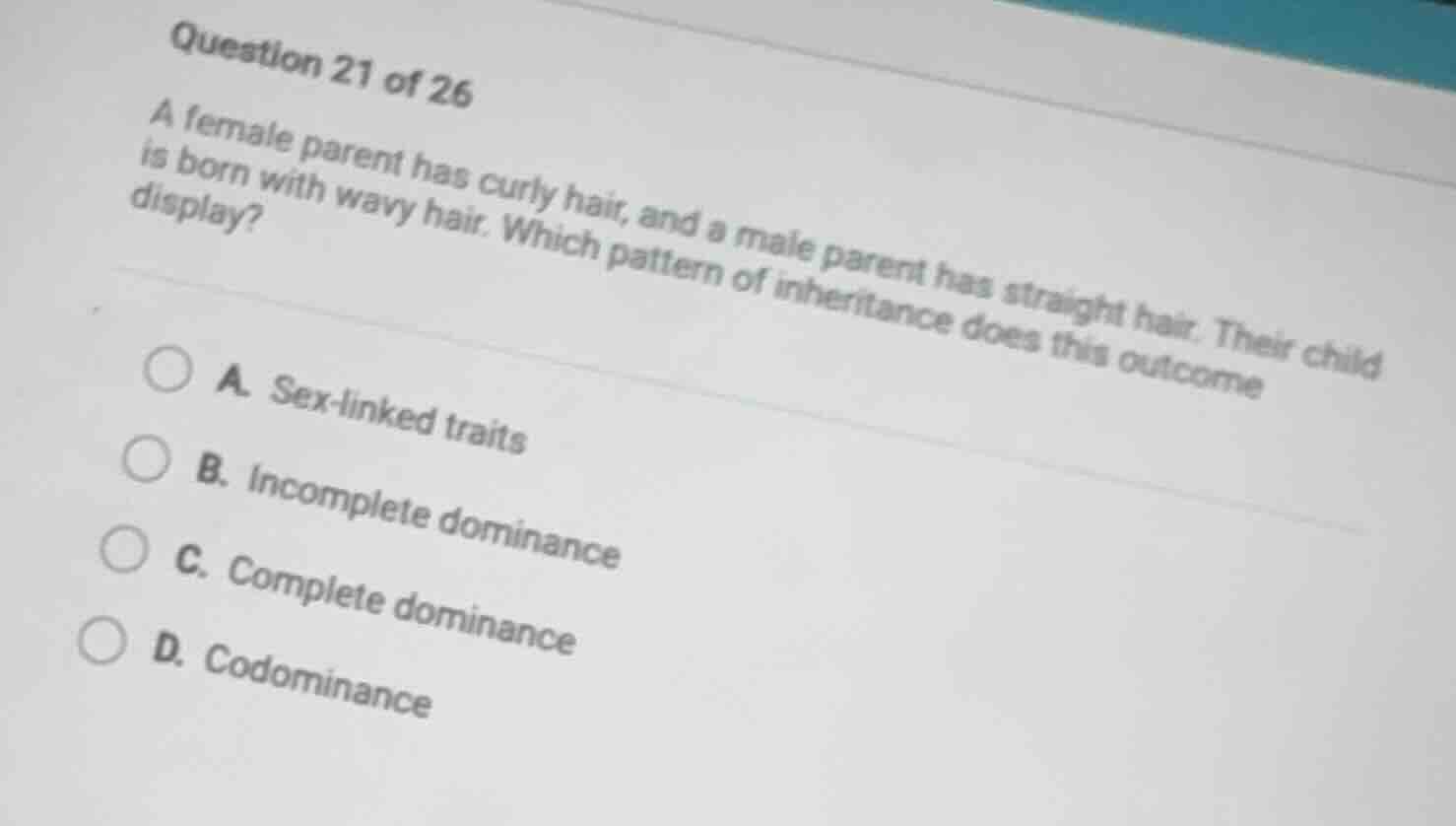
a female parent has curly hair, and a male parent has straight hair. their child is born with wavy hair. which pattern of inheritance does this outcome display?
a. sex-linked traits
b. incomplete dominance
c. complete dominance
d. codominance
<pre_analysis>
{
"quality": "clear",
"question_count": 1,
"skills_matched": [
"direct_cot",
"multiple_choice_formatter",
"explain_then_answer",
"tutor"
],
"needs_drawing": false,
"concepts_used": [
"Dominance",
"Phenotype"
],
"new_concepts": [
"Incomplete Dominance",
"Non-Mendelian Inheritance"
],
"current_concepts": [
"Dominance",
"Phenotype",
"Incomplete Dominance",
"Non-Mendelian Inheritance"
]
}
</pre_analysis>
<reasoning>
Analyze the parental phenotypes
The female parent has curly hair and the male parent has straight hair. These represent two distinct, contrasting homozygous phenotypes for hair texture.
Examine the offspring phenotype
The child is born with wavy hair. Wavy hair is an intermediate phenotype that lies between the curly and straight hair textures of the parents.
Identify the inheritance pattern
Using the Dominance and Phenotype concepts, we evaluate how alleles interact. When a heterozygous individual displays an intermediate phenotype that is a blend of the two homozygous parental phenotypes, it demonstrates incomplete dominance.
Evaluate the given options
- Sex-linked traits: Traits carried on sex chromosomes, which is not indicated by this simple blending.
- Incomplete dominance: The heterozygous offspring shows an intermediate, blended phenotype (wavy). This fits perfectly.
- Complete dominance: One allele completely masks the other, which would result in only curly or only straight hair.
- Codominance: Both alleles are fully and separately expressed (e.g., having both straight and curly hairs individually), rather than blended.
</reasoning>
<answer>
<mcq-option>(A) Sex-linked traits</mcq-option>
<mcq-correct>(B) Incomplete dominance</mcq-correct>
<mcq-option>(C) Complete dominance</mcq-option>
<mcq-option>(D) Codominance</mcq-option>
</answer>
<post_analysis>
{
"subject": "Natural Science",
"question_type": "Multiple Choice",
"knowledge_point": [
"Natural Science",
"Biology",
"Incomplete Dominance"
]
}
</post_analysis>
Snap & solve any problem in the app
Get step-by-step solutions on Sovi AI
Photo-based solutions with guided steps
Explore more problems and detailed explanations
<pre_analysis>
{
"quality": "clear",
"question_count": 1,
"skills_matched": [
"direct_cot",
"multiple_choice_formatter",
"explain_then_answer",
"tutor"
],
"needs_drawing": false,
"concepts_used": [
"Dominance",
"Phenotype"
],
"new_concepts": [
"Incomplete Dominance",
"Non-Mendelian Inheritance"
],
"current_concepts": [
"Dominance",
"Phenotype",
"Incomplete Dominance",
"Non-Mendelian Inheritance"
]
}
</pre_analysis>
<reasoning>
Analyze the parental phenotypes
The female parent has curly hair and the male parent has straight hair. These represent two distinct, contrasting homozygous phenotypes for hair texture.
Examine the offspring phenotype
The child is born with wavy hair. Wavy hair is an intermediate phenotype that lies between the curly and straight hair textures of the parents.
Identify the inheritance pattern
Using the Dominance and Phenotype concepts, we evaluate how alleles interact. When a heterozygous individual displays an intermediate phenotype that is a blend of the two homozygous parental phenotypes, it demonstrates incomplete dominance.
Evaluate the given options
- Sex-linked traits: Traits carried on sex chromosomes, which is not indicated by this simple blending.
- Incomplete dominance: The heterozygous offspring shows an intermediate, blended phenotype (wavy). This fits perfectly.
- Complete dominance: One allele completely masks the other, which would result in only curly or only straight hair.
- Codominance: Both alleles are fully and separately expressed (e.g., having both straight and curly hairs individually), rather than blended.
</reasoning>
<answer>
<mcq-option>(A) Sex-linked traits</mcq-option>
<mcq-correct>(B) Incomplete dominance</mcq-correct>
<mcq-option>(C) Complete dominance</mcq-option>
<mcq-option>(D) Codominance</mcq-option>
</answer>
<post_analysis>
{
"subject": "Natural Science",
"question_type": "Multiple Choice",
"knowledge_point": [
"Natural Science",
"Biology",
"Incomplete Dominance"
]
}
</post_analysis>