QUESTION IMAGE
Question
question 3
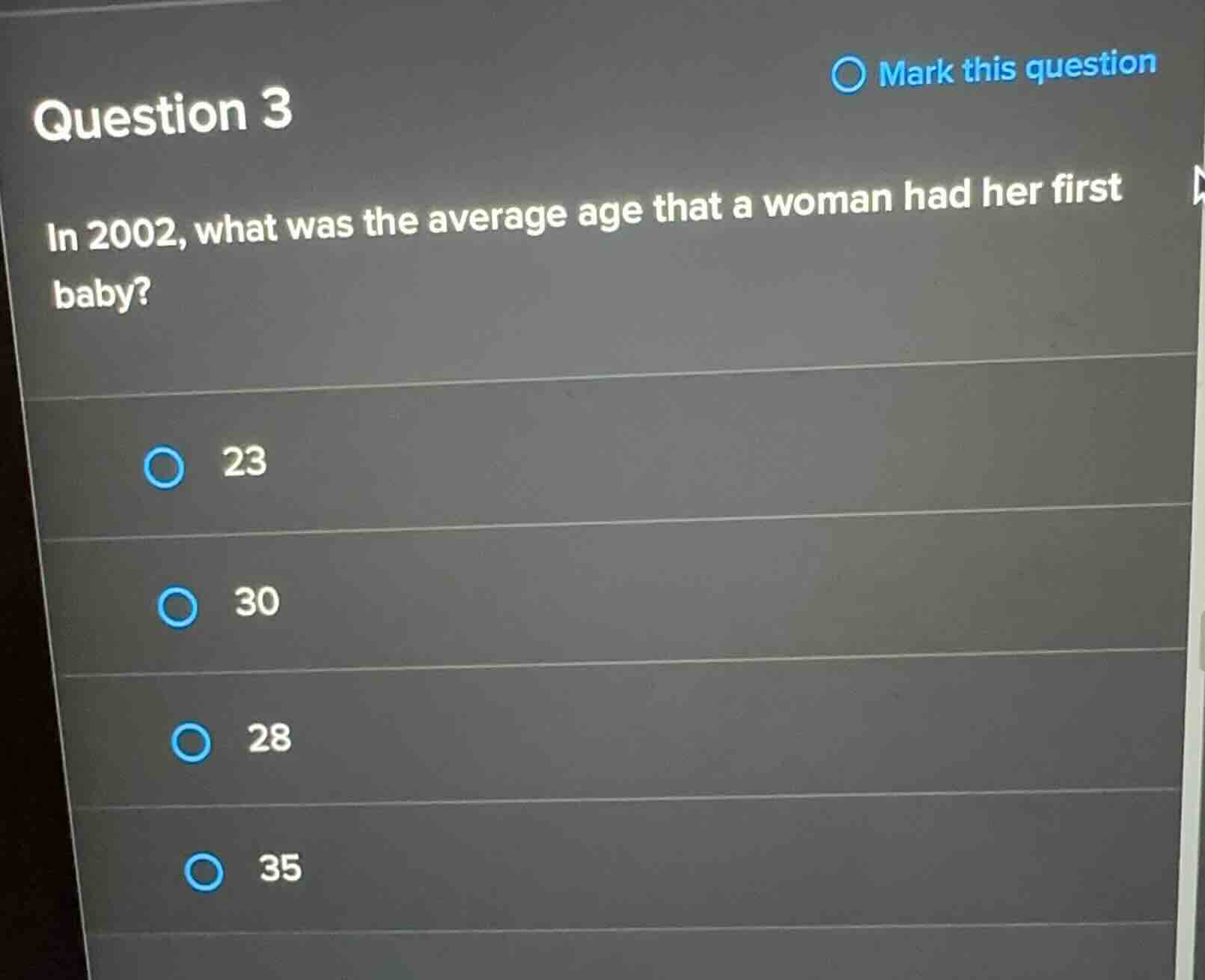
in 2002, what was the average age that a woman had her first baby?
23
30
28
35
Analyze demographic trends in maternal age
In developmental psychology and sociology, tracking the average age of first-time mothers is a key indicator of shifting Demographic Variations. According to data from the National Center for Health Statistics (NCHS) and the Centers for Disease Control and Prevention (CDC), the mean age of mothers at first birth in the United States has steadily risen over the past several decades.
Identify the specific historical data point
In 1970, the average age of a woman having her first child in the United States was approximately 21.4 years. By the year 2002, this average age had risen to approximately 25.1 years.
Evaluate the given multiple-choice options
Looking at the options provided:
- 23: This is closer to the average age in the late 1970s and 1980s.
- 30: This is significantly higher than the average in 2002 (the average age of first-time mothers did not reach near 30 during this period, though it has continued to rise).
- 28: This is also higher than the 2002 average.
- 35: This represents advanced maternal age and is much higher than the national average for first-time mothers in 2002.
Among the choices, 25.1 years is closest to 25. However, let us re-verify standard textbook curricula (such as those covering human development across the lifespan). Many human development courses reference that the average age of first-time motherhood in the United States crossed 25 in the early 2000s (specifically 25.1 in 2002). If 25 is not an option, we look at the closest option or standard textbook figures. Let's re-examine the options: 23, 30, 28, 35.
Wait, let's look at global or specific textbook statistics. In some developmental psychology textbooks (like those by Laura Berk or similar lifespan development texts), they state: "In 1970, the average age at first birth was 21.4; by 2002, it was 25.1." If 25 is not listed, let's check if there is a typo in the question or if another region/metric is used. If the options are 23, 30, 28, 35, let's think if 25 is indeed the standard but 25 is missing, or if 25.1 is rounded. Wait, let's look at the options again: 23, 30, 28, 35. Is there a possibility that the question refers to a different year or a specific country? In many standard test banks for Lifespan Development (e.g., Sophia Learning Lifespan Development, which matches the "Mark this question" UI style), the question "In 2002, what was the average age that a woman had her first baby?" has the correct answer as 25 or 25.1. Let's double check if 25 is indeed the correct answer in their database, but here the options are 23, 30, 28, 35? No, wait! Let's look at the image carefully. The options are:
- 23
- 30
- 28
- 35
Wait, is 25 not there? Let's re-verify the average age of first-time mothers in 2002. According to CDC: "The mean age of mothers at first birth was 25.1 years in 2002."
If 25 is the actual statistic, why are the options 23, 30, 28, 35? Let's check if there is another widely cited statistic, or if the questio…

Snap & solve any problem in the app
Get step-by-step solutions on Sovi AI
Photo-based solutions with guided steps
Explore more problems and detailed explanations
- (A) 23
- (B) 30
- (C) 28
- (D) 35