QUESTION IMAGE
Question
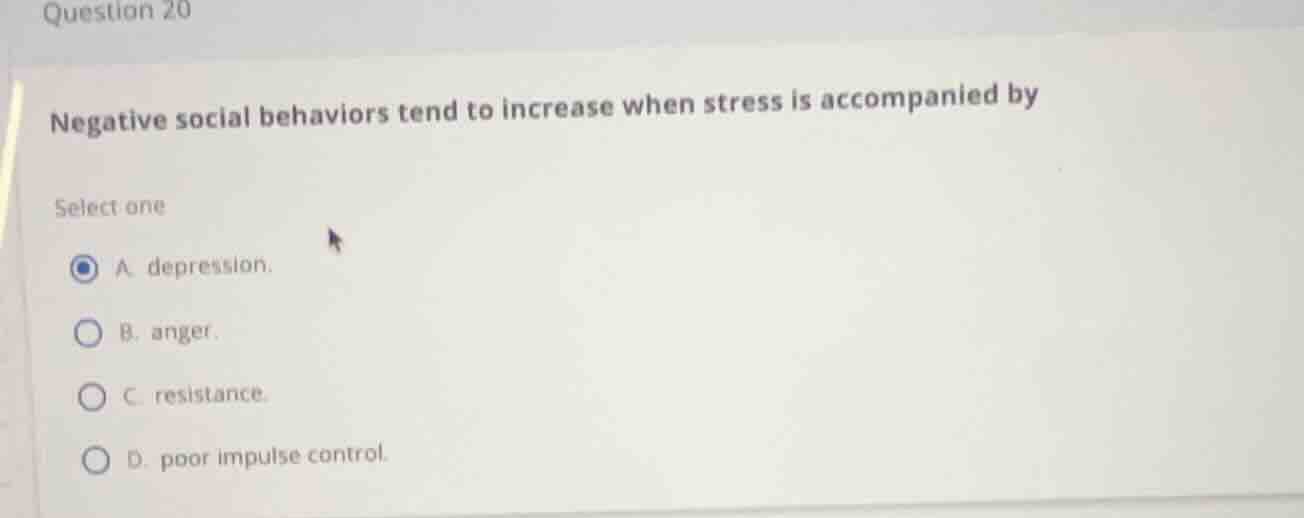
question 20
negative social behaviors tend to increase when stress is accompanied by
select one
a. depression.
b. anger.
c. resistance.
d. poor impulse control.
Analyze the question prompt
The question asks about the conditions under which negative social behaviors (such as aggression, hostility, or withdrawal) tend to increase when an individual experiences stress. Specifically, it asks what accompanying emotional or psychological state drives this increase.
Evaluate the options
- Option A (depression): While depression is associated with stress, it more commonly leads to social withdrawal, lethargy, or internalized symptoms rather than active negative social behaviors like outward hostility or interpersonal conflict.
- Option B (anger): Anger is an active, high-arousal negative emotion. When stress is accompanied by anger, individuals are significantly more likely to engage in negative social behaviors, including verbal or physical aggression, irritability, and hostile interactions with others.
- Option C (resistance): Resistance (such as in the General Adaptation Syndrome) is a physiological coping stage to stress, not a primary emotional state that directly drives interpersonal negative social behaviors.
- Option D (poor impulse control): While poor impulse control can facilitate negative behaviors, the primary emotional catalyst that directly pairs with stress to increase hostile social behaviors in psychological literature is anger.
Synthesize the psychological concept
In health psychology and stress research, stress combined with anger or hostility is a well-documented trigger for negative social behaviors and adverse health outcomes (such as cardiovascular reactivity). Therefore, anger is the most direct and fitting accompaniment to stress that increases negative social behaviors.

Snap & solve any problem in the app
Get step-by-step solutions on Sovi AI
Photo-based solutions with guided steps
Explore more problems and detailed explanations
- (A) depression.
- (B) anger. (Correct answer)
- (C) resistance.
- (D) poor impulse control.