QUESTION IMAGE
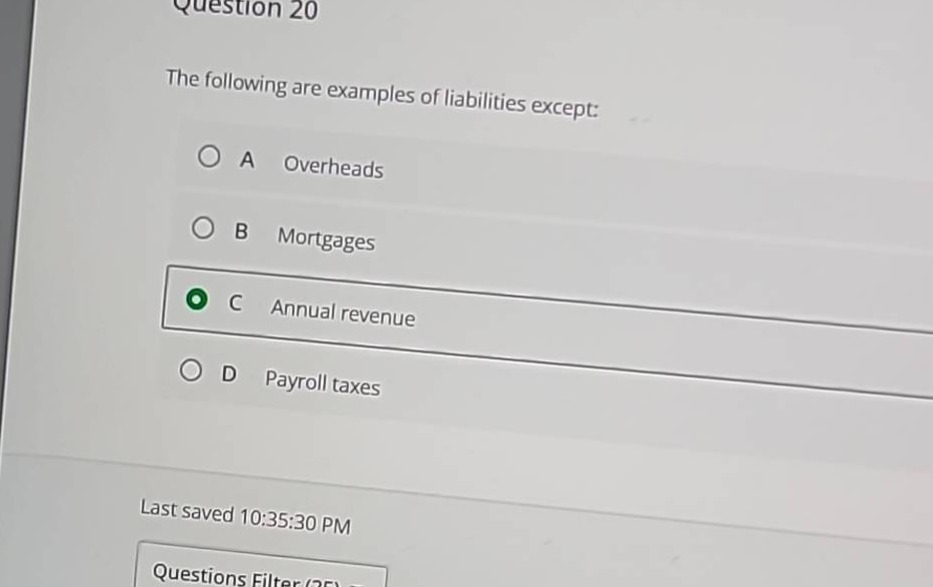
Question
question 20
the following are examples of liabilities except:
a overheads
b mortgages
c annual revenue
d payroll taxes
🆕 New Concept Discovered: Accounting Elements Classification
Distinguishing liabilities, expenses, and revenues.
Step 1: Define a Liability
In accounting, a liability is a present financial obligation of the business arising from past events, the settlement of which is expected to result in an outflow of resources (usually cash). In simple terms, it is money that the business owes to external parties.
Step 2: Analyze the Options
- Overheads (Option A): These are ongoing business operating expenses (such as rent, utilities, and insurance). While they are expenses on the income statement, unpaid overheads represent a liability (accounts payable/accrued expenses). However, in some contexts, overheads themselves are classified strictly as expenses rather than balance sheet liabilities. Let's compare this with the other options.
- Mortgages (Option B): A mortgage is a long-term loan used to purchase property. This is a clear, classic example of a long-term liability because it is money owed to a lender.
- Annual revenue (Option C): Revenue is the total amount of money brought in by a company's operations (sales of goods or services). It is classified as an income/revenue account on the income statement, which ultimately increases equity. It is never a liability, as it represents money earned rather than money owed.
- Payroll taxes (Option D): These are taxes withheld from employee wages or owed by the employer to tax authorities. Until they are paid to the government, they are classified as current liabilities (payroll taxes payable).
Step 3: Identify the Exception
While "Overheads" are technically expenses, "Annual revenue" is fundamentally an inflow of economic benefits (income) and is the absolute opposite of a liability (an obligation to pay out resources). Therefore, "Annual revenue" is the most definitive non-liability among the choices.

Snap & solve any problem in the app
Get step-by-step solutions on Sovi AI
Photo-based solutions with guided steps
Explore more problems and detailed explanations
C Annual revenue