QUESTION IMAGE
Question
question 2-19
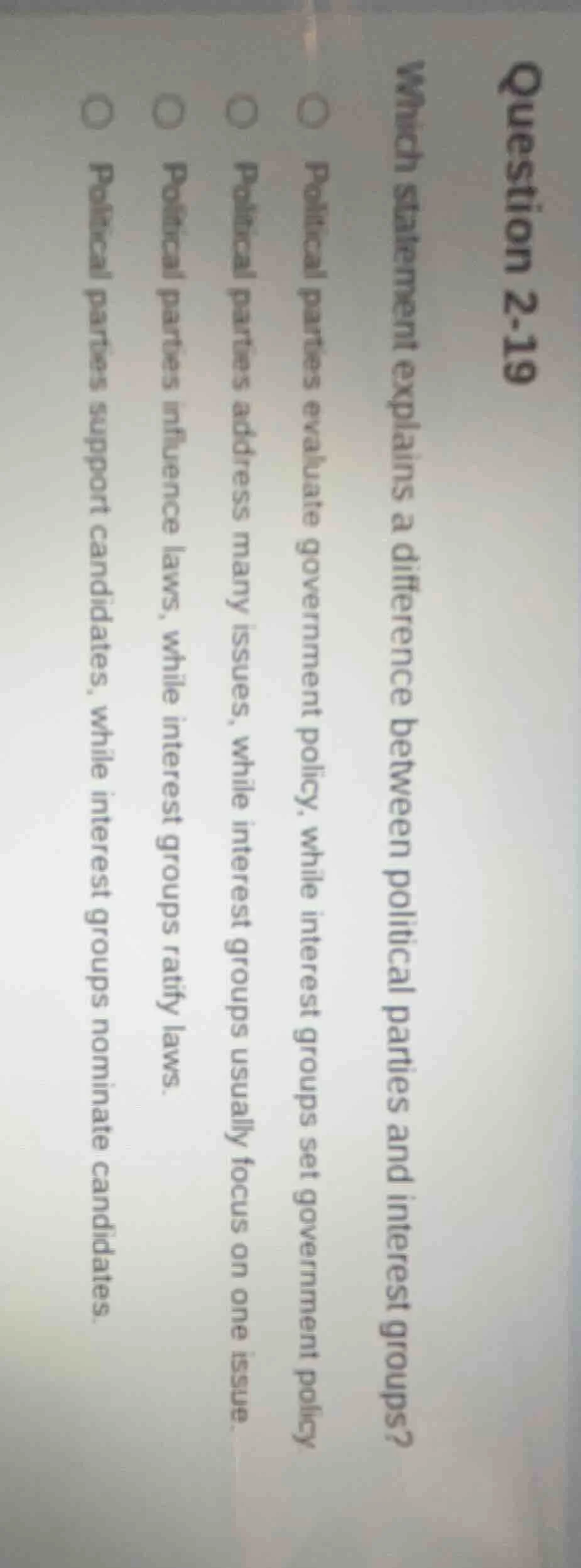
which statement explains a difference between political parties and interest groups?
○ political parties evaluate government policy, while interest groups set government policy
○ political parties address many issues, while interest groups usually focus on one issue
○ political parties influence laws, while interest groups ratify laws.
○ political parties support candidates, while interest groups nominate candidates.
To determine the correct statement, we analyze the roles of political parties and interest groups:
- Political parties typically address a broad range of political issues as they aim to gain power and govern, dealing with multiple policy areas.
- Interest groups, on the other hand, usually focus on a single or a few related issues (e.g., environmental groups focus on environmental policies, labor unions on workers' rights) to advocate for specific interests.
- Option 1 is incorrect: Interest groups do not set government policy (they influence it), and political parties do not just evaluate it (they create/propose it).
- Option 2 is incorrect: Interest groups do not ratify laws (legislatures or relevant bodies do), and political parties' role in law - making is more about influencing and proposing, not just influencing while others ratify.
- Option 4 is incorrect: Political parties nominate candidates, and interest groups support candidates (not nominate).
- Option 3 correctly states the difference in the scope of issues they address.

Snap & solve any problem in the app
Get step-by-step solutions on Sovi AI
Photo-based solutions with guided steps
Explore more problems and detailed explanations
C. Political parties address many issues, while interest groups usually focus on one issue (assuming the third option is labeled C; adjust the label as per the actual question's numbering, but the content is "Political parties address many issues, while interest groups usually focus on one issue").