Sovi.AI - AI Math Tutor

Scan to solve math questions

QUESTION IMAGE

question 18 of 26 how does the enzyme responsible for elongation also \…

Question

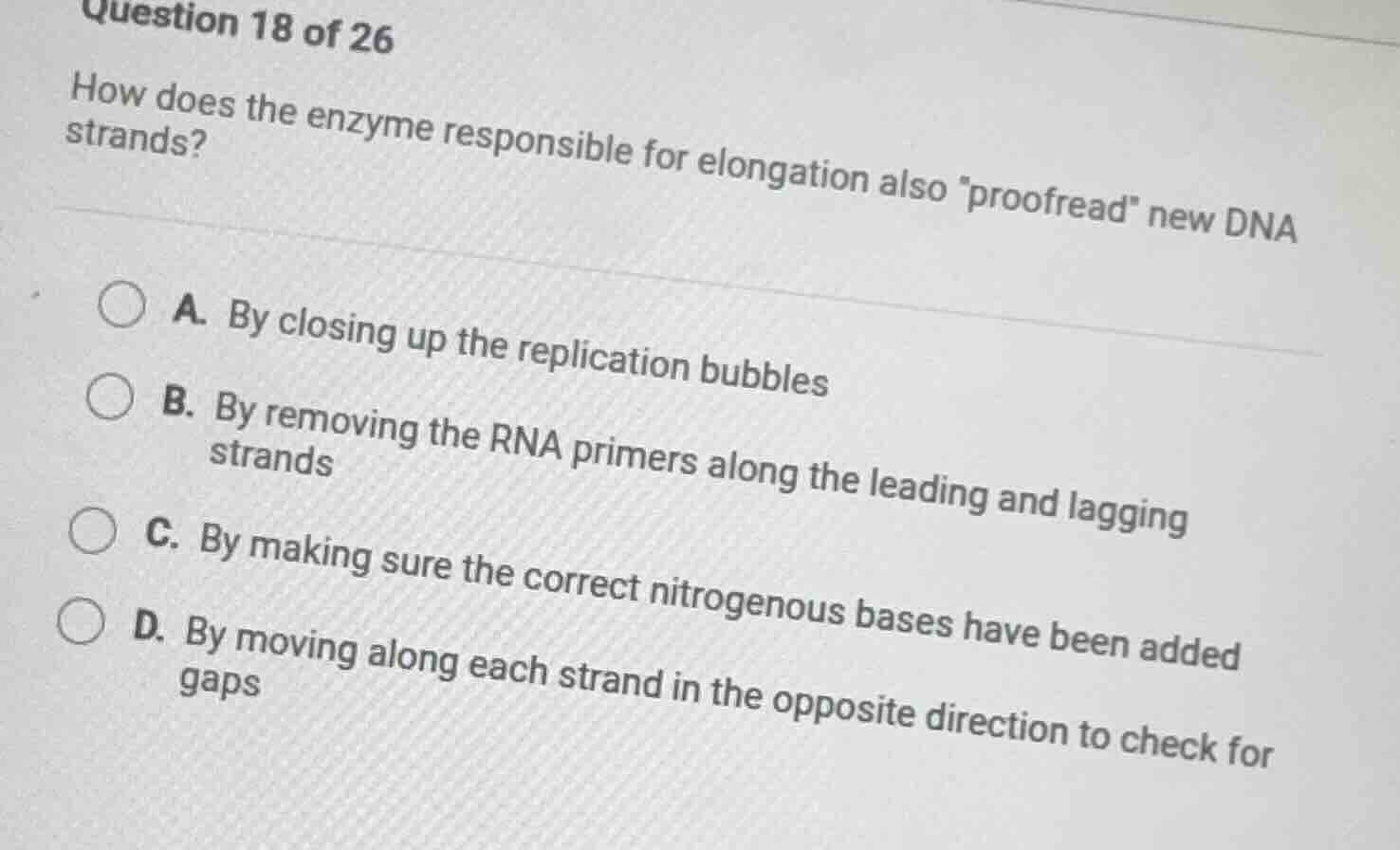
question 18 of 26

how does the enzyme responsible for elongation also \proofread\ new dna strands?

a. by closing up the replication bubbles
b. by removing the rna primers along the leading and lagging strands
c. by making sure the correct nitrogenous bases have been added
d. by moving along each strand in the opposite direction to check for gaps

Explanation:

Response

<pre_analysis>
{
"quality": "clear",
"question_count": 1,
"skills_matched": [
"direct_cot",
"multiple_choice_formatter",
"explain_then_answer",
"tutor"
],
"needs_drawing": false,
"concepts_used": [
"DNA Replication Errors"
],
"new_concepts": [
"DNA Polymerase Proofreading"
],
"current_concepts": [
"DNA Replication Errors",
"DNA Polymerase Proofreading"
]
}
</pre_analysis>

<reasoning>

Identify the enzyme and its primary function

The question asks about the enzyme responsible for elongation during DNA replication, which is DNA polymerase. Its primary role during elongation is to synthesize new DNA strands by adding complementary nucleotides.

Understand the proofreading mechanism

During synthesis, DNA polymerase also performs a "proofreading" function to minimize DNA Replication Errors. If an incorrect nucleotide is accidentally added, the enzyme detects the mismatch, pauses, removes the mismatched base using its exonuclease activity, and replaces it with the correct one.

Evaluate the given options

  • A. By closing up the replication bubbles: This is incorrect. Replication bubbles are not closed up by DNA polymerase's proofreading activity.
  • B. By removing the RNA primers along the leading and lagging strands: This is incorrect. While DNA polymerase I removes RNA primers in prokaryotes, this is a separate processing step rather than the active proofreading of newly synthesized bases during elongation.
  • C. By making sure the correct nitrogenous bases have been added: This is correct. Proofreading specifically refers to checking and ensuring that the correct complementary nitrogenous bases are paired and incorporated.
  • D. By moving along each strand in the opposite direction to check for gaps: This is incorrect. DNA polymerase does not move backward along the entire strand to search for gaps; it checks the immediate base pair it has just synthesized.

</reasoning>

<answer>
<mcq-option>A. By closing up the replication bubbles</mcq-option>
<mcq-option>B. By removing the RNA primers along the leading and lagging strands</mcq-option>
<mcq-correct>C. By making sure the correct nitrogenous bases have been added</mcq-correct>
<mcq-option>D. By moving along each strand in the opposite direction to check for gaps</mcq-option>
</answer>

<post_analysis>
{
"subject": "Natural Science",
"question_type": "Multiple Choice",
"knowledge_point": [
"Natural Science",
"Biology",
"DNA Replication"
]
}
</post_analysis>

Answer:

<pre_analysis>
{
"quality": "clear",
"question_count": 1,
"skills_matched": [
"direct_cot",
"multiple_choice_formatter",
"explain_then_answer",
"tutor"
],
"needs_drawing": false,
"concepts_used": [
"DNA Replication Errors"
],
"new_concepts": [
"DNA Polymerase Proofreading"
],
"current_concepts": [
"DNA Replication Errors",
"DNA Polymerase Proofreading"
]
}
</pre_analysis>

<reasoning>

Identify the enzyme and its primary function

The question asks about the enzyme responsible for elongation during DNA replication, which is DNA polymerase. Its primary role during elongation is to synthesize new DNA strands by adding complementary nucleotides.

Understand the proofreading mechanism

During synthesis, DNA polymerase also performs a "proofreading" function to minimize DNA Replication Errors. If an incorrect nucleotide is accidentally added, the enzyme detects the mismatch, pauses, removes the mismatched base using its exonuclease activity, and replaces it with the correct one.

Evaluate the given options

  • A. By closing up the replication bubbles: This is incorrect. Replication bubbles are not closed up by DNA polymerase's proofreading activity.
  • B. By removing the RNA primers along the leading and lagging strands: This is incorrect. While DNA polymerase I removes RNA primers in prokaryotes, this is a separate processing step rather than the active proofreading of newly synthesized bases during elongation.
  • C. By making sure the correct nitrogenous bases have been added: This is correct. Proofreading specifically refers to checking and ensuring that the correct complementary nitrogenous bases are paired and incorporated.
  • D. By moving along each strand in the opposite direction to check for gaps: This is incorrect. DNA polymerase does not move backward along the entire strand to search for gaps; it checks the immediate base pair it has just synthesized.

</reasoning>

<answer>
<mcq-option>A. By closing up the replication bubbles</mcq-option>
<mcq-option>B. By removing the RNA primers along the leading and lagging strands</mcq-option>
<mcq-correct>C. By making sure the correct nitrogenous bases have been added</mcq-correct>
<mcq-option>D. By moving along each strand in the opposite direction to check for gaps</mcq-option>
</answer>

<post_analysis>
{
"subject": "Natural Science",
"question_type": "Multiple Choice",
"knowledge_point": [
"Natural Science",
"Biology",
"DNA Replication"
]
}
</post_analysis>