QUESTION IMAGE
Question
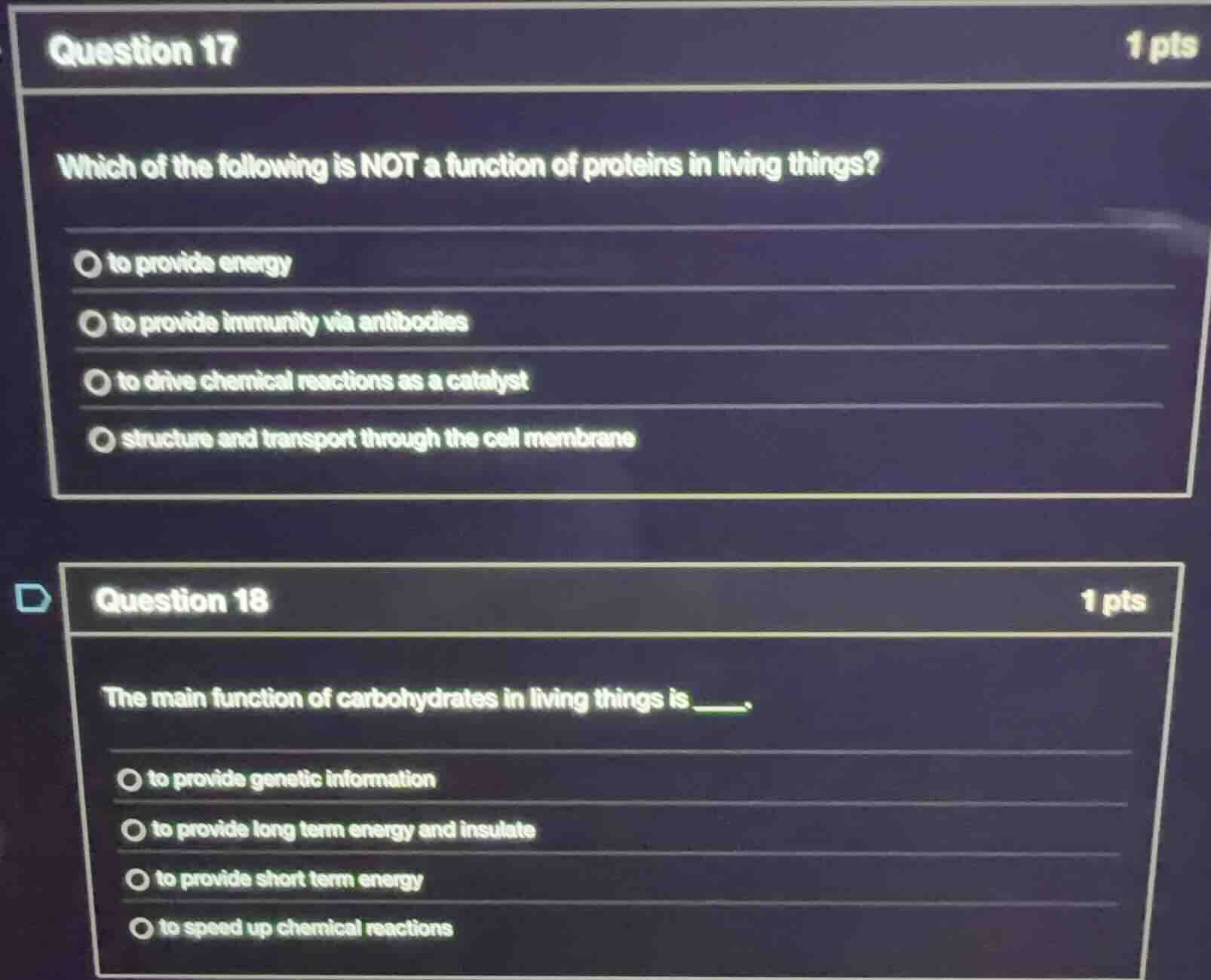
question 17
which of the following is not a function of proteins in living things?
- to provide energy
- to provide immunity via antibodies
- to drive chemical reactions as a catalyst
- structure and transport through the cell membrane
question 18
the main function of carbohydrates in living things is ___.
- to provide genetic information
- to provide long term energy and insulate
- to provide short term energy
- to speed up chemical reactions
<pre_analysis>
{
"quality": "clear",
"question_count": 2,
"skills_matched": [
"direct_cot",
"multiple_choice_formatter",
"explain_then_answer",
"quick"
],
"needs_drawing": false,
"concepts_used": [
"Biomolecules",
"Lipid Functions"
],
"new_concepts": [
"Protein Functions",
"Carbohydrate Functions"
],
"current_concepts": [
"Biomolecules",
"Lipid Functions",
"Protein Functions",
"Carbohydrate Functions"
]
}
</pre_analysis>
<reasoning>
Analyze Question 17
Proteins perform many essential roles, including structural support, transport across membranes, immune defense (antibodies), and catalyzing biochemical reactions (enzymes). While proteins can be broken down for energy under extreme starvation, providing energy is primarily the function of carbohydrates and lipids, not a primary function of proteins.
Analyze Question 18
Carbohydrates serve as the primary, readily accessible source of short-term energy for living organisms (e.g., glucose). Nucleic acids store genetic information, lipids provide long-term energy storage and insulation, and proteins (enzymes) speed up chemical reactions.
</reasoning>
<answer>
Question 17
<mcq-correct>to provide energy</mcq-correct>
<mcq-option>to provide immunity via antibodies</mcq-option>
<mcq-option>to drive chemical reactions as a catalyst</mcq-option>
<mcq-option>structure and transport through the cell membrane</mcq-option>
Question 18
<mcq-option>to provide genetic information</mcq-option>
<mcq-option>to provide long term energy and insulate</mcq-option>
<mcq-correct>to provide short term energy</mcq-correct>
<mcq-option>to speed up chemical reactions</mcq-option>
</answer>
<post_analysis>
{
"subject": "Natural Science",
"question_type": "Multiple Choice",
"knowledge_point": [
"Natural Science",
"Biology",
"Biomolecules"
]
}
</post_analysis>
Snap & solve any problem in the app
Get step-by-step solutions on Sovi AI
Photo-based solutions with guided steps
Explore more problems and detailed explanations
<pre_analysis>
{
"quality": "clear",
"question_count": 2,
"skills_matched": [
"direct_cot",
"multiple_choice_formatter",
"explain_then_answer",
"quick"
],
"needs_drawing": false,
"concepts_used": [
"Biomolecules",
"Lipid Functions"
],
"new_concepts": [
"Protein Functions",
"Carbohydrate Functions"
],
"current_concepts": [
"Biomolecules",
"Lipid Functions",
"Protein Functions",
"Carbohydrate Functions"
]
}
</pre_analysis>
<reasoning>
Analyze Question 17
Proteins perform many essential roles, including structural support, transport across membranes, immune defense (antibodies), and catalyzing biochemical reactions (enzymes). While proteins can be broken down for energy under extreme starvation, providing energy is primarily the function of carbohydrates and lipids, not a primary function of proteins.
Analyze Question 18
Carbohydrates serve as the primary, readily accessible source of short-term energy for living organisms (e.g., glucose). Nucleic acids store genetic information, lipids provide long-term energy storage and insulation, and proteins (enzymes) speed up chemical reactions.
</reasoning>
<answer>
Question 17
<mcq-correct>to provide energy</mcq-correct>
<mcq-option>to provide immunity via antibodies</mcq-option>
<mcq-option>to drive chemical reactions as a catalyst</mcq-option>
<mcq-option>structure and transport through the cell membrane</mcq-option>
Question 18
<mcq-option>to provide genetic information</mcq-option>
<mcq-option>to provide long term energy and insulate</mcq-option>
<mcq-correct>to provide short term energy</mcq-correct>
<mcq-option>to speed up chemical reactions</mcq-option>
</answer>
<post_analysis>
{
"subject": "Natural Science",
"question_type": "Multiple Choice",
"knowledge_point": [
"Natural Science",
"Biology",
"Biomolecules"
]
}
</post_analysis>