QUESTION IMAGE
Question
question 17
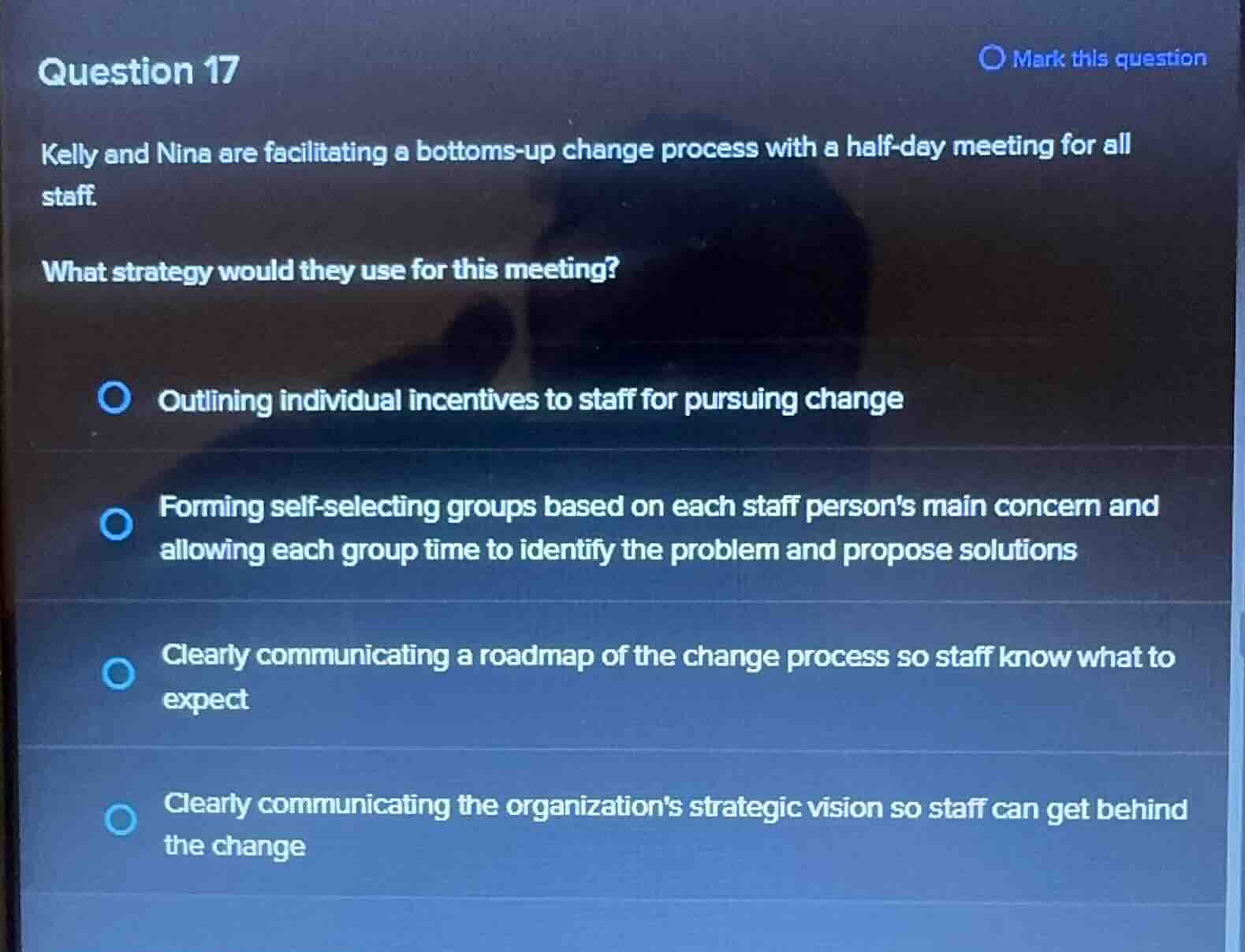
kelly and nina are facilitating a bottoms-up change process with a half-day meeting for all staff.
what strategy would they use for this meeting?
- outlining individual incentives to staff for pursuing change
- forming self-selecting groups based on each staff persons main concern and allowing each group time to identify the problem and propose solutions
- clearly communicating a roadmap of the change process so staff know what to expect
- clearly communicating the organizations strategic vision so staff can get behind the change
Analyze the change process type
The question states that Kelly and Nina are facilitating a Bottom-Up Change process. Bottom-up change (often associated with Emergent Change) relies on the participation, collaboration, and input of employees at all levels of the organization rather than being directed entirely by top management.
Evaluate the options against bottom-up principles
- Option 1: Outlining individual incentives to staff for pursuing change. This is a transactional approach to motivation, not a core collaborative strategy for facilitating a bottom-up meeting.
- Option 2: Forming self-selecting groups based on each staff person's main concern and allowing each group time to identify the problem and propose solutions. This directly aligns with Bottom-Up Change principles. It empowers employees to self-organize, identify issues, and collaboratively generate solutions from the ground up.
- Option 3: Clearly communicating a roadmap of the change process so staff know what to expect. This represents a top-down, planned approach where management has already decided the path and is simply informing the staff.
- Option 4: Clearly communicating the organization's strategic vision so staff can get behind the change. This is also a top-down approach where leadership defines the vision and seeks buy-in from employees.
Select the correct strategy
The strategy that best facilitates a bottom-up, participative change process in a staff-wide meeting is allowing self-selection and collaborative problem-solving/solution generation. Therefore, the second option is correct.

Snap & solve any problem in the app
Get step-by-step solutions on Sovi AI
Photo-based solutions with guided steps
Explore more problems and detailed explanations
- Outlining individual incentives to staff for pursuing change
- Forming self-selecting groups based on each staff person's main concern and allowing each group time to identify the problem and propose solutions (Correct answer)
- Clearly communicating a roadmap of the change process so staff know what to expect
- Clearly communicating the organization's strategic vision so staff can get behind the change