QUESTION IMAGE
Question
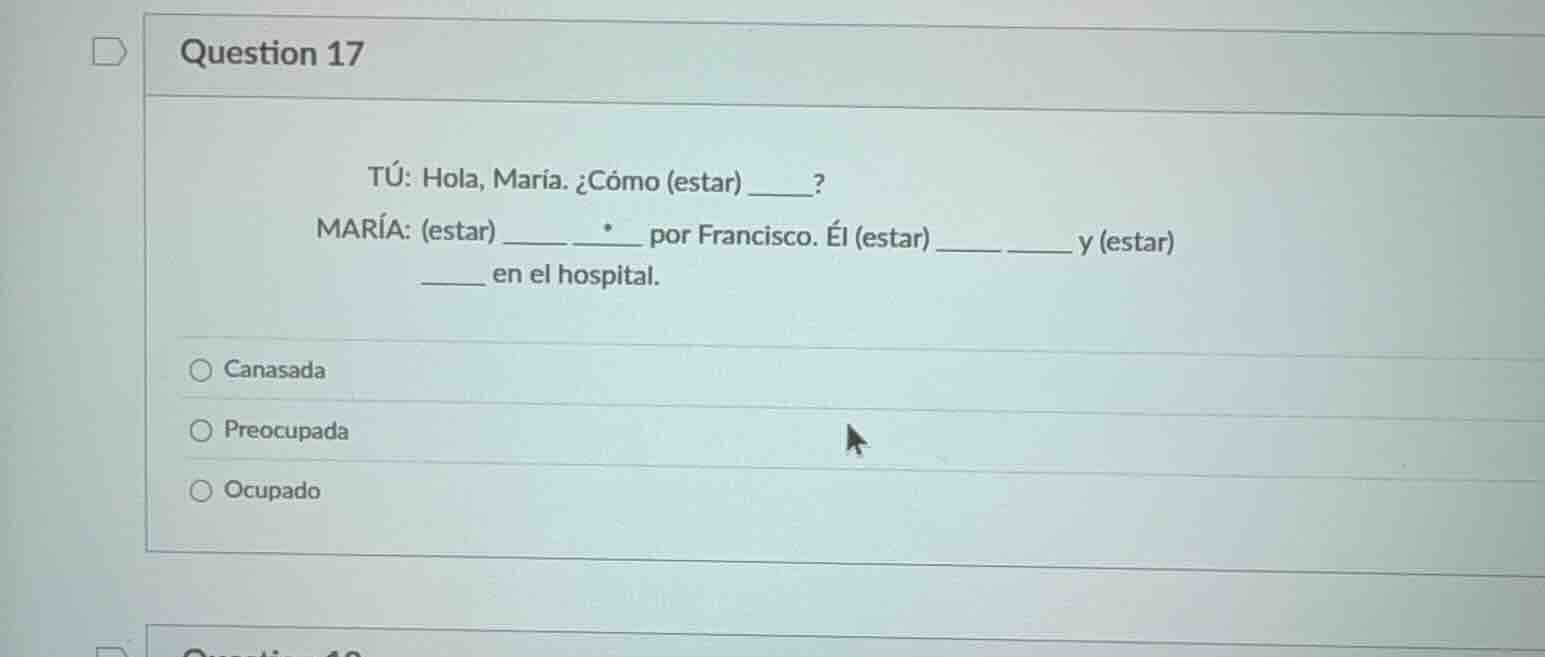
question 17
tú: hola, maría. ¿cómo (estar) ______?
maría: (estar) ____ * __ por francisco. él (estar) __ y (estar) ____ en el hospital.
canasada
preocupada
ocupado
Analyze the dialogue context
The dialogue is between "TÚ" (you) and "MARÍA".
"TÚ" addresses María informally: "Hola, María. ¿Cómo (estar) \_\_\_\_\_?"
Since the subject is "tú" (informal you), the verb estar must be conjugated in the second-person singular present tense.
Using Estar Conjugation, this gives estás.
Analyze María's response
María responds: "(estar) \_\_\_\_\_
por Francisco."
Since María is speaking about herself, the subject is "yo" (I).
Using Spanish Verb Conjugation, the "yo" form of estar is estoy.
She is expressing an emotion or state regarding Francisco, which requires a feminine singular adjective because María is female.
Evaluate the multiple-choice options
We need to choose the correct adjective to fill the blank after estoy:
- Canasada: This is a misspelling of cansada (tired).
- Preocupada: This means "worried" (feminine singular). This fits the context of being worried "por Francisco" (about Francisco).
- Ocupado: This means "busy" (masculine singular). Since María is female, this does not agree in gender.
Complete the remaining blanks
The sentence continues: "Él (estar) \_\_\_\_\_ \_\_\_\_\_ y (estar) \_\_\_\_\_ en el hospital."
- "Él" (he, referring to Francisco) requires the third-person singular form of estar, which is está.
- The adjective following "Él está" must describe his state (e.g., enfermo / sick or grave / serious).
- The final blank "(estar) \_\_\_\_\_ en el hospital" also refers to "él", so it uses está.
Thus, "Preocupada" is the only grammatically and contextually correct option.

Snap & solve any problem in the app
Get step-by-step solutions on Sovi AI
Photo-based solutions with guided steps
Explore more problems and detailed explanations
- Canasada
- Preocupada (Correct answer)
- Ocupado