QUESTION IMAGE
Question
question 17 of 23 - multiple choice
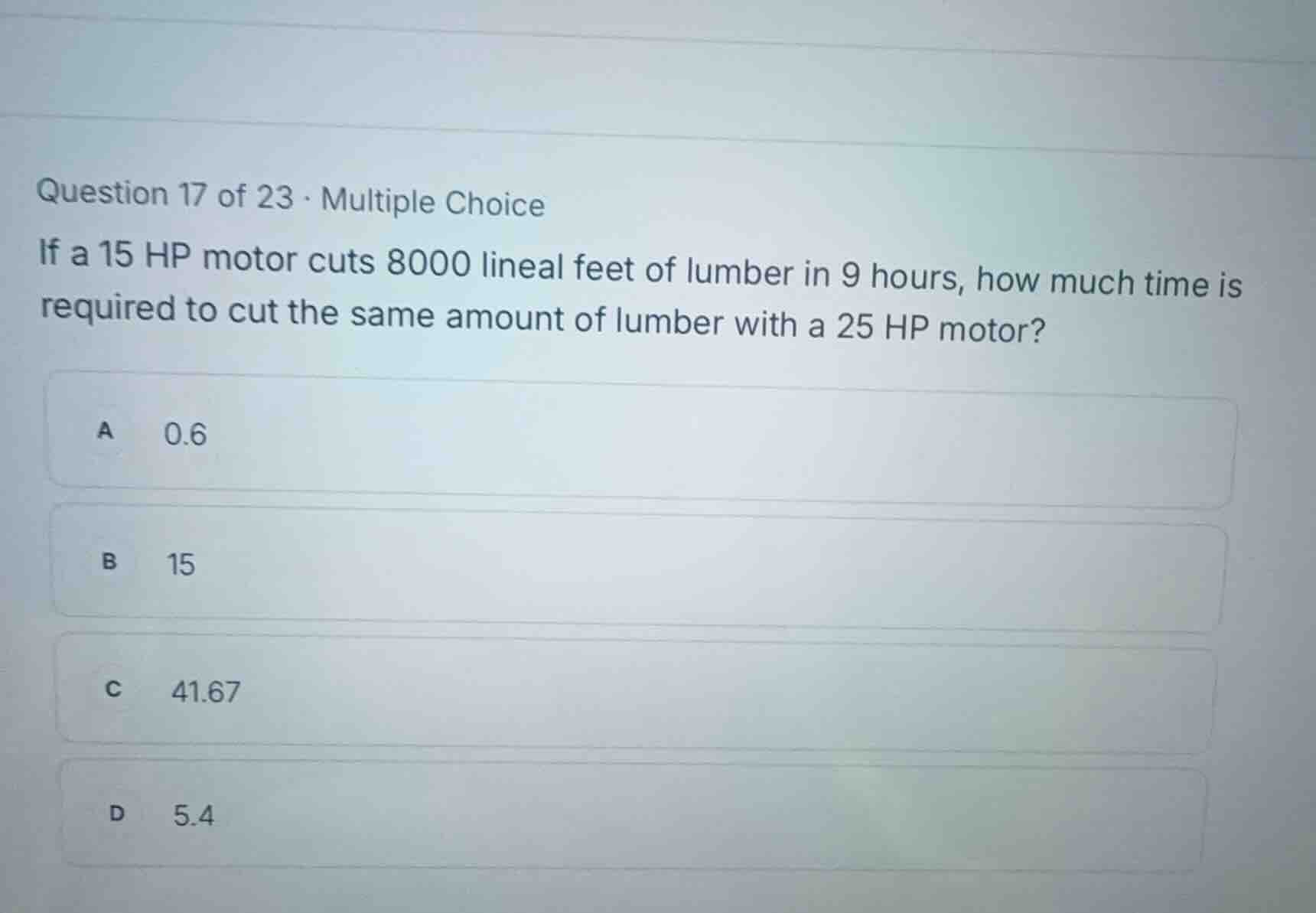
if a 15 hp motor cuts 8000 lineal feet of lumber in 9 hours, how much time is required to cut the same amount of lumber with a 25 hp motor?
a 0.6
b 15
c 41.67
d 5.4
<pre_analysis>
{
"quality": "clear",
"question_count": 1,
"skills_matched": [
"step_cot",
"multiple_choice_formatter",
"explain_then_answer",
"tutor"
],
"needs_drawing": false,
"concepts_used": [],
"new_concepts": [
"Inverse Proportion",
"Work Rate Word Problems"
],
"current_concepts": [
"Inverse Proportion",
"Work Rate Word Problems"
]
}
</pre_analysis>
<reasoning>
Identify the relationship between variables
The amount of lumber is constant at 8000 lineal feet.
The motor power \(P\) and the time required \(T\) are inversely proportional.
More horsepower means the job is completed in less time.
Set up the inverse proportion equation
Since power and time are inversely proportional:
\[P_1 \cdot T_1 = P_2 \cdot T_2\]
We are given:
\[P_1 = 15\text{ HP},\quad T_1 = 9\text{ hours},\quad P_2 = 25\text{ HP}\]
Solve for the unknown time
Using the inverse proportion formula:
\[15 \cdot 9 = 25 \cdot T_2\]
\[135 = 25 \cdot T_2\]
\[T_2 = \frac{135}{25} = 5.4\text{ hours}\]
Analyze the common misconception for Option B
If a student incorrectly assumes a direct proportion:
\[\frac{P_1}{T_1} = \frac{P_2}{T_2} \implies \frac{15}{9} = \frac{25}{T_2}\]
\[T_2 = \frac{25 \cdot 9}{15} = 15\text{ hours}\]
This direct proportion error leads directly to the incorrect option B.
</reasoning>
<answer>
<mcq-option>(A) 0.6</mcq-option>
<mcq-option>(B) 15</mcq-option>
<mcq-option>(C) 41.67</mcq-option>
<mcq-correct>(D) 5.4</mcq-correct>
</answer>
<post_analysis>
{
"subject": "Mathematics",
"question_type": "Multiple Choice",
"knowledge_point": [
"Mathematics",
"Algebra",
"Inverse Proportion"
]
}
</post_analysis>
Snap & solve any problem in the app
Get step-by-step solutions on Sovi AI
Photo-based solutions with guided steps
Explore more problems and detailed explanations
<pre_analysis>
{
"quality": "clear",
"question_count": 1,
"skills_matched": [
"step_cot",
"multiple_choice_formatter",
"explain_then_answer",
"tutor"
],
"needs_drawing": false,
"concepts_used": [],
"new_concepts": [
"Inverse Proportion",
"Work Rate Word Problems"
],
"current_concepts": [
"Inverse Proportion",
"Work Rate Word Problems"
]
}
</pre_analysis>
<reasoning>
Identify the relationship between variables
The amount of lumber is constant at 8000 lineal feet.
The motor power \(P\) and the time required \(T\) are inversely proportional.
More horsepower means the job is completed in less time.
Set up the inverse proportion equation
Since power and time are inversely proportional:
\[P_1 \cdot T_1 = P_2 \cdot T_2\]
We are given:
\[P_1 = 15\text{ HP},\quad T_1 = 9\text{ hours},\quad P_2 = 25\text{ HP}\]
Solve for the unknown time
Using the inverse proportion formula:
\[15 \cdot 9 = 25 \cdot T_2\]
\[135 = 25 \cdot T_2\]
\[T_2 = \frac{135}{25} = 5.4\text{ hours}\]
Analyze the common misconception for Option B
If a student incorrectly assumes a direct proportion:
\[\frac{P_1}{T_1} = \frac{P_2}{T_2} \implies \frac{15}{9} = \frac{25}{T_2}\]
\[T_2 = \frac{25 \cdot 9}{15} = 15\text{ hours}\]
This direct proportion error leads directly to the incorrect option B.
</reasoning>
<answer>
<mcq-option>(A) 0.6</mcq-option>
<mcq-option>(B) 15</mcq-option>
<mcq-option>(C) 41.67</mcq-option>
<mcq-correct>(D) 5.4</mcq-correct>
</answer>
<post_analysis>
{
"subject": "Mathematics",
"question_type": "Multiple Choice",
"knowledge_point": [
"Mathematics",
"Algebra",
"Inverse Proportion"
]
}
</post_analysis>