QUESTION IMAGE
Question
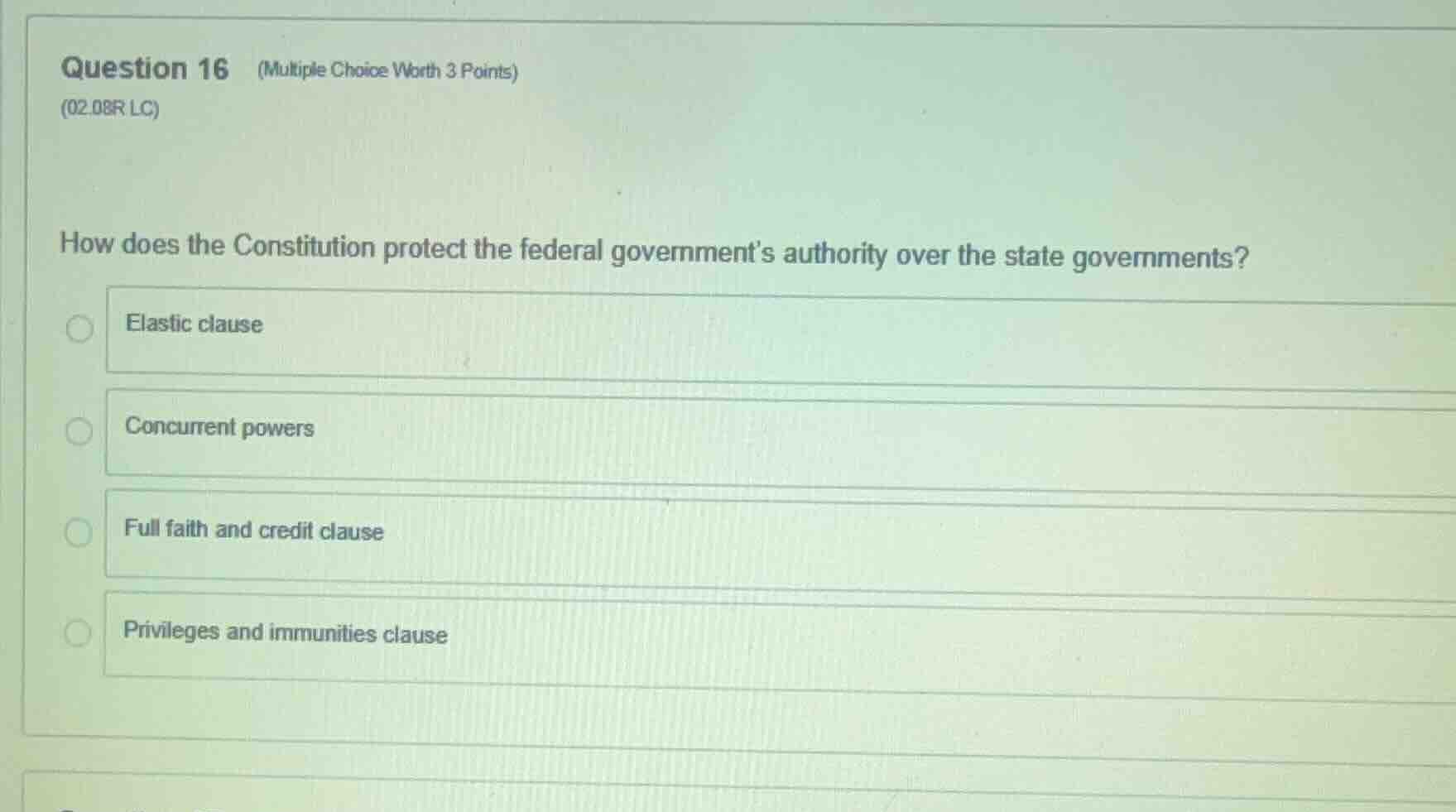
question 16 (multiple choice worth 3 points)
(02.08r lc)
how does the constitution protect the federal governments authority over the state governments?
- elastic clause
- concurrent powers
- full faith and credit clause
- privileges and immunities clause
Analyze the question
The question asks how the Constitution protects the federal government's authority over state governments. We need to evaluate the given options to find the mechanism that expands or secures federal power relative to the states.
Evaluate the options
- Elastic clause: Also known as the Necessary and Proper Clause (Article I, Section 8), it grants Congress the power to pass all laws necessary and proper for carrying out its enumerated list of powers. This has historically been used to expand and protect federal authority over states.
- Concurrent powers: These are powers shared by both the federal and state governments (e.g., taxing). This concept, which relates to Concurrent Powers and Federalism, represents shared authority rather than a mechanism protecting federal supremacy over states.
- Full faith and credit clause: This clause (Article IV, Section 1) requires states to respect the public acts, records, and judicial proceedings of every other state. It governs relations between states, not federal authority over states.
- Privileges and immunities clause: This clause (Article IV, Section 2) prevents a state from treating citizens of other states in a discriminatory manner. Like the Full Faith and Credit Clause, it regulates interstate relations.
Determine the correct choice
The Elastic clause is the constitutional mechanism among the choices that allows the federal government to stretch its powers, thereby protecting and asserting its authority over state jurisdictions when necessary.

Snap & solve any problem in the app
Get step-by-step solutions on Sovi AI
Photo-based solutions with guided steps
Explore more problems and detailed explanations
- (A) Elastic clause (Correct answer)
- (B) Concurrent powers
- (C) Full faith and credit clause
- (D) Privileges and immunities clause