QUESTION IMAGE
Question
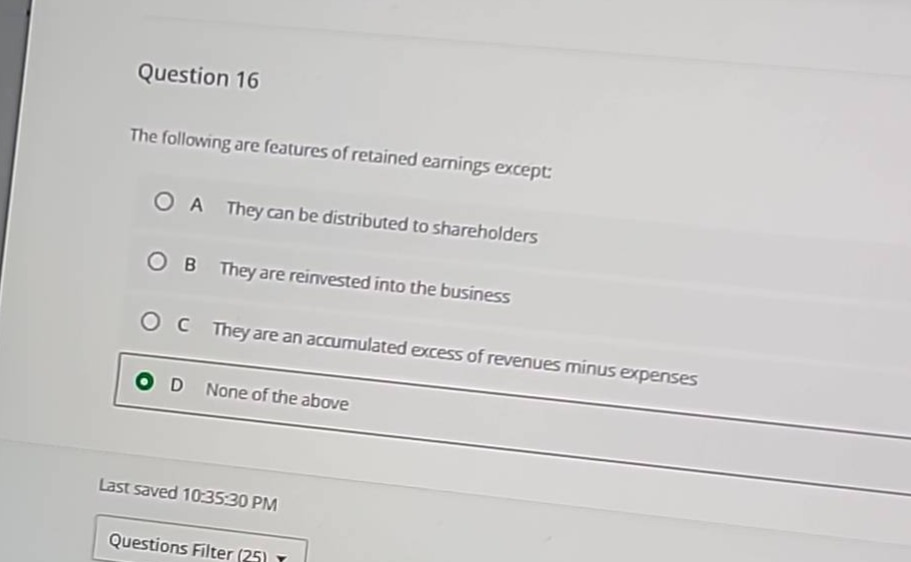
question 16
the following are features of retained earnings except:
a they can be distributed to shareholders
b they are reinvested into the business
c they are an accumulated excess of revenues minus expenses
d none of the above
🆕 New Concept Discovered: Retained Earnings
The portion of net income kept in the business.
Step 1: Define Retained Earnings
Retained earnings represent the cumulative net income (revenues minus expenses) of a corporation that is kept (retained) in the business rather than distributed to shareholders as dividends.
Mathematically, the balance is built up over time:
Step 2: Evaluate Option A
- Statement: "They can be distributed to shareholders"
- Analysis: Retained earnings represent the pool of accumulated profits from which a company is legally allowed to declare and pay dividends to its shareholders. Therefore, this is a true feature of retained earnings.
Step 3: Evaluate Option B
- Statement: "They are reinvested into the business"
- Analysis: By definition, profits that are retained (not paid out as dividends) are kept within the company to fund operations, pay off debt, or purchase assets. This means they are reinvested into the business. Therefore, this is a true feature of retained earnings.
Step 4: Evaluate Option C
- Statement: "They are an accumulated excess of revenues minus expenses"
- Analysis: "Revenues minus expenses" equals net income. Retained earnings are the accumulation of these net incomes over the lifespan of the company (minus any dividends paid). Therefore, this is a true feature of retained earnings.
Step 5: Determine the Correct Option
Since statements A, B, and C are all true, accurate features of retained earnings, there is no statement among them that is not a feature. Therefore, the correct choice is "None of the above".

Snap & solve any problem in the app
Get step-by-step solutions on Sovi AI
Photo-based solutions with guided steps
Explore more problems and detailed explanations
D None of the above