QUESTION IMAGE
Question
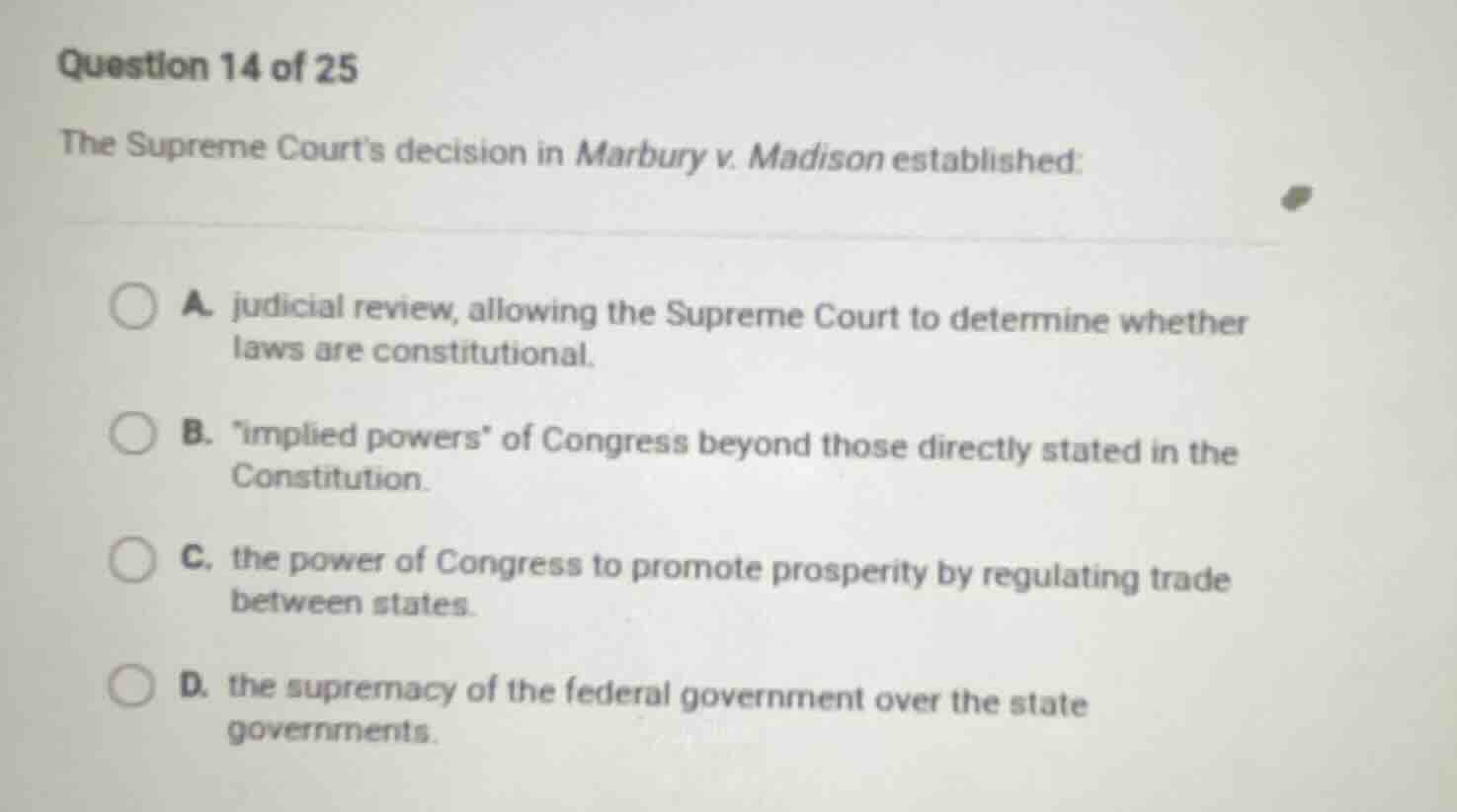
question 14 of 25
the supreme courts decision in marbury v. madison established:
a. judicial review, allowing the supreme court to determine whether laws are constitutional.
b. \implied powers\ of congress beyond those directly stated in the constitution.
c. the power of congress to promote prosperity by regulating trade between states.
d. the supremacy of the federal government over the state governments.
Identify the core legal question
The question asks what was established by the landmark Supreme Court decision in Marbury v. Madison (1803).
Analyze the historical ruling
In Marbury v. Madison, Chief Justice John Marshall declared that the Supreme Court has the power to review acts of Congress and the President to determine their constitutionality. This principle is known as judicial review.
Evaluate the given options
- Option A describes judicial review, which matches the outcome of Marbury v. Madison.
- Option B refers to "implied powers," which was established in McCulloch v. Maryland (1819).
- Option C refers to the regulation of interstate commerce, established in Gibbons v. Ogden (1824).
- Option D refers to federal supremacy, also reinforced in McCulloch v. Maryland.
Select the correct option
Option A is the correct choice because it accurately defines the establishment of judicial review.

Snap & solve any problem in the app
Get step-by-step solutions on Sovi AI
Photo-based solutions with guided steps
Explore more problems and detailed explanations
- A. judicial review, allowing the Supreme Court to determine whether laws are constitutional. (Correct answer)
- B. "implied powers" of Congress beyond those directly stated in the Constitution.
- C. the power of Congress to promote prosperity by regulating trade between states.
- D. the supremacy of the federal government over the state governments.