QUESTION IMAGE
Question
question 14 of 25
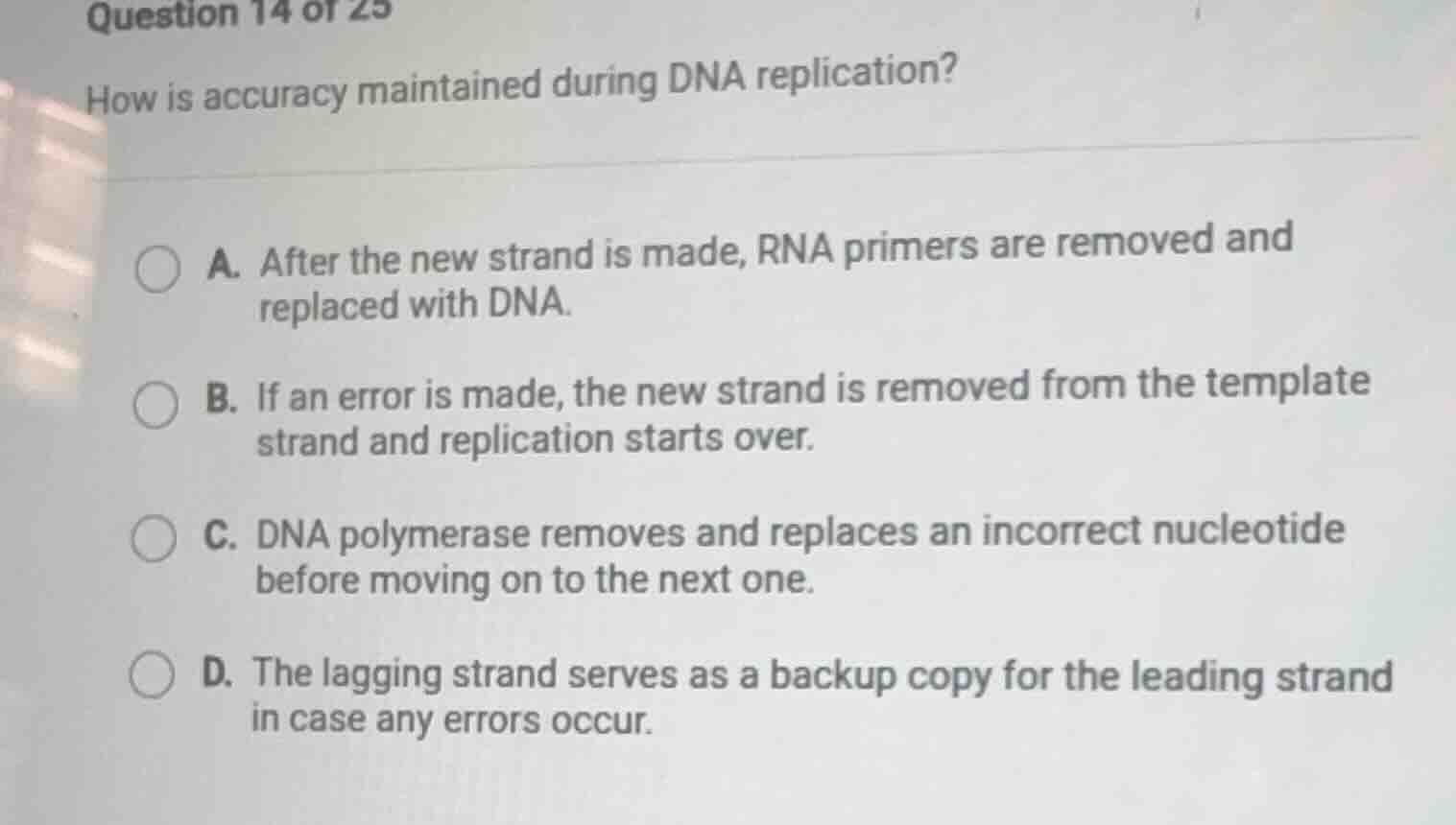
how is accuracy maintained during dna replication?
a. after the new strand is made, rna primers are removed and replaced with dna.
b. if an error is made, the new strand is removed from the template strand and replication starts over.
c. dna polymerase removes and replaces an incorrect nucleotide before moving on to the next one.
d. the lagging strand serves as a backup copy for the leading strand in case any errors occur.
<pre_analysis>
{
"quality": "clear",
"question_count": 1,
"skills_matched": [
"direct_cot",
"multiple_choice_formatter",
"explain_then_answer",
"quick"
],
"needs_drawing": false,
"concepts_used": [],
"new_concepts": [
"DNA Polymerase Proofreading",
"DNA Replication Errors"
],
"current_concepts": [
"DNA Polymerase Proofreading",
"DNA Replication Errors"
]
}
</pre_analysis>
<reasoning>
Analyze the mechanism of replication accuracy
DNA replication is highly accurate due to the proofreading capability of DNA polymerase. When an incorrect nucleotide is added, the enzyme detects the mismatch, removes the incorrect base using its exonuclease activity, and replaces it with the correct one before continuing synthesis.
Evaluate the given options
- Option A: Removing RNA primers is a standard step in replication, but it does not serve as the primary mechanism for correcting replication errors.
- Option B: Replication does not start completely over if a single error is made.
- Option C: This accurately describes the proofreading mechanism of DNA polymerase.
- Option D: The lagging strand is synthesized in fragments and does not serve as a backup copy for the leading strand.
</reasoning>
<answer>
<mcq-option>A. After the new strand is made, RNA primers are removed and replaced with DNA.</mcq-option>
<mcq-option>B. If an error is made, the new strand is removed from the template strand and replication starts over.</mcq-option>
<mcq-correct>C. DNA polymerase removes and replaces an incorrect nucleotide before moving on to the next one.</mcq-correct>
<mcq-option>D. The lagging strand serves as a backup copy for the leading strand in case any errors occur.</mcq-option>
</answer>
<post_analysis>
{
"subject": "Natural Science",
"question_type": "Multiple Choice",
"knowledge_point": [
"Natural Science",
"Biology",
"DNA Replication"
]
}
</post_analysis>
Snap & solve any problem in the app
Get step-by-step solutions on Sovi AI
Photo-based solutions with guided steps
Explore more problems and detailed explanations
<pre_analysis>
{
"quality": "clear",
"question_count": 1,
"skills_matched": [
"direct_cot",
"multiple_choice_formatter",
"explain_then_answer",
"quick"
],
"needs_drawing": false,
"concepts_used": [],
"new_concepts": [
"DNA Polymerase Proofreading",
"DNA Replication Errors"
],
"current_concepts": [
"DNA Polymerase Proofreading",
"DNA Replication Errors"
]
}
</pre_analysis>
<reasoning>
Analyze the mechanism of replication accuracy
DNA replication is highly accurate due to the proofreading capability of DNA polymerase. When an incorrect nucleotide is added, the enzyme detects the mismatch, removes the incorrect base using its exonuclease activity, and replaces it with the correct one before continuing synthesis.
Evaluate the given options
- Option A: Removing RNA primers is a standard step in replication, but it does not serve as the primary mechanism for correcting replication errors.
- Option B: Replication does not start completely over if a single error is made.
- Option C: This accurately describes the proofreading mechanism of DNA polymerase.
- Option D: The lagging strand is synthesized in fragments and does not serve as a backup copy for the leading strand.
</reasoning>
<answer>
<mcq-option>A. After the new strand is made, RNA primers are removed and replaced with DNA.</mcq-option>
<mcq-option>B. If an error is made, the new strand is removed from the template strand and replication starts over.</mcq-option>
<mcq-correct>C. DNA polymerase removes and replaces an incorrect nucleotide before moving on to the next one.</mcq-correct>
<mcq-option>D. The lagging strand serves as a backup copy for the leading strand in case any errors occur.</mcq-option>
</answer>
<post_analysis>
{
"subject": "Natural Science",
"question_type": "Multiple Choice",
"knowledge_point": [
"Natural Science",
"Biology",
"DNA Replication"
]
}
</post_analysis>