QUESTION IMAGE
Question
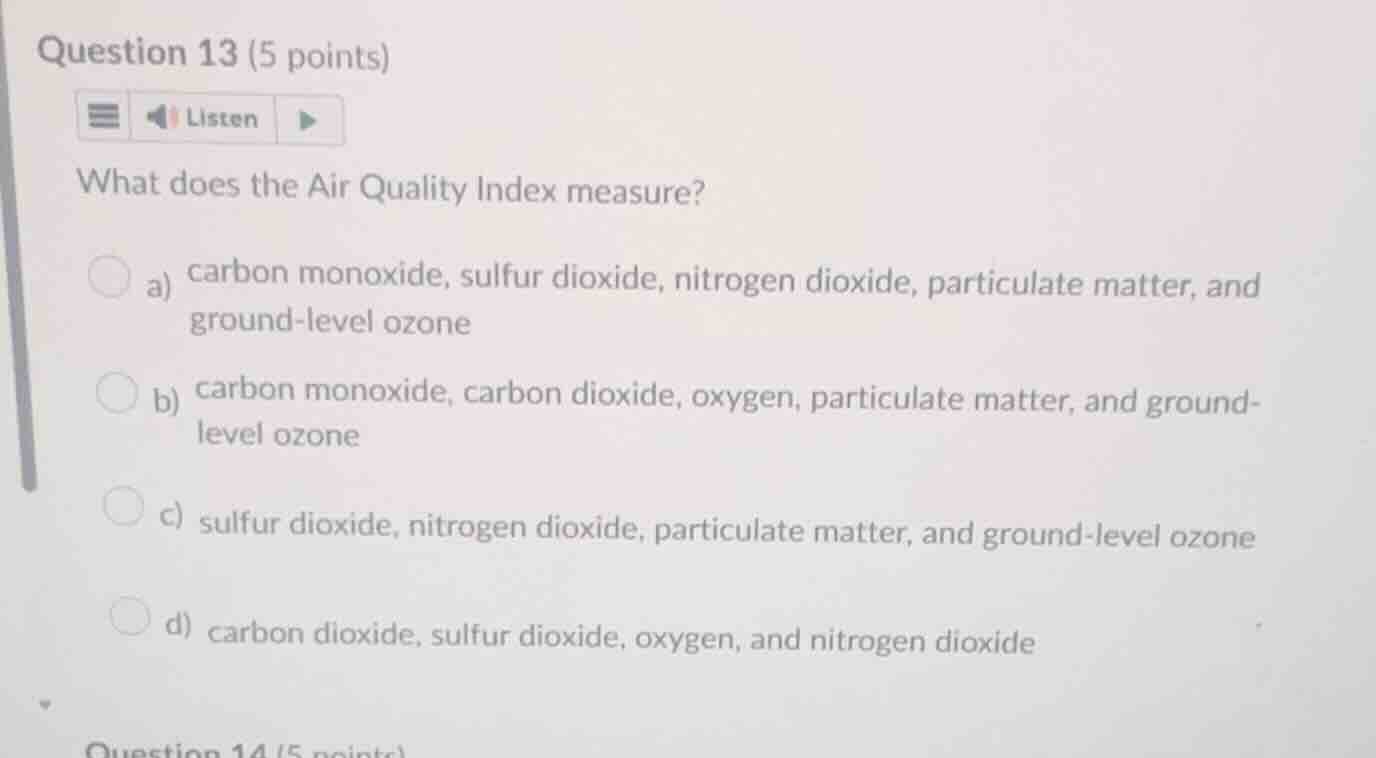
question 13 (5 points)
what does the air quality index measure?
a) carbon monoxide, sulfur dioxide, nitrogen dioxide, particulate matter, and ground-level ozone
b) carbon monoxide, carbon dioxide, oxygen, particulate matter, and ground-level ozone
c) sulfur dioxide, nitrogen dioxide, particulate matter, and ground-level ozone
d) carbon dioxide, sulfur dioxide, oxygen, and nitrogen dioxide
🆕 New Concept Discovered: Air Quality Index (AQI)
Measuring key pollutants in the air we breathe
Step 1: Define the Air Quality Index (AQI)
The Air Quality Index (AQI) is a standardized system used by environmental agencies (such as the US EPA) to report daily air quality and indicate how clean or polluted the surrounding air is.
Step 2: Identify the regulated criteria pollutants
The AQI focuses on health effects that can happen within a few hours or days after breathing unhealthy air. To calculate the AQI, environmental agencies track five major air pollutants regulated by the Clean Air Act:
- Ground-level ozone (\(\text{O}_3\))
- Particulate matter (PM2.5 and PM10)
- Carbon monoxide (\(\text{CO}\))
- Sulfur dioxide (\(\text{SO}_2\))
- Nitrogen dioxide (\(\text{NO}_2\))
Note: Carbon dioxide (\(\text{CO}_2\)) and oxygen (\(\text{O}_2\)) are not tracked by the AQI because they are natural components of the atmosphere and do not act as immediate criteria air pollutants affecting daily local air quality indexes.
Step 3: Match with the given options
- Option a: Lists carbon monoxide, sulfur dioxide, nitrogen dioxide, particulate matter, and ground-level ozone. This matches all five criteria pollutants perfectly.
- Option b: Incorrectly includes carbon dioxide and oxygen.
- Option c: Missing carbon monoxide.
- Option d: Incorrectly includes carbon dioxide and oxygen, and is missing particulate matter and ozone.

Snap & solve any problem in the app
Get step-by-step solutions on Sovi AI
Photo-based solutions with guided steps
Explore more problems and detailed explanations
a) carbon monoxide, sulfur dioxide, nitrogen dioxide, particulate matter, and ground-level ozone