QUESTION IMAGE
Question
question 12
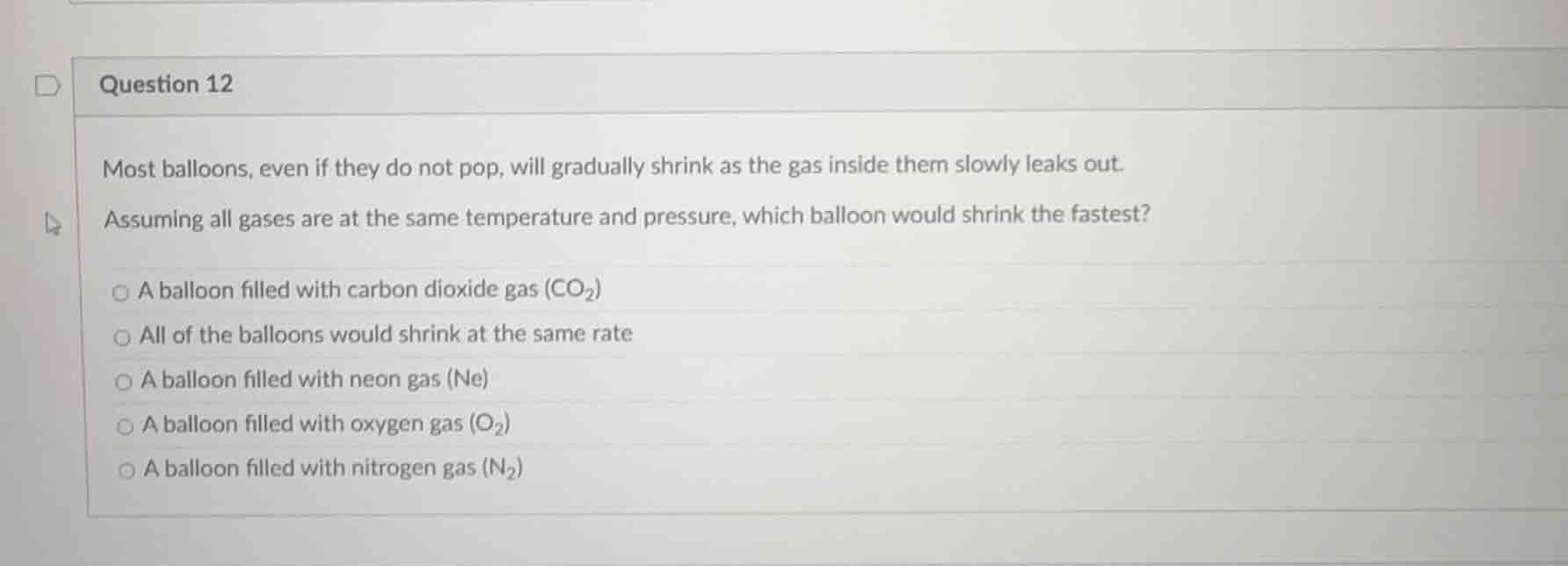
most balloons, even if they do not pop, will gradually shrink as the gas inside them slowly leaks out.
assuming all gases are at the same temperature and pressure, which balloon would shrink the fastest?
- a balloon filled with carbon dioxide gas (\\(\text{co}_2\\))
- all of the balloons would shrink at the same rate
- a balloon filled with neon gas (\\(\text{ne}\\))
- a balloon filled with oxygen gas (\\(\text{o}_2\\))
- a balloon filled with nitrogen gas (\\(\text{n}_2\\))
<pre_analysis>
{
"quality": "clear",
"question_count": 1,
"skills_matched": [
"step_cot",
"multiple_choice_formatter",
"explain_then_answer",
"quick"
],
"needs_drawing": false,
"concepts_used": [
"Molar Mass of Gases"
],
"new_concepts": [
"Graham's Law of Effusion"
],
"current_concepts": [
"Molar Mass of Gases",
"Graham's Law of Effusion"
]
}
</pre_analysis>
<reasoning>
State the physical principle
\[
\text{Rate of effusion} \propto \frac{1}{\sqrt{M}}
\]
Calculate the molar masses of the gases
\[
\]
Determine the fastest shrinking balloon
\[
M(\text{Ne}) < M(\text{N}_2) < M(\text{O}_2) < M(\text{CO}_2) \implies \text{Rate}(\text{Ne}) \text{ is the highest}
\]
</reasoning>
<answer>
<mcq-option>A balloon filled with carbon dioxide gas (\(\text{CO}_2\))</mcq-option>
<mcq-option>All of the balloons would shrink at the same rate</mcq-option>
<mcq-correct>A balloon filled with neon gas (\(\text{Ne}\))</mcq-correct>
<mcq-option>A balloon filled with oxygen gas (\(\text{O}_2\))</mcq-option>
<mcq-option>A balloon filled with nitrogen gas (\(\text{N}_2\))</mcq-option>
</answer>
<post_analysis>
{
"subject": "Natural Science",
"question_type": "Multiple Choice",
"knowledge_point": [
"Natural Science",
"Chemistry",
"Graham's Law of Effusion"
]
}
</post_analysis>
Snap & solve any problem in the app
Get step-by-step solutions on Sovi AI
Photo-based solutions with guided steps
Explore more problems and detailed explanations
<pre_analysis>
{
"quality": "clear",
"question_count": 1,
"skills_matched": [
"step_cot",
"multiple_choice_formatter",
"explain_then_answer",
"quick"
],
"needs_drawing": false,
"concepts_used": [
"Molar Mass of Gases"
],
"new_concepts": [
"Graham's Law of Effusion"
],
"current_concepts": [
"Molar Mass of Gases",
"Graham's Law of Effusion"
]
}
</pre_analysis>
<reasoning>
State the physical principle
\[
\text{Rate of effusion} \propto \frac{1}{\sqrt{M}}
\]
Calculate the molar masses of the gases
\[
\]
Determine the fastest shrinking balloon
\[
M(\text{Ne}) < M(\text{N}_2) < M(\text{O}_2) < M(\text{CO}_2) \implies \text{Rate}(\text{Ne}) \text{ is the highest}
\]
</reasoning>
<answer>
<mcq-option>A balloon filled with carbon dioxide gas (\(\text{CO}_2\))</mcq-option>
<mcq-option>All of the balloons would shrink at the same rate</mcq-option>
<mcq-correct>A balloon filled with neon gas (\(\text{Ne}\))</mcq-correct>
<mcq-option>A balloon filled with oxygen gas (\(\text{O}_2\))</mcq-option>
<mcq-option>A balloon filled with nitrogen gas (\(\text{N}_2\))</mcq-option>
</answer>
<post_analysis>
{
"subject": "Natural Science",
"question_type": "Multiple Choice",
"knowledge_point": [
"Natural Science",
"Chemistry",
"Graham's Law of Effusion"
]
}
</post_analysis>