QUESTION IMAGE
Question
question 11
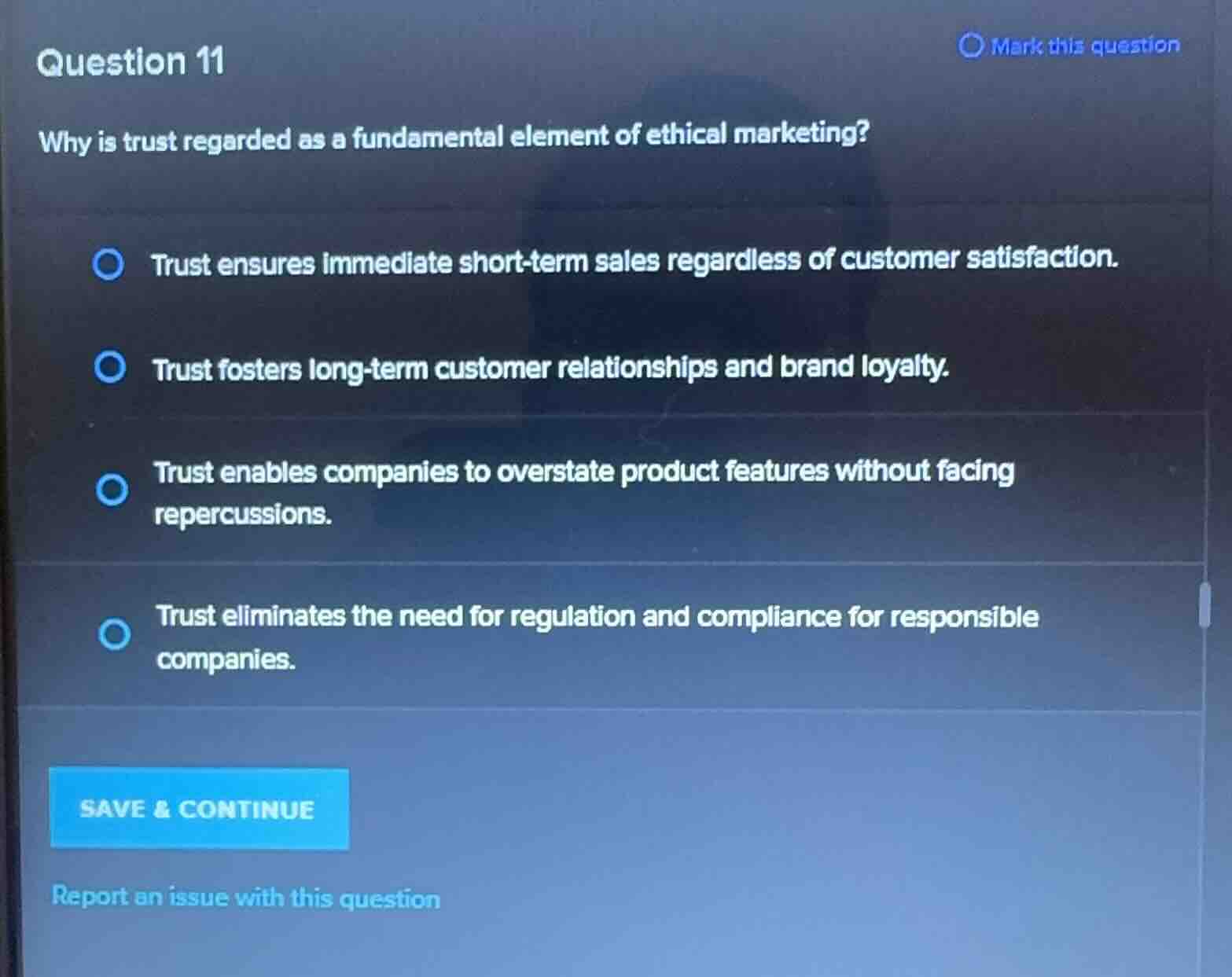
why is trust regarded as a fundamental element of ethical marketing?
- trust ensures immediate short-term sales regardless of customer satisfaction.
- trust fosters long-term customer relationships and brand loyalty.
- trust enables companies to overstate product features without facing repercussions.
- trust eliminates the need for regulation and compliance for responsible companies.
Analyze the role of trust in marketing
Using the Ethical Marketing knowledge point
Trust serves as the foundation of long-term interactions between a business and its consumers. When a brand acts ethically, it builds credibility, which directly encourages repeat purchases, positive word-of-mouth, and sustained customer retention over time.
Evaluate the given options
- Option 1: "Trust ensures immediate short-term sales regardless of customer satisfaction." This is incorrect because prioritizing short-term sales over satisfaction is contrary to ethical marketing and relationship building.
- Option 2: "Trust fosters long-term customer relationships and brand loyalty." This is correct because ethical practices build mutual respect, leading to sustained customer retention and loyalty.
- Option 3: "Trust enables companies to overstate product features without facing repercussions." This is incorrect because overstating features is deceptive, which destroys trust and violates ethical standards.
- Option 4: "Trust eliminates the need for regulation and compliance for responsible companies." This is incorrect because legal regulations and compliance standards remain mandatory regardless of how trusted a company is.

Snap & solve any problem in the app
Get step-by-step solutions on Sovi AI
Photo-based solutions with guided steps
Explore more problems and detailed explanations
- (A) Trust ensures immediate short-term sales regardless of customer satisfaction.
- (B) Trust fosters long-term customer relationships and brand loyalty. (Correct answer)
- (C) Trust enables companies to overstate product features without facing repercussions.
- (D) Trust eliminates the need for regulation and compliance for responsible companies.