Sovi.AI - AI Math Tutor

Scan to solve math questions

QUESTION IMAGE

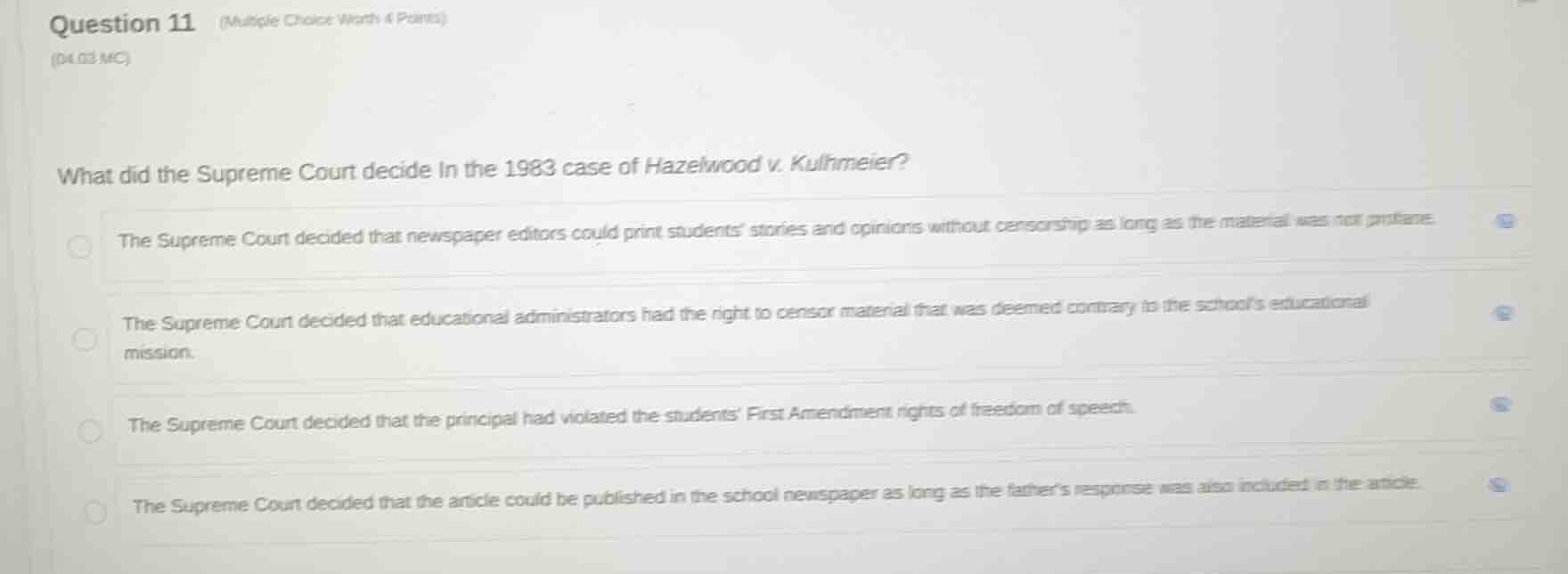
question 11 (multiple choice worth 4 points) (04.03 mc) what did the su…

Question

question 11 (multiple choice worth 4 points)
(04.03 mc)

what did the supreme court decide in the 1988 case of hazelwood v. kuhlmeier?

  • the supreme court decided that newspaper editors could print students stories and opinions without censorship as long as the material was not profane.
  • the supreme court decided that educational administrators had the right to censor material that was deemed contrary to the schools educational mission.
  • the supreme court decided that the principal had violated the students first amendment rights of freedom of speech.
  • the supreme court decided that the article could be published in the school newspaper as long as the fathers response was also included in the article.

Explanation:

Response

<pre_analysis>
{
"quality": "clear",
"question_count": 1,
"skills_matched": [
"direct_cot",
"multiple_choice_formatter",
"explain_then_answer",
"quick"
],
"needs_drawing": false,
"concepts_used": [],
"new_concepts": [
"First Amendment Rights",
"Hazelwood v. Kuhlmeier",
"Student Free Speech"
],
"current_concepts": [
"First Amendment Rights",
"Hazelwood v. Kuhlmeier",
"Student Free Speech"
]
}
</pre_analysis><reasoning>

Analyze the case of Hazelwood v. Kuhlmeier

The 1988 Supreme Court case Hazelwood School District v. Kuhlmeier addressed whether school administrators violate students' First Amendment rights by exercising editorial control over the content of student-run school newspapers.

Evaluate the Supreme Court's decision

The Supreme Court ruled in a 5-3 decision that school-sponsored publications, such as student newspapers, are not public forums and are subject to a lower level of First Amendment protection. Therefore, school administrators can censor material if their actions are reasonably related to legitimate pedagogical concerns.

Match with the correct option

The second option states: "The Supreme Court decided that educational administrators had the right to censor material that was deemed contrary to the school's educational mission." This directly aligns with the Court's ruling.
</reasoning><answer>
<mcq-option>(A) The Supreme Court decided that newspaper editors could print students' stories and opinions without censorship as long as the material was not profane.</mcq-option>
<mcq-correct>(B) The Supreme Court decided that educational administrators had the right to censor material that was deemed contrary to the school's educational mission.</mcq-correct>
<mcq-option>(C) The Supreme Court decided that the principal had violated the students' First Amendment rights of freedom of speech.</mcq-option>
<mcq-option>(D) The Supreme Court decided that the article could be published in the school newspaper as long as the father's response was also included in the article.</mcq-option>
</answer><post_analysis>
{
"subject": "Social Science",
"question_type": "Multiple Choice",
"knowledge_point": [
"Social Science",
"US Government",
"Supreme Court Cases"
]
}
</post_analysis>

Answer:

<pre_analysis>
{
"quality": "clear",
"question_count": 1,
"skills_matched": [
"direct_cot",
"multiple_choice_formatter",
"explain_then_answer",
"quick"
],
"needs_drawing": false,
"concepts_used": [],
"new_concepts": [
"First Amendment Rights",
"Hazelwood v. Kuhlmeier",
"Student Free Speech"
],
"current_concepts": [
"First Amendment Rights",
"Hazelwood v. Kuhlmeier",
"Student Free Speech"
]
}
</pre_analysis><reasoning>

Analyze the case of Hazelwood v. Kuhlmeier

The 1988 Supreme Court case Hazelwood School District v. Kuhlmeier addressed whether school administrators violate students' First Amendment rights by exercising editorial control over the content of student-run school newspapers.

Evaluate the Supreme Court's decision

The Supreme Court ruled in a 5-3 decision that school-sponsored publications, such as student newspapers, are not public forums and are subject to a lower level of First Amendment protection. Therefore, school administrators can censor material if their actions are reasonably related to legitimate pedagogical concerns.

Match with the correct option

The second option states: "The Supreme Court decided that educational administrators had the right to censor material that was deemed contrary to the school's educational mission." This directly aligns with the Court's ruling.
</reasoning><answer>
<mcq-option>(A) The Supreme Court decided that newspaper editors could print students' stories and opinions without censorship as long as the material was not profane.</mcq-option>
<mcq-correct>(B) The Supreme Court decided that educational administrators had the right to censor material that was deemed contrary to the school's educational mission.</mcq-correct>
<mcq-option>(C) The Supreme Court decided that the principal had violated the students' First Amendment rights of freedom of speech.</mcq-option>
<mcq-option>(D) The Supreme Court decided that the article could be published in the school newspaper as long as the father's response was also included in the article.</mcq-option>
</answer><post_analysis>
{
"subject": "Social Science",
"question_type": "Multiple Choice",
"knowledge_point": [
"Social Science",
"US Government",
"Supreme Court Cases"
]
}
</post_analysis>