QUESTION IMAGE
Question
question 4 of 10
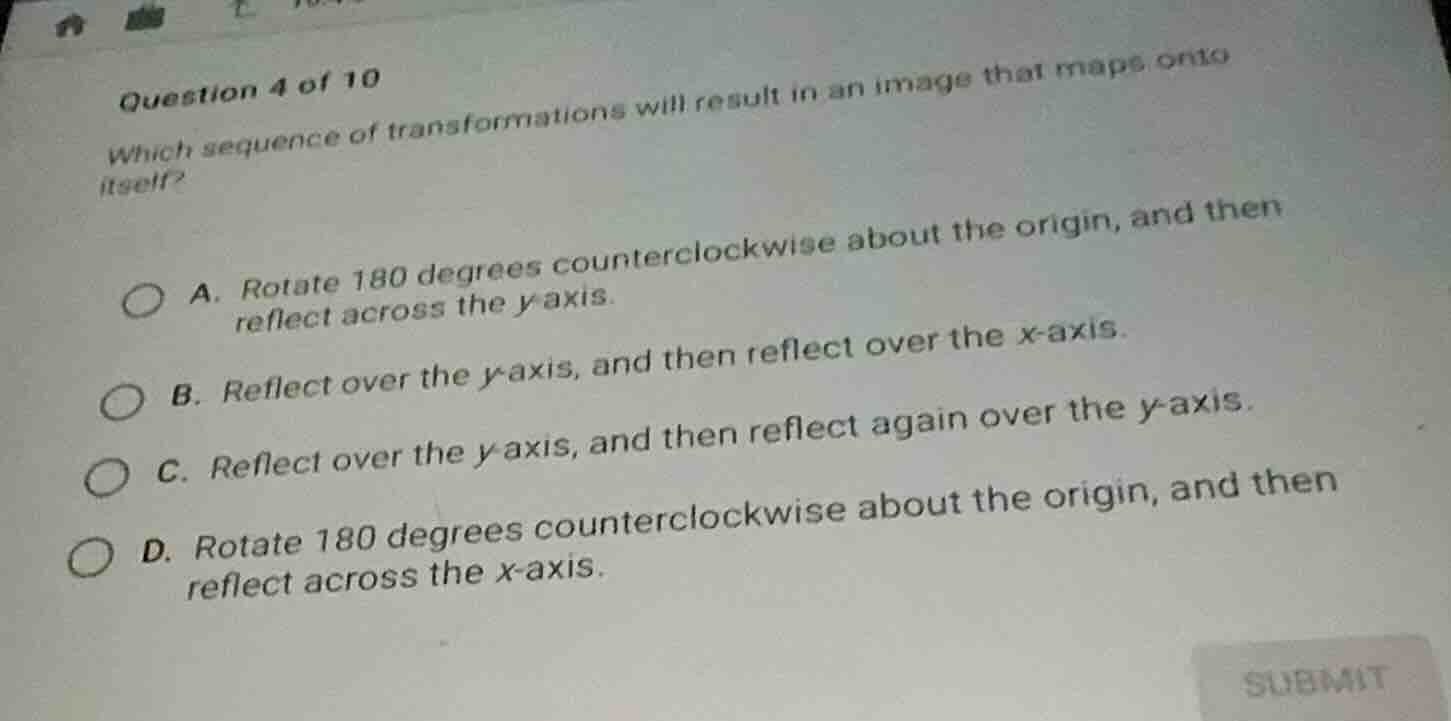
which sequence of transformations will result in an image that maps onto itself?
a. rotate 180 degrees counterclockwise about the origin, and then reflect across the \\(y\\)-axis.
b. reflect over the \\(y\\)-axis, and then reflect over the \\(x\\)-axis.
c. reflect over the \\(y\\)-axis, and then reflect again over the \\(y\\)-axis.
d. rotate 180 degrees counterclockwise about the origin, and then reflect across the \\(x\\)-axis.
Analyze the identity transformation condition
An image maps onto itself if the sequence of transformations results in the identity transformation:
Evaluate each option using coordinate rules
- Option A: Rotate \(180^\circ\) counterclockwise about the origin, then reflect across the \(y\)-axis.
- Option B: Reflect over the \(y\)-axis, then reflect over the \(x\)-axis.
- Option C: Reflect over the \(y\)-axis, then reflect again over the \(y\)-axis.
- Option D: Rotate \(180^\circ\) counterclockwise about the origin, then reflect across the \(x\)-axis.
Identify the correct sequence
Option C results in the original coordinates \((x, y)\), meaning the image maps onto itself.

Snap & solve any problem in the app
Get step-by-step solutions on Sovi AI
Photo-based solutions with guided steps
Explore more problems and detailed explanations
- (A) Rotate 180 degrees counterclockwise about the origin, and then reflect across the y-axis.
- (B) Reflect over the y-axis, and then reflect over the x-axis.
- (C) Reflect over the y-axis, and then reflect again over the y-axis. (Correct answer)
- (D) Rotate 180 degrees counterclockwise about the origin, and then reflect across the x-axis.