QUESTION IMAGE
Question
question 5 of 10
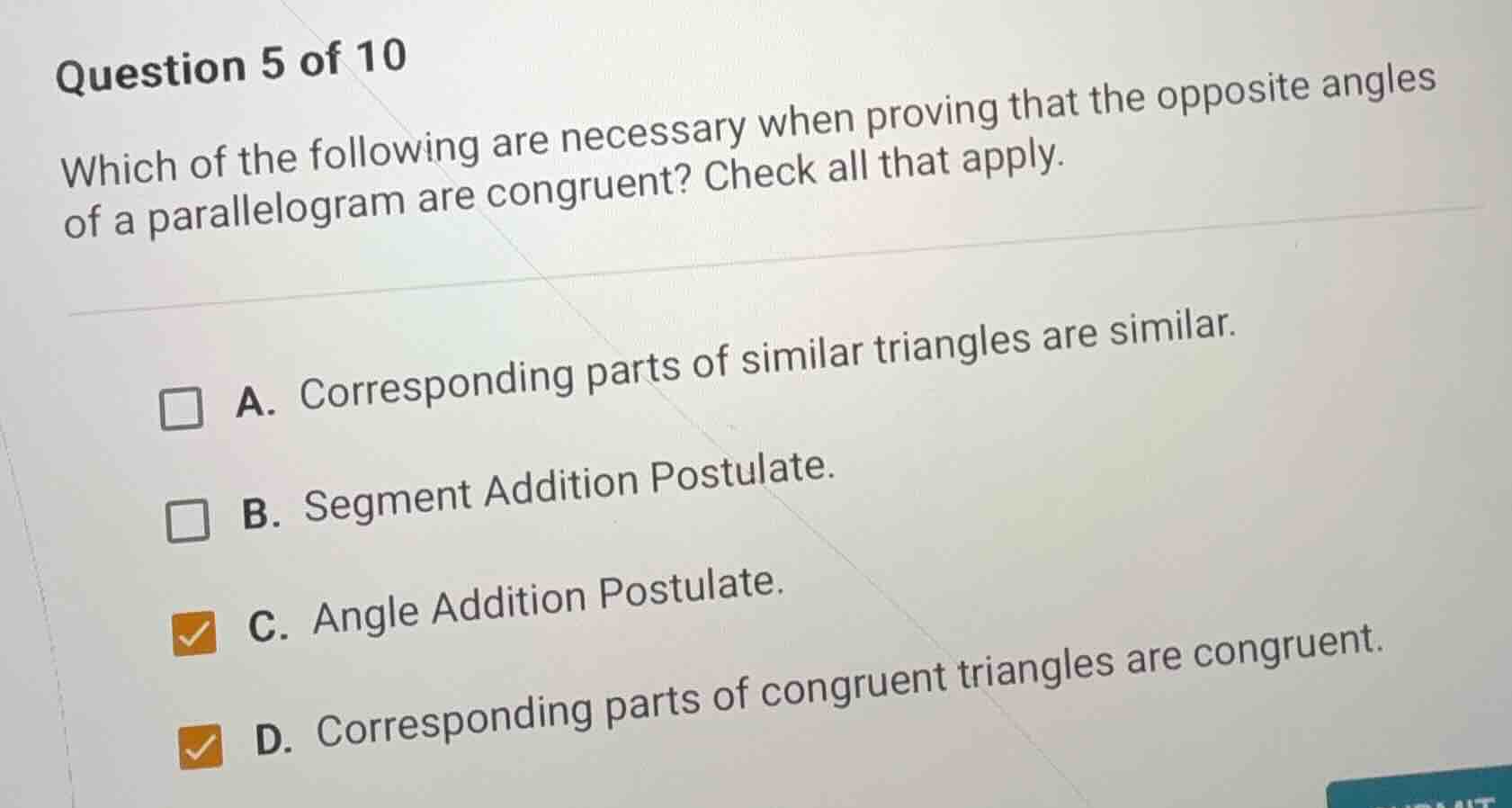
which of the following are necessary when proving that the opposite angles of a parallelogram are congruent? check all that apply.
a. corresponding parts of similar triangles are similar.
b. segment addition postulate.
c. angle addition postulate.
d. corresponding parts of congruent triangles are congruent.
Analyze the proof structure
Using the Geometric Proof Strategies knowledge point:
To prove that the opposite angles of a parallelogram are congruent, we draw a diagonal (e.g., \(BD\)) to divide the parallelogram \(ABCD\) into two triangles, \(\triangle ABD\) and \(\triangle CDB\).
Apply triangle congruence
Using the Triangle Congruence Postulates knowledge point:
We prove \(\triangle ABD \cong \triangle CDB\) using ASA (Angle-Side-Angle) based on parallel lines and the shared diagonal.
Identify CPCTC requirement
Using the Geometric Proof Strategies knowledge point
This step relies directly on CPCTC (Corresponding Parts of Congruent Triangles are Congruent). Thus, Option D is necessary.
Identify Angle Addition requirement
Using the Geometric Proof Strategies knowledge point
To prove the other pair of opposite angles are congruent (\(\angle B \cong \angle D\)), we write:
This step requires the Angle Addition Postulate. Thus, Option C is necessary.

Snap & solve any problem in the app
Get step-by-step solutions on Sovi AI
Photo-based solutions with guided steps
Explore more problems and detailed explanations
- A. Corresponding parts of similar triangles are similar.
- B. Segment Addition Postulate.
- C. Angle Addition Postulate. (Correct answer)
- D. Corresponding parts of congruent triangles are congruent. (Correct answer)