QUESTION IMAGE
Question
question 10
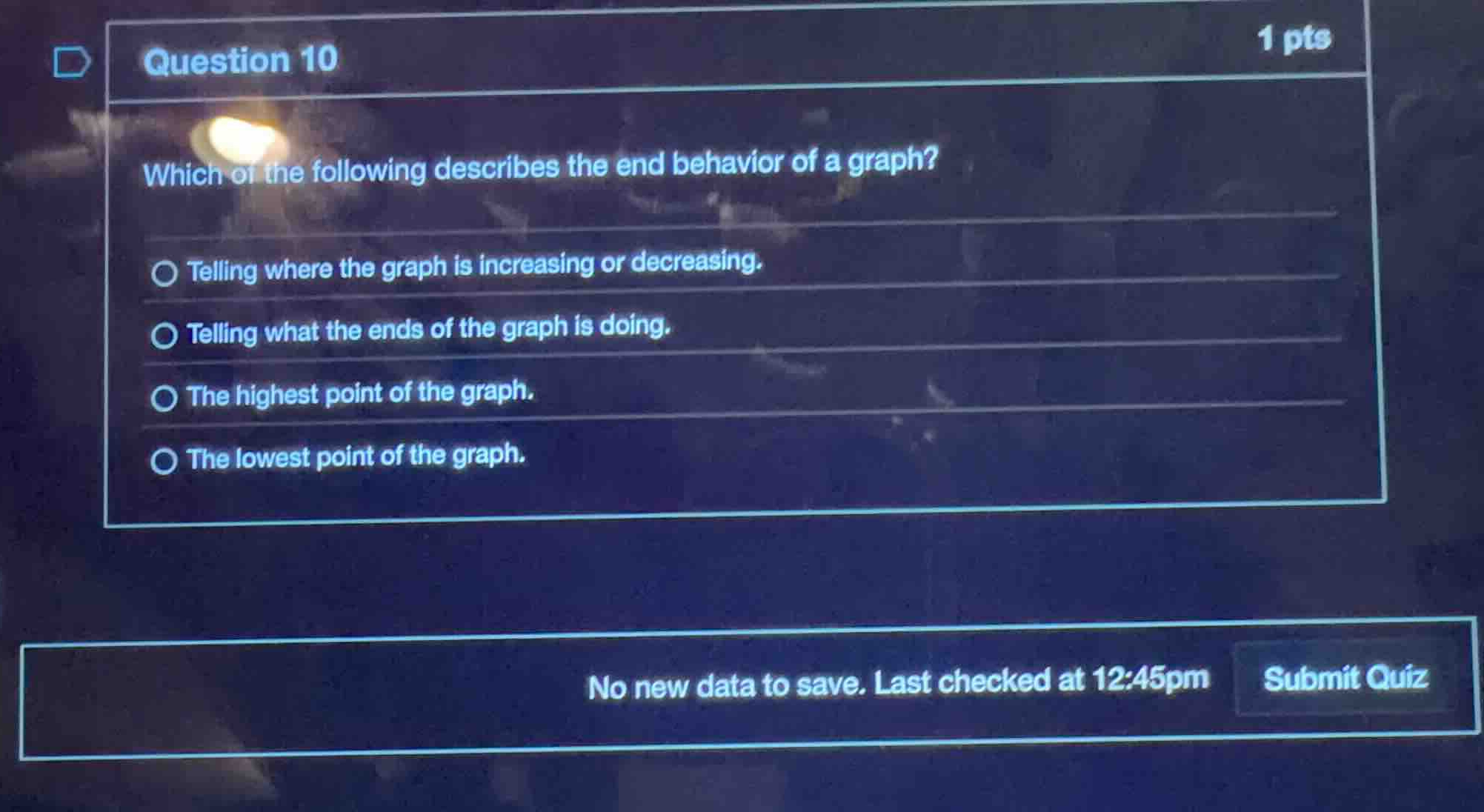
which of the following describes the end behavior of a graph?
telling where the graph is increasing or decreasing.
telling what the ends of the graph is doing.
the highest point of the graph.
the lowest point of the graph.
<pre_analysis>
{
"quality": "clear",
"question_count": 1,
"skills_matched": [
"direct_cot",
"multiple_choice_formatter",
"explain_then_answer",
"quick"
],
"needs_drawing": false,
"concepts_used": [],
"new_concepts": [
"End Behavior"
],
"current_concepts": [
"End Behavior",
"Graph Characteristics"
]
}
</pre_analysis>
<reasoning>
Define end behavior of a function
The end behavior of a graph describes what happens to the values of \(y\) (the function values) as \(x\) approaches positive infinity (\(x \to \infty\)) and negative infinity (\(x \to -\infty\)). In simple terms, it describes what the ends of the graph are doing as you move far to the left and far to the right.
Evaluate the given options
- Telling where the graph is increasing or decreasing: This describes intervals of increase and decrease, which occur in the middle domain of the function, not the extreme ends.
- Telling what the ends of the graph is doing: This directly matches the definition of end behavior (how the graph behaves at its far left and far right limits).
- The highest point of the graph: This describes the absolute maximum of the graph.
- The lowest point of the graph: This describes the absolute minimum of the graph.
</reasoning>
<answer>
<mcq-option>Telling where the graph is increasing or decreasing.</mcq-option>
<mcq-correct>Telling what the ends of the graph is doing.</mcq-correct>
<mcq-option>The highest point of the graph.</mcq-option>
<mcq-option>The lowest point of the graph.</mcq-option>
</answer>
<post_analysis>
{
"subject": "Mathematics",
"question_type": "Multiple Choice",
"knowledge_point": [
"Mathematics",
"Algebra",
"End Behavior"
]
}
</post_analysis>
Snap & solve any problem in the app
Get step-by-step solutions on Sovi AI
Photo-based solutions with guided steps
Explore more problems and detailed explanations
<pre_analysis>
{
"quality": "clear",
"question_count": 1,
"skills_matched": [
"direct_cot",
"multiple_choice_formatter",
"explain_then_answer",
"quick"
],
"needs_drawing": false,
"concepts_used": [],
"new_concepts": [
"End Behavior"
],
"current_concepts": [
"End Behavior",
"Graph Characteristics"
]
}
</pre_analysis>
<reasoning>
Define end behavior of a function
The end behavior of a graph describes what happens to the values of \(y\) (the function values) as \(x\) approaches positive infinity (\(x \to \infty\)) and negative infinity (\(x \to -\infty\)). In simple terms, it describes what the ends of the graph are doing as you move far to the left and far to the right.
Evaluate the given options
- Telling where the graph is increasing or decreasing: This describes intervals of increase and decrease, which occur in the middle domain of the function, not the extreme ends.
- Telling what the ends of the graph is doing: This directly matches the definition of end behavior (how the graph behaves at its far left and far right limits).
- The highest point of the graph: This describes the absolute maximum of the graph.
- The lowest point of the graph: This describes the absolute minimum of the graph.
</reasoning>
<answer>
<mcq-option>Telling where the graph is increasing or decreasing.</mcq-option>
<mcq-correct>Telling what the ends of the graph is doing.</mcq-correct>
<mcq-option>The highest point of the graph.</mcq-option>
<mcq-option>The lowest point of the graph.</mcq-option>
</answer>
<post_analysis>
{
"subject": "Mathematics",
"question_type": "Multiple Choice",
"knowledge_point": [
"Mathematics",
"Algebra",
"End Behavior"
]
}
</post_analysis>