QUESTION IMAGE
Question
question 7 of 10
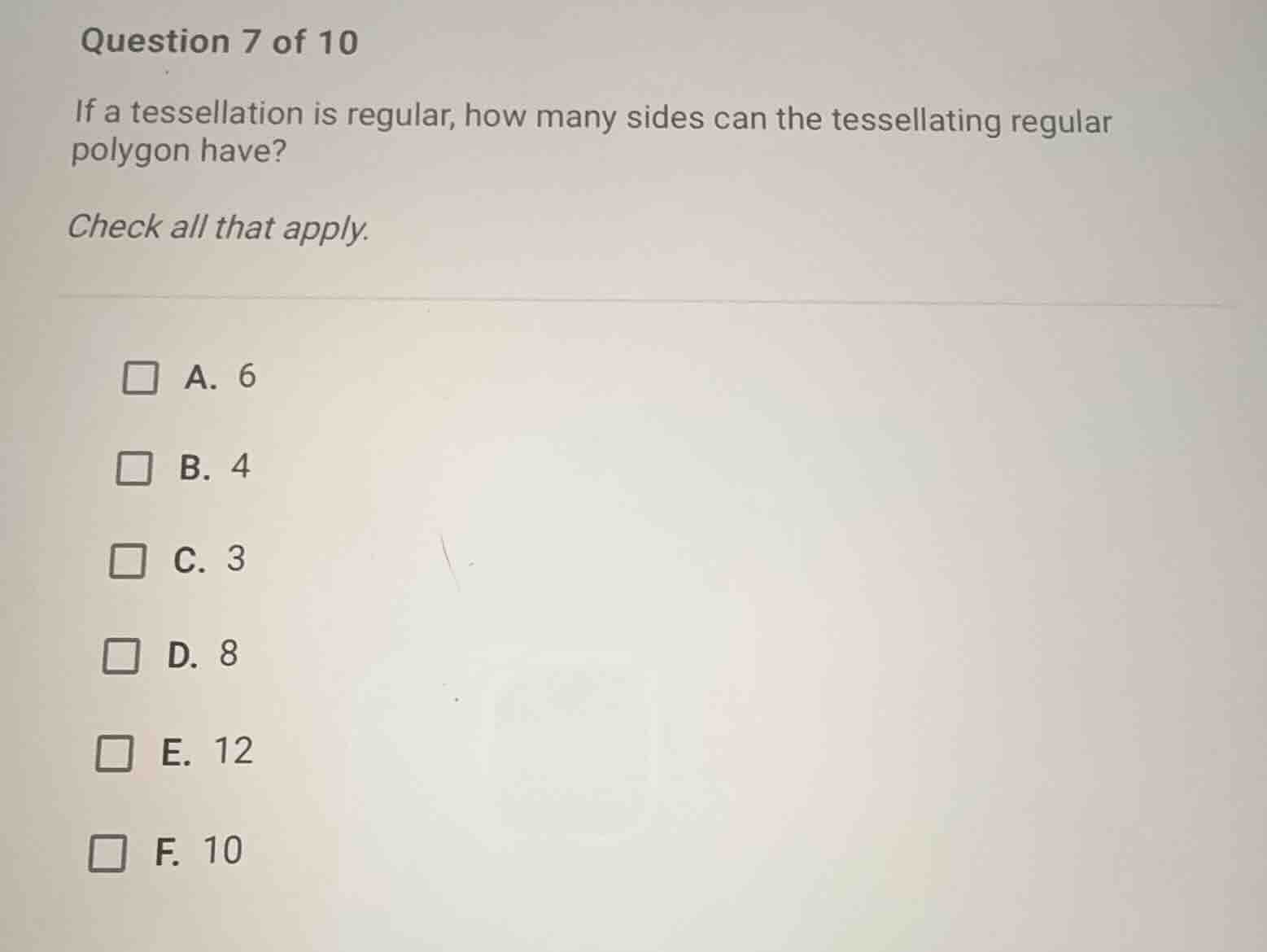
if a tessellation is regular, how many sides can the tessellating regular polygon have?
check all that apply.
a. 6
b. 4
c. 3
d. 8
e. 12
f. 10
Define regular tessellations
Using the Regular Tessellation and Tessellation Definition knowledge points
$$
\theta = \frac{(n-2) \times 180^\circ}{n}
$$
$$
k \times \theta = 360^\circ \implies k \times \frac{(n-2) \times 180^\circ}{n} = 360^\circ
$$
Solve for possible values of n
Using the Regular Tessellation knowledge point
$$
\frac{k(n-2)}{n} = 2 \implies k(n-2) = 2n \implies kn - 2k = 2n \implies n(k-2) = 2k
$$
$$
n = \frac{2k}{k-2} = \frac{2(k-2) + 4}{k-2} = 2 + \frac{4}{k-2}
$$
Since \(k\) must be an integer greater than or equal to 3:
- If \(k = 3\): \(n = 2 + \frac{4}{1} = 6\) (regular hexagons)
- If \(k = 4\): \(n = 2 + \frac{4}{2} = 4\) (squares)
- If \(k = 6\): \(n = 2 + \frac{4}{4} = 3\) (equilateral triangles)
Match with given options
Using the Regular Tessellation knowledge point
- Option A (6): Yes, equilateral hexagons tessellate.
- Option B (4): Yes, squares tessellate.
- Option C (3): Yes, equilateral triangles tessellate.
- Options D (8), E (12), F (10): No, these do not form regular tessellations.

Snap & solve any problem in the app
Get step-by-step solutions on Sovi AI
Photo-based solutions with guided steps
Explore more problems and detailed explanations
- A. 6 (Correct answer)
- B. 4 (Correct answer)
- C. 3 (Correct answer)
- D. 8
- E. 12
- F. 10