QUESTION IMAGE
Question
question 7 of 10
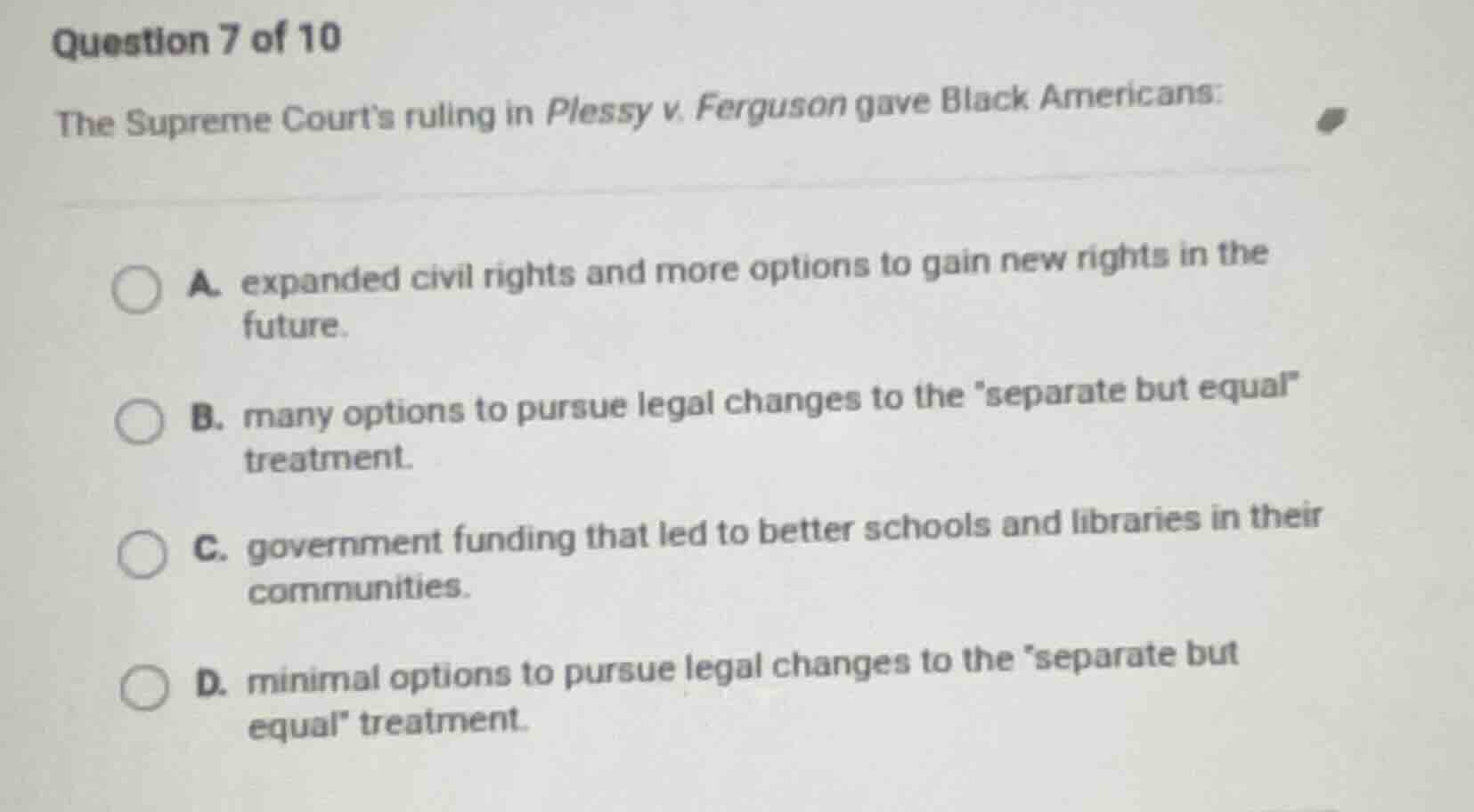
the supreme courts ruling in plessy v. ferguson gave black americans:
a. expanded civil rights and more options to gain new rights in the future.
b. many options to pursue legal changes to the \separate but equal\ treatment.
c. government funding that led to better schools and libraries in their communities.
d. minimal options to pursue legal changes to the \separate but equal\ treatment.
Analyze the historical context of Plessy v. Ferguson
The 1896 Supreme Court decision in Plessy v. Ferguson upheld the constitutionality of racial segregation laws for public facilities under the doctrine of "separate but equal." This ruling directly reinforced Jim Crow Laws and institutionalized Racial Segregation across the United States, particularly in the South.
Evaluate the impact on legal options for Black Americans
By establishing the "separate but equal" doctrine as the supreme law of the land, the Court severely restricted the ability of Black Americans to challenge segregation in courts. It meant that as long as facilities were claimed to be equal (even if they were vastly inferior in practice), segregation was legally permissible. This left Black Americans with extremely limited legal recourse to fight discriminatory practices.
Assess the given multiple-choice options
- Option A is incorrect because the ruling restricted, rather than expanded, civil rights.
- Option B is incorrect because the ruling closed off most legal avenues to challenge segregation, rather than offering "many options."
- Option C is incorrect because the ruling did not guarantee or provide federal funding for Black communities; facilities remained highly unequal and underfunded.
- Option D is correct because the "separate but equal" precedent created a massive legal barrier, leaving Black Americans with minimal options to pursue legal changes to segregated treatment for decades.

Snap & solve any problem in the app
Get step-by-step solutions on Sovi AI
Photo-based solutions with guided steps
Explore more problems and detailed explanations
- A. expanded civil rights and more options to gain new rights in the future.
- B. many options to pursue legal changes to the "separate but equal" treatment.
- C. government funding that led to better schools and libraries in their communities.
- D. minimal options to pursue legal changes to the "separate but equal" treatment. (Correct answer)