QUESTION IMAGE
Question
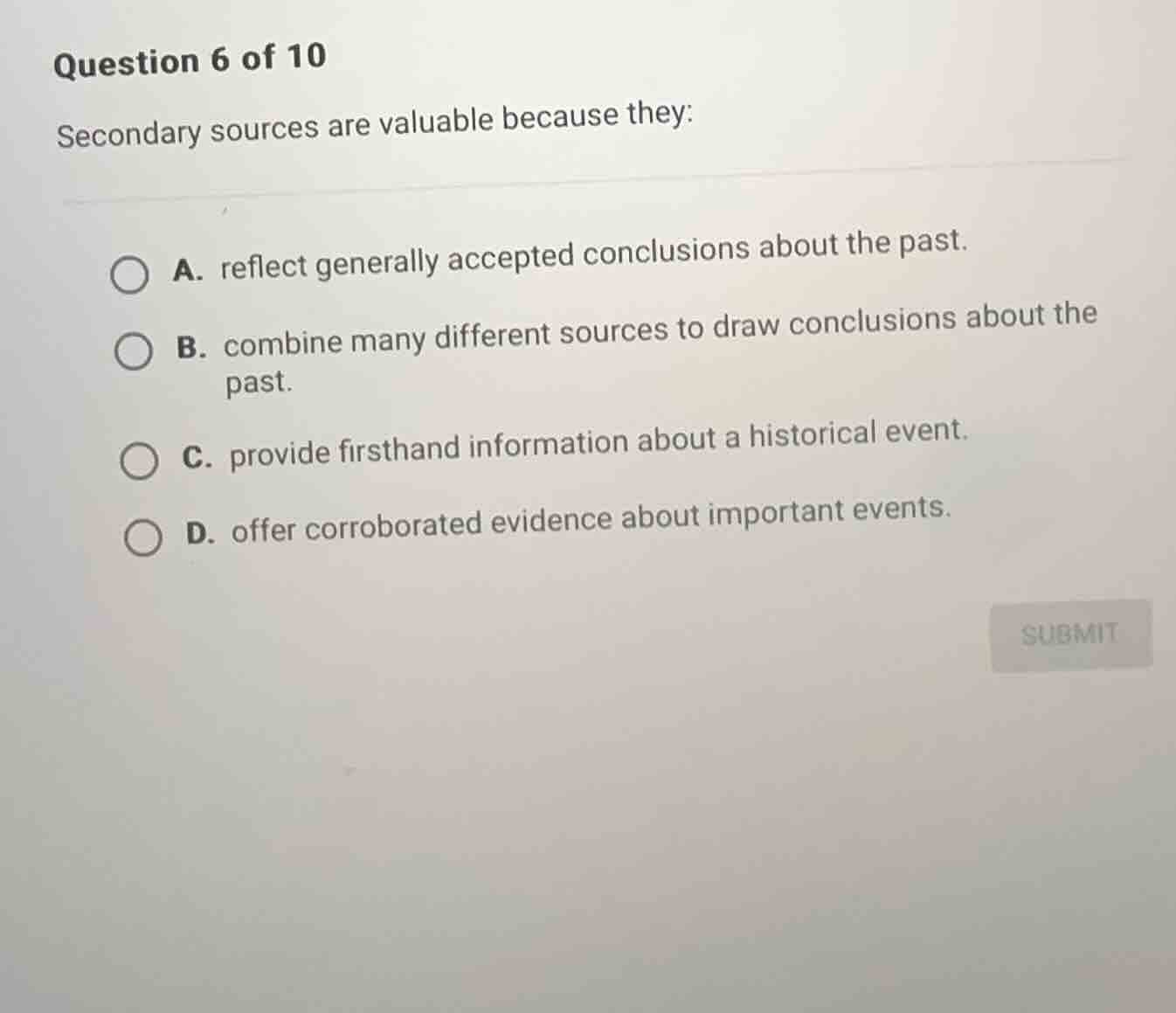
question 6 of 10
secondary sources are valuable because they:
a. reflect generally accepted conclusions about the past.
b. combine many different sources to draw conclusions about the past.
c. provide firsthand information about a historical event.
d. offer corroborated evidence about important events.
Brief Explanations
To determine why secondary sources are valuable, we analyze each option:
- Option A: Secondary sources don't just reflect "generally accepted conclusions" passively; they analyze and synthesize. Eliminate A.
- Option B: Secondary sources (like history books, scholarly articles) synthesize multiple primary or other sources to draw conclusions about the past. This matches their definition.
- Option C: Firsthand information is from primary sources (e.g., diaries, eyewitness accounts), not secondary. Eliminate C.
- Option D: Corroborated evidence is more about cross - checking, and secondary sources focus on analysis/synthesis of multiple sources rather than just corroboration. Eliminate D.

Snap & solve any problem in the app
Get step-by-step solutions on Sovi AI
Photo-based solutions with guided steps
Explore more problems and detailed explanations
B. combine many different sources to draw conclusions about the past.