QUESTION IMAGE
Question
question 4 of 10
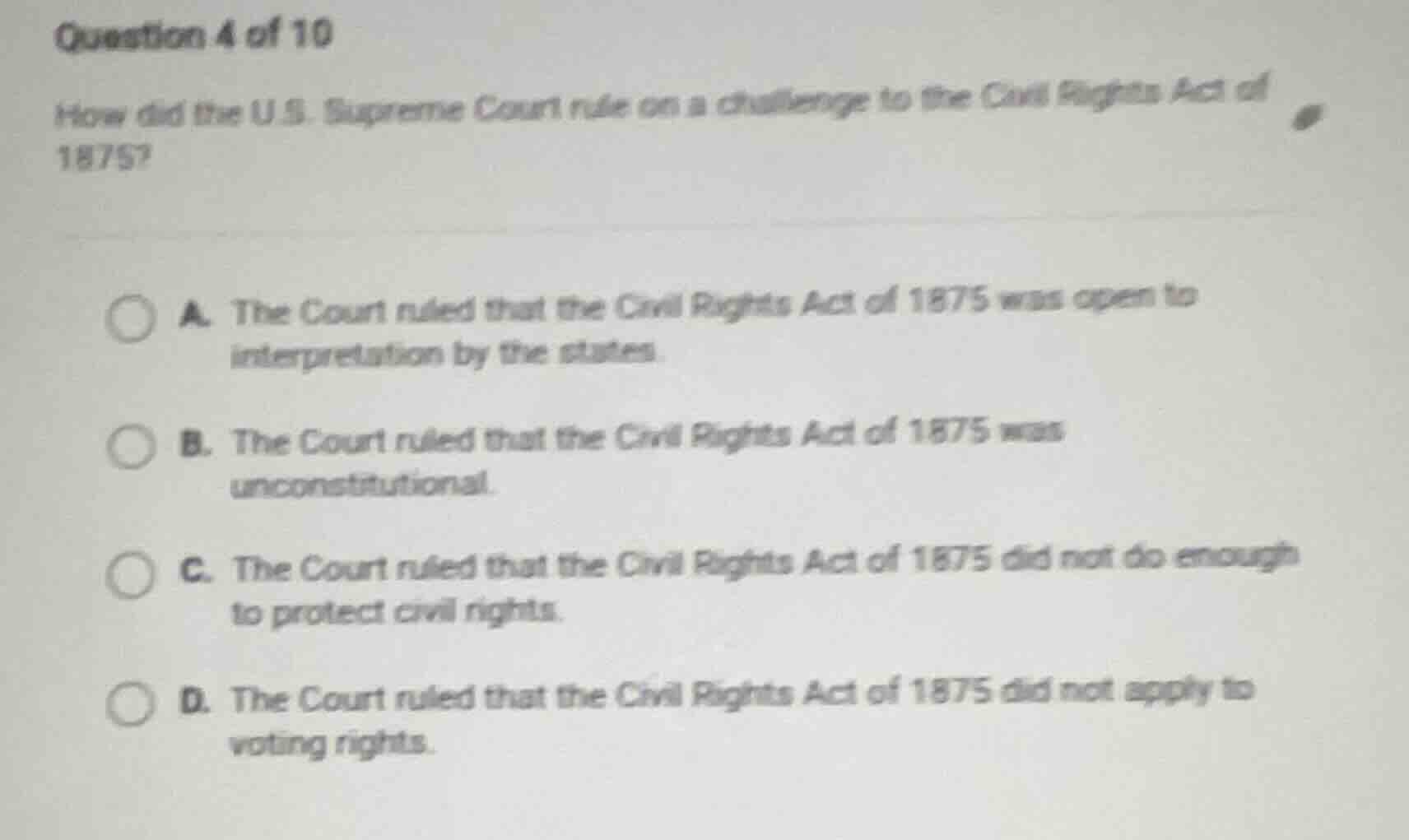
how did the u.s. supreme court rule on a challenge to the civil rights act of 1875?
a. the court ruled that the civil rights act of 1875 was open to interpretation by the states.
b. the court ruled that the civil rights act of 1875 was unconstitutional.
c. the court ruled that the civil rights act of 1875 did not do enough to protect civil rights.
d. the court ruled that the civil rights act of 1875 did not apply to voting rights.
Identify the historical context of the Civil Rights Act of 1875
The Civil Rights Act of 1875 was a federal law enacted during the Reconstruction Era that guaranteed African Americans equal treatment in public accommodations, public transportation, and prohibited exclusion from jury service.
Analyze the Supreme Court's ruling on the Act
In 1883, the U.S. Supreme Court consolidated five similar cases into the Civil Rights Cases. The Court ruled 8–1 that the Civil Rights Act of 1875 was unconstitutional.
Determine the constitutional basis of the decision
The Court declared that the Fourteenth Amendment only prohibited discrimination by state governments ("state action"), not by private individuals or businesses. This ruling paved the way for the rise of Jim Crow Laws and legalized segregation in the South.
Match the ruling to the correct multiple-choice option
The Court's decision directly declared the Civil Rights Act of 1875 unconstitutional, which corresponds to option B.

Snap & solve any problem in the app
Get step-by-step solutions on Sovi AI
Photo-based solutions with guided steps
Explore more problems and detailed explanations
- (A) The Court ruled that the Civil Rights Act of 1875 was open to interpretation by the states.
- (B) The Court ruled that the Civil Rights Act of 1875 was unconstitutional. (Correct answer)
- (C) The Court ruled that the Civil Rights Act of 1875 did not do enough to protect civil rights.
- (D) The Court ruled that the Civil Rights Act of 1875 did not apply to voting rights.