QUESTION IMAGE
Question
question 10
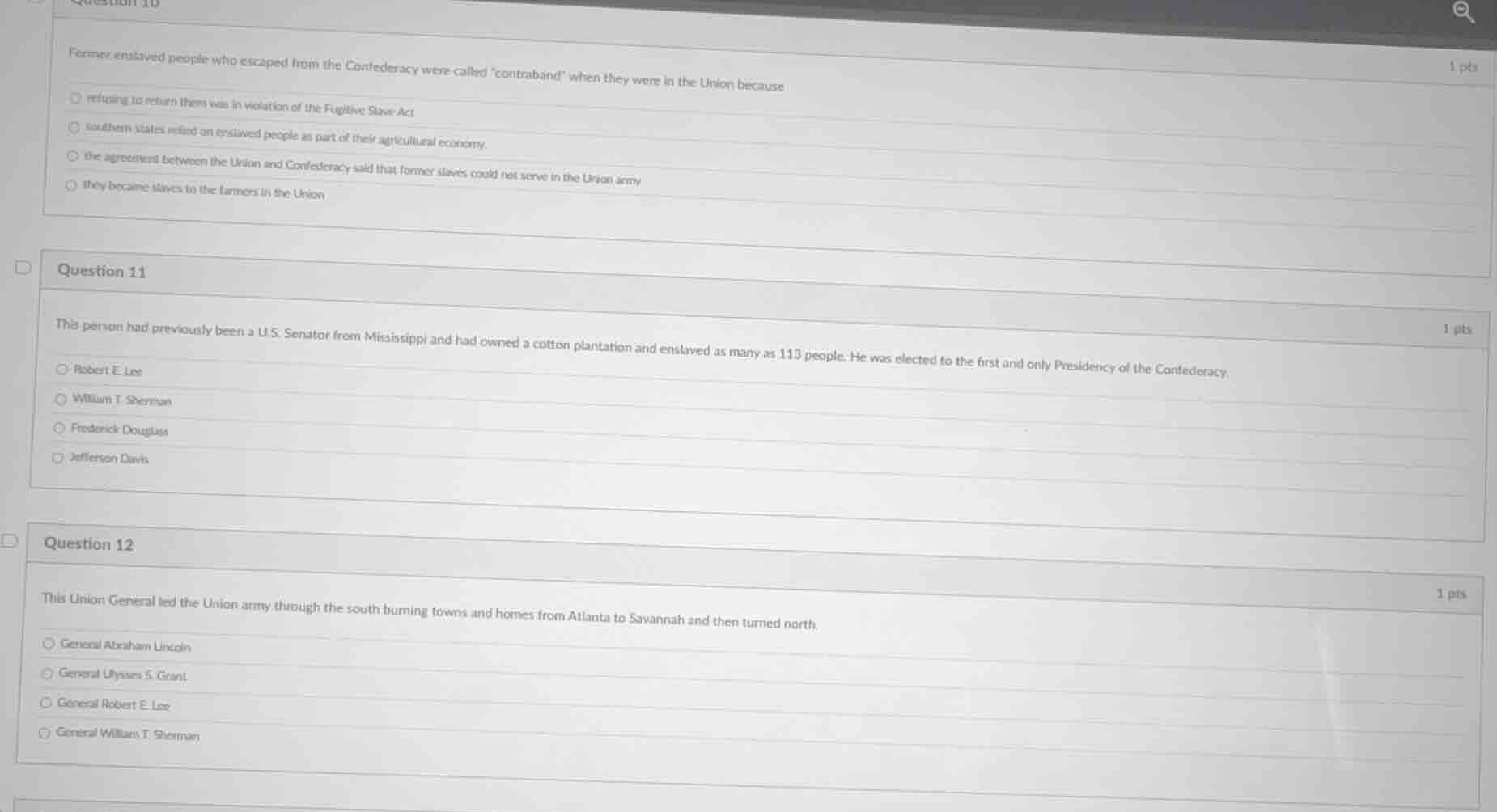
former enslaved people who escaped from the confederacy were called \contraband\ when they were in the union because
refusing to return them was in violation of the fugitive slave act
southern states relied on enslaved people as part of their agricultural economy.
the agreement between the union and confederacy said that former slaves could not serve in the union army
they became slaves to the farmers in the union
question 11
this person had previously been a u.s. senator from mississippi and had owned a cotton plantation and enslaved as many as 113 people. he was elected to the first and only presidency of the confederacy.
robert e. lee
william t. sherman
frederick douglass
jefferson davis
question 12
this union general led the union army through the south burning towns and homes from atlanta to savannah and then turned north.
general abraham lincoln
general ulysses s. grant
general robert e. lee
general william t. sherman
Analyze Question 10
The question asks why former enslaved people who escaped to Union lines were referred to as "contraband." During the Civil War, Union General Benjamin Butler declared escaped slaves as "contraband of war" to avoid returning them under the Fugitive Slave Act. Since the Confederacy claimed enslaved people as property, the Union army confiscated them as enemy property (contraband) used to support the rebellion. Therefore, refusing to return them was technically in violation of the Fugitive Slave Act, but justified under laws of war.
Analyze Question 11
The question describes a person who was a U.S. Senator from Mississippi, owned a cotton plantation with many enslaved people, and was elected as the President of the Confederacy. This description uniquely identifies Jefferson Davis, who served as the first and only President of the Confederate States of America.
Analyze Question 12
The question describes a Union General who led the Union army through the South, burning towns and homes from Atlanta to Savannah, and then turned north. This refers to General William Tecumseh Sherman and his famous "March to the Sea" campaign, which utilized total war tactics to break the Confederacy's will to fight.

Snap & solve any problem in the app
Get step-by-step solutions on Sovi AI
Photo-based solutions with guided steps
Explore more problems and detailed explanations
Question 10
- (A) refusing to return them was in violation of the Fugitive Slave Act (Correct answer)
- (B) southern states relied on enslaved people as part of their agricultural economy.
- (C) the agreement between the Union and Confederacy said that former slaves could not serve in the Union army
- (D) they became slaves to the farmers in the Union
Question 11
- (A) Robert E. Lee
- (B) William T. Sherman
- (C) Frederick Douglass
- (D) Jefferson Davis (Correct answer)
Question 12
- (A) General Abraham Lincoln
- (B) General Ulysses S. Grant
- (C) General Robert E. Lee
- (D) General William T. Sherman (Correct answer)