QUESTION IMAGE
Question
question 4 of 10
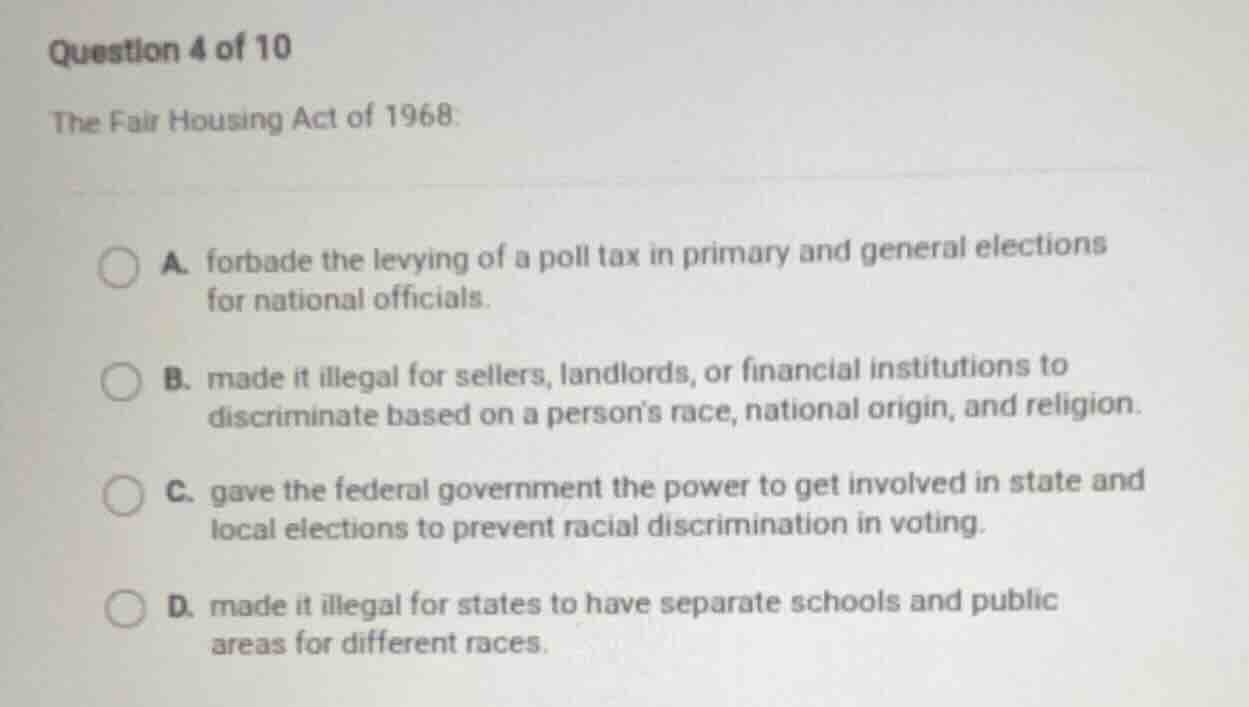
the fair housing act of 1968:
a. forbade the levying of a poll tax in primary and general elections for national officials.
b. made it illegal for sellers, landlords, or financial institutions to discriminate based on a persons race, national origin, and religion.
c. gave the federal government the power to get involved in state and local elections to prevent racial discrimination in voting.
d. made it illegal for states to have separate schools and public areas for different races.
Analyze the Fair Housing Act of 1968
The Fair Housing Act of 1968 (also known as Title VIII of the Civil Rights Act of 1968) was a landmark piece of legislation during the Civil Rights Movement. Its primary purpose was to prohibit discrimination concerning the sale, rental, and financing of housing based on race, religion, national origin, and sex.
Evaluate the given options
- Option A refers to the Twenty-Fourth Amendment (ratified in 1964), which banned poll taxes in federal elections.
- Option B directly describes the core mandate of the Fair Housing Act of 1968, which prohibited discrimination by sellers, landlords, and financial institutions (such as banks offering mortgages) based on protected classes.
- Option C describes the Voting Rights Act of 1965, which gave the federal government oversight over state and local registration and voting procedures.
- Option D refers to the broader desegregation efforts, such as the Civil Rights Act of 1964 and the landmark Supreme Court ruling in Brown v. Board of Education (1954).
Confirm the correct choice
Option B is the only choice that accurately describes the provisions of the Fair Housing Act of 1968.

Snap & solve any problem in the app
Get step-by-step solutions on Sovi AI
Photo-based solutions with guided steps
Explore more problems and detailed explanations
- (A) forbade the levying of a poll tax in primary and general elections for national officials.
- (B) made it illegal for sellers, landlords, or financial institutions to discriminate based on a person's race, national origin, and religion. (Correct answer)
- (C) gave the federal government the power to get involved in state and local elections to prevent racial discrimination in voting.
- (D) made it illegal for states to have separate schools and public areas for different races.