QUESTION IMAGE
Question
question 9 of 10
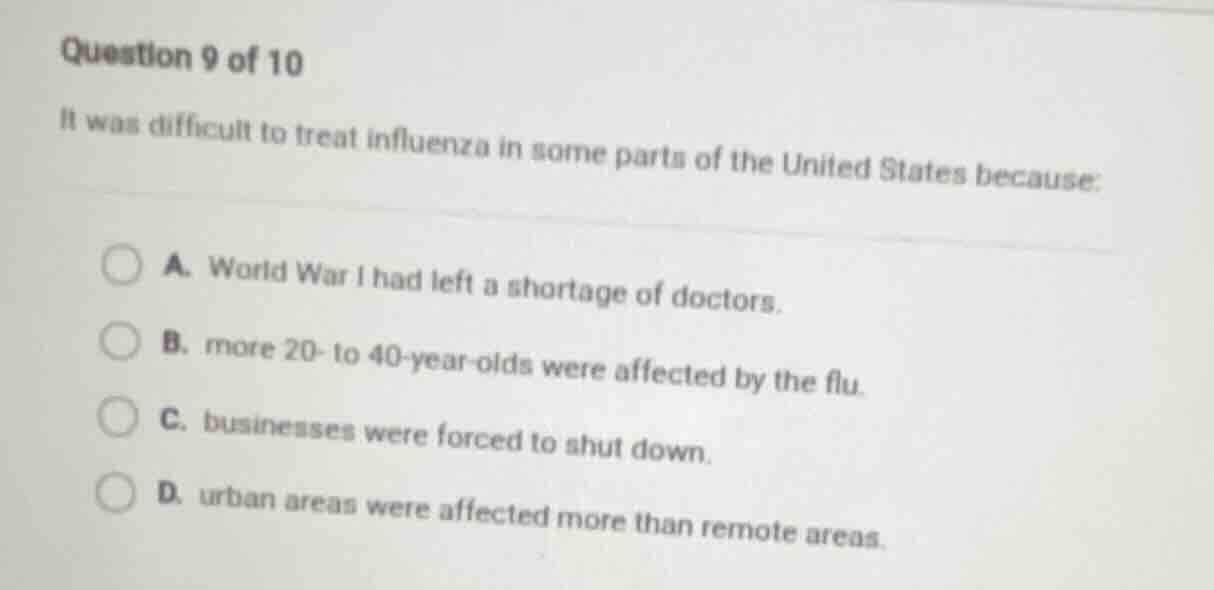
it was difficult to treat influenza in some parts of the united states because:
a. world war i had left a shortage of doctors.
b. more 20- to 40-year-olds were affected by the flu.
c. businesses were forced to shut down.
d. urban areas were affected more than remote areas.
Analyze the historical context of the 1918 influenza pandemic
The question asks why it was difficult to treat influenza in some parts of the United States during the pandemic. This outbreak occurred in 1918, overlapping directly with the final year of United States involvement in World War I.
Evaluate the impact of wartime mobilization on domestic healthcare
During World War I, the United States underwent a massive military mobilization. Under WWI Mass Mobilization, a significant percentage of the nation's medical professionals—including doctors and nurses—were drafted or volunteered to serve in the military overseas or at domestic military training camps. This mobilization left civilian communities across the country with a severe shortage of qualified healthcare workers to manage the sudden and devastating outbreak of the Spanish flu.
Assess the given multiple-choice options
- Option A (World War I had left a shortage of doctors): This directly aligns with the historical reality that military enlistment and deployment of medical personnel left civilian areas understaffed during the height of the pandemic.
- Option B (more 20- to 40-year-olds were affected by the flu): While it is a unique historical fact that the 1918 flu unusually targeted healthy young adults, this demographic characteristic of the virus itself does not explain why there was a lack of treatment resources or difficulty in administering care.
- Option C (businesses were forced to shut down): Business closures were a public health measure to prevent the spread, not the primary cause of the difficulty in treating those who were already sick.
- Option D (urban areas were affected more than remote areas): Both urban and rural areas struggled, but the geographic distribution of cases does not explain the general systemic difficulty in treating patients as directly as the lack of medical personnel.
Therefore, Option A is the most accurate explanation.

Snap & solve any problem in the app
Get step-by-step solutions on Sovi AI
Photo-based solutions with guided steps
Explore more problems and detailed explanations
- A. World War I had left a shortage of doctors. (Correct answer)
- B. more 20- to 40-year-olds were affected by the flu.
- C. businesses were forced to shut down.
- D. urban areas were affected more than remote areas.