QUESTION IMAGE
Question
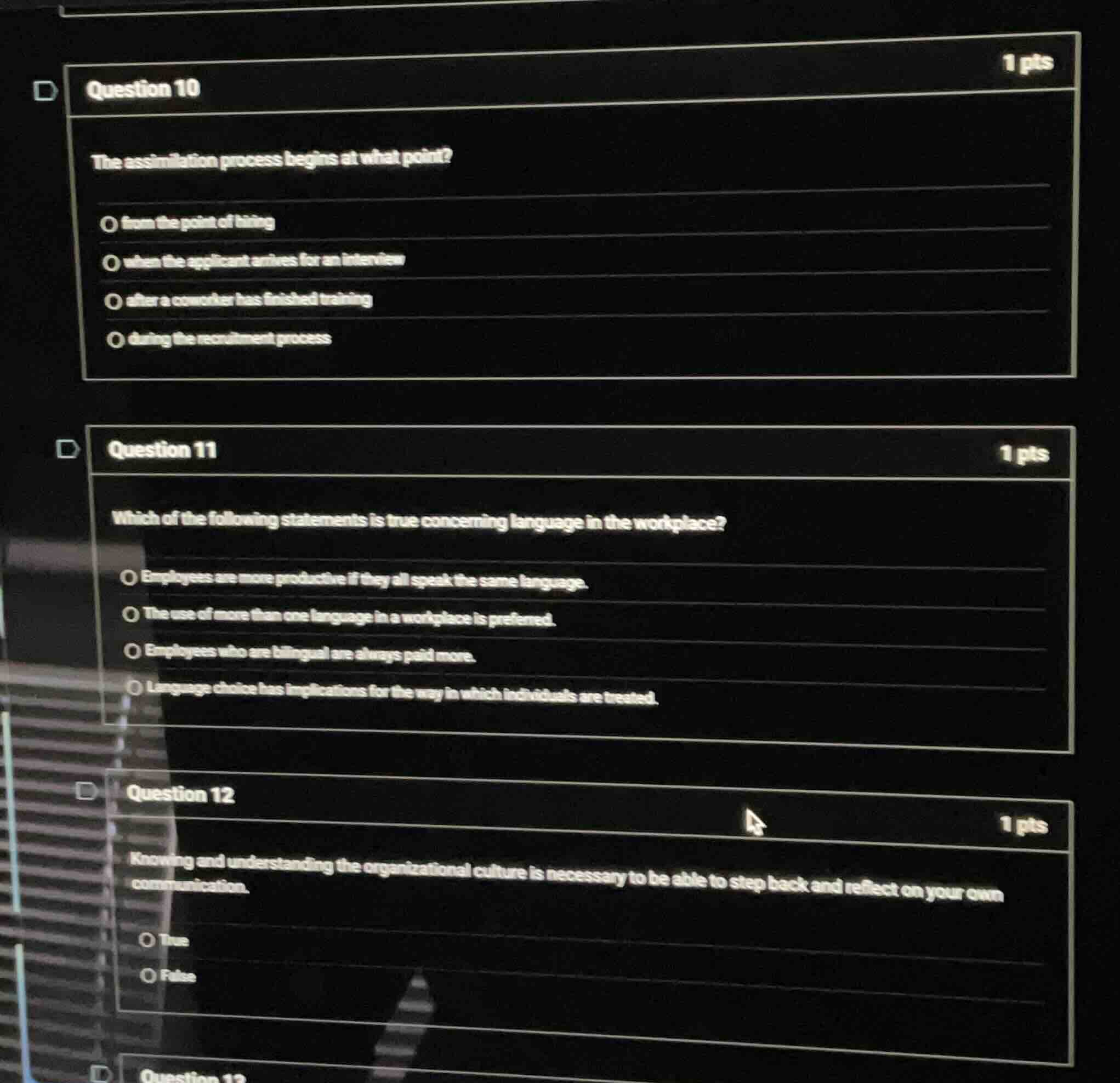
question 10
the assimilation process begins at what point?
- from the point of hiring
- when the applicant arrives for an interview
- after a coworker has finished training
- during the recruitment process
question 11
which of the following statements is true concerning language in the workplace?
- employees are more productive if they all speak the same language.
- the use of more than one language in a workplace is preferred.
- employees who are bilingual are always paid more.
- language choice has implications for the way in which individuals are treated.
question 12
knowing and understanding the organizational culture is necessary to be able to step back and reflect on your own communication.
- true
- false
Analyze Question 10
Organizational assimilation is the process by which individuals join, integrate into, and exit organizations. The very first phase is the anticipatory socialization phase, which occurs before an individual enters the organization. This phase includes learning about the work and the organization during recruitment, job fairs, and interviews. Therefore, the assimilation process begins during the recruitment process, even before hiring occurs.
Analyze Question 11
Language choice in professional environments affects power dynamics, inclusion, and interpersonal relationships. The statement "Language choice has implications for the way in which individuals are treated" is a fundamental truth in organizational communication, as linguistic bias or language policies directly impact employee experiences, inclusion, and professional evaluation. Other options make absolute or unsupported claims (e.g., "always paid more" or "always more productive").
Analyze Question 12
To engage in self-reflection and critical evaluation of one's own communication within an organization, one must understand the norms, values, and expectations that make up the organizational culture. Without this contextual knowledge, it is difficult to objectively assess how one's communication is received or how it aligns with organizational standards. Thus, knowing and understanding organizational culture is necessary for reflective communication.

Snap & solve any problem in the app
Get step-by-step solutions on Sovi AI
Photo-based solutions with guided steps
Explore more problems and detailed explanations
Question 10
- from the point of hiring
- when the applicant arrives for an interview
- after a coworker has finished training
- during the recruitment process (Correct answer)
Question 11
- Employees are more productive if they all speak the same language.
- The use of more than one language in a workplace is preferred.
- Employees who are bilingual are always paid more.
- Language choice has implications for the way in which individuals are treated. (Correct answer)
Question 12
- True (Correct answer)
- False