QUESTION IMAGE
Question
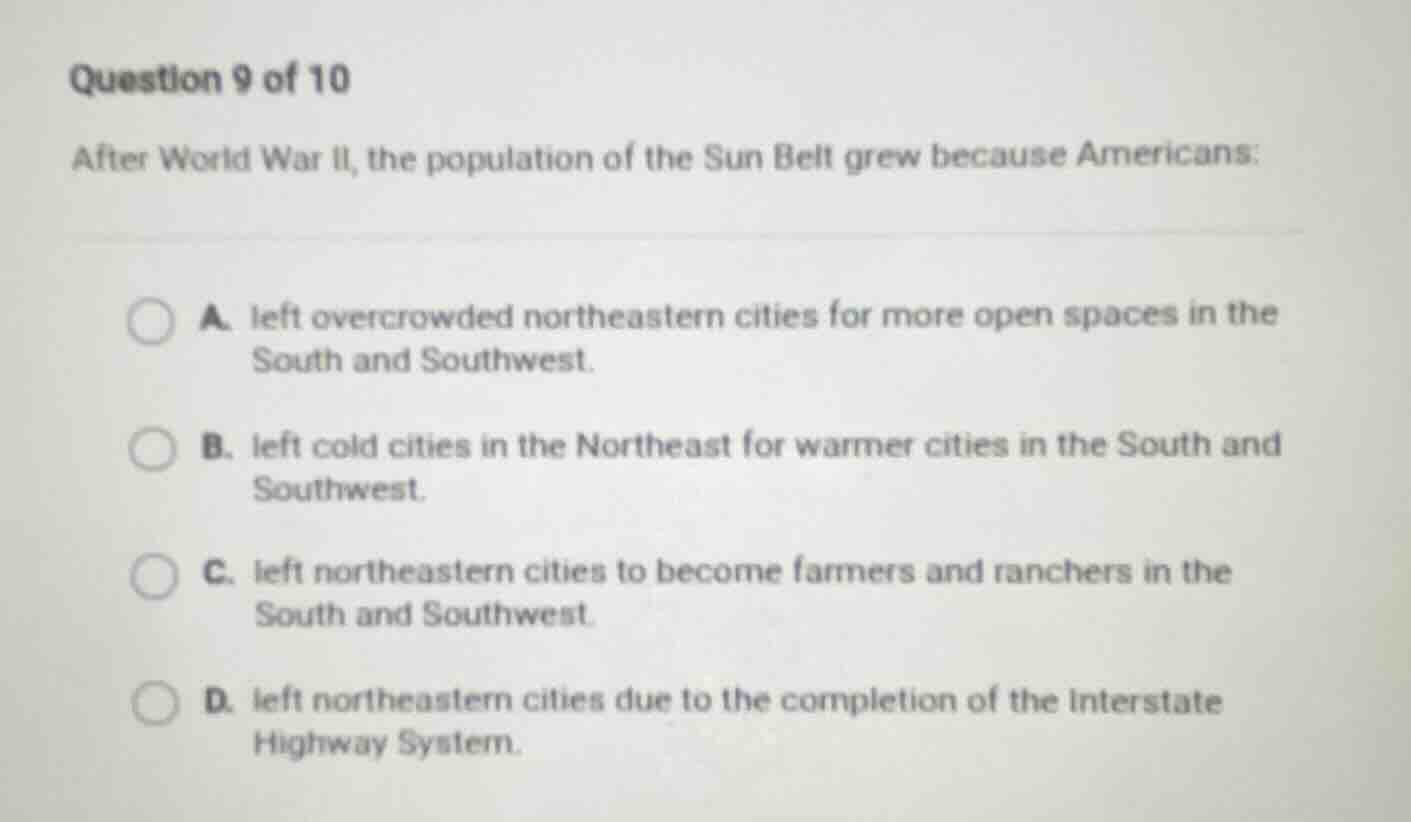
question 9 of 10
after world war ii, the population of the sun belt grew because americans:
a. left overcrowded northeastern cities for more open spaces in the south and southwest.
b. left cold cities in the northeast for warmer cities in the south and southwest.
c. left northeastern cities to become farmers and ranchers in the south and southwest.
d. left northeastern cities due to the completion of the interstate highway system.
Analyze the historical context of postwar migration
Following World War II, the United States experienced a massive demographic shift. Millions of Americans migrated from the colder, older industrial cities of the Northeast and Midwest (often called the Frost Belt or Rust Belt) to the South and Southwest, a region known as the Sun Belt.
Evaluate the primary drivers of Sun Belt growth
The primary pull factors for this migration included a warmer climate, lower cost of living, the widespread availability of home air conditioning, and a booming postwar economy driven by defense industries, aerospace, and technology jobs.
Assess the provided multiple-choice options
- Option A suggests Americans left for "more open spaces." While suburbanization occurred, the migration to the Sun Belt was primarily urban and suburban, centered around growing metropolitan areas rather than a search for rural open spaces.
- Option B states that Americans "left cold cities in the Northeast for warmer cities in the South and Southwest." This directly addresses the climatic appeal of the Sun Belt, which, combined with economic opportunities, was a major driver of this regional shift.
- Option C suggests they left to become "farmers and ranchers." Postwar migration was characterized by industrial, service, and technology-sector employment, not a return to agriculture.
- Option D attributes the migration to the completion of the Interstate Highway System. While the Interstate Highway System facilitated travel and suburban growth, its construction began in the late 1950s and took decades to complete; it was a facilitating factor rather than the primary reason why people chose to relocate to the Sun Belt.
Determine the best fit
Option B most accurately and directly summarizes the broad regional appeal (escaping the cold Northeast for the warmer climate of the South and Southwest) that characterized the Sun Belt migration.

Snap & solve any problem in the app
Get step-by-step solutions on Sovi AI
Photo-based solutions with guided steps
Explore more problems and detailed explanations
- (A) left overcrowded northeastern cities for more open spaces in the South and Southwest.
- (B) left cold cities in the Northeast for warmer cities in the South and Southwest. (Correct answer)
- (C) left northeastern cities to become farmers and ranchers in the South and Southwest.
- (D) left northeastern cities due to the completion of the Interstate Highway System.