QUESTION IMAGE
Question
question 1 of 10
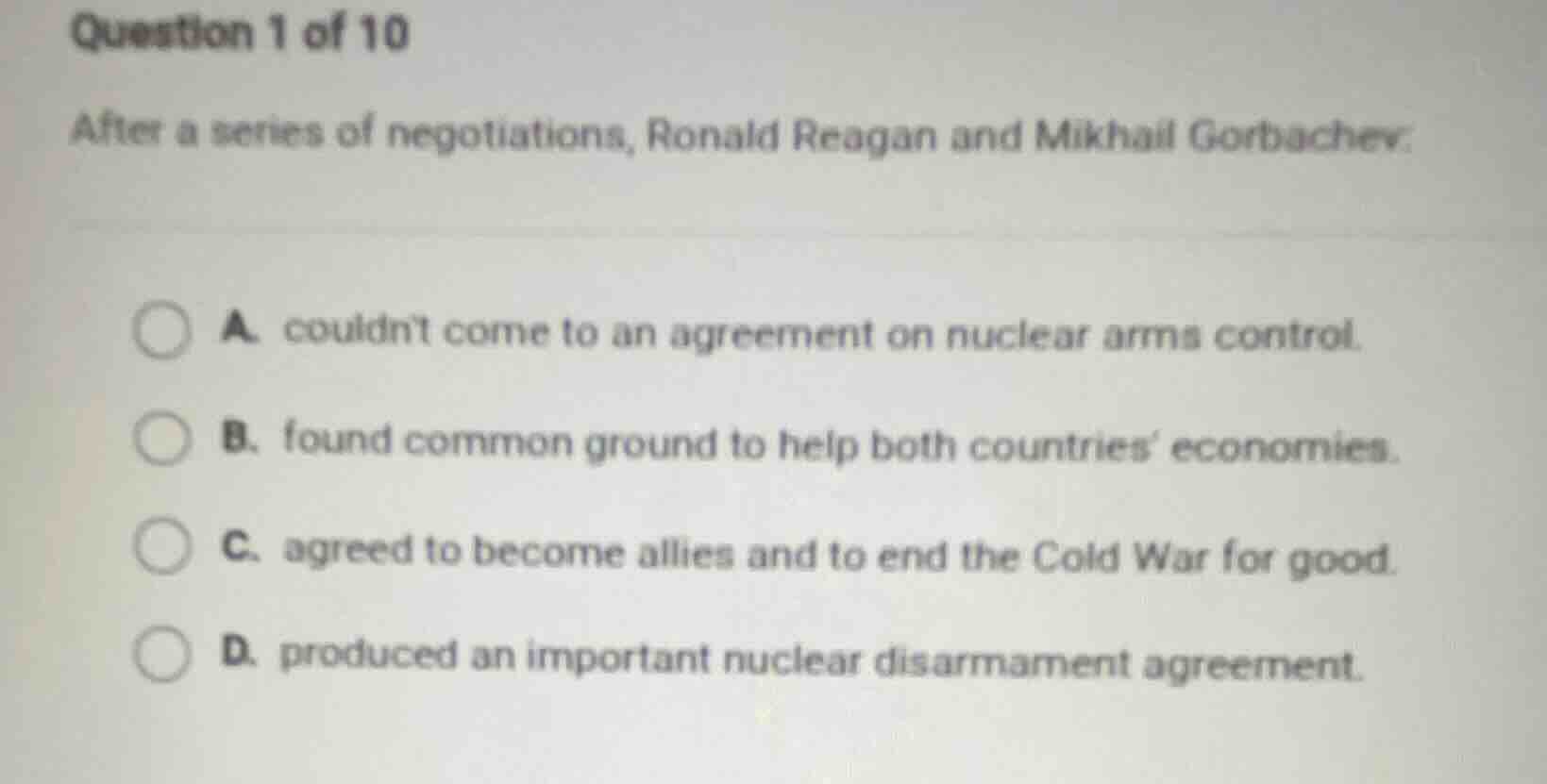
after a series of negotiations, ronald reagan and mikhail gorbachev:
a. couldnt come to an agreement on nuclear arms control.
b. found common ground to help both countries economies.
c. agreed to become allies and to end the cold war for good.
d. produced an important nuclear disarmament agreement.
Analyze the historical context
Using the Reagan Foreign Policy and Gorbachev Reforms knowledge points
During the mid-to-late 1980s, US President Ronald Reagan and Soviet General Secretary Mikhail Gorbachev held a series of historic summit meetings (including Geneva, Reykjavik, Washington, and Moscow) to discuss diplomatic relations and military build-ups.
Evaluate the diplomatic outcomes
Using the Reagan Foreign Policy knowledge point
These summits culminated in the signing of the Intermediate-Range Nuclear Forces (INF) Treaty in 1987. This landmark treaty eliminated an entire class of nuclear weapons (all land-based missiles with ranges of 500 to 5,500 kilometers), representing a major breakthrough in nuclear disarmament rather than just arms limitation.
Assess the incorrect options
Using the Reagan Foreign Policy knowledge point
- Option A is incorrect because they did reach a major agreement (the INF Treaty).
- Option B is incorrect because their negotiations focused primarily on security, arms reduction, and geopolitical issues rather than mutual economic integration.
- Option C is incorrect because they did not formally become allies, nor did they completely end the Cold War during Reagan's presidency (the Soviet Union dissolved later in 1991).

Snap & solve any problem in the app
Get step-by-step solutions on Sovi AI
Photo-based solutions with guided steps
Explore more problems and detailed explanations
- (A) couldn't come to an agreement on nuclear arms control.
- (B) found common ground to help both countries' economies.
- (C) agreed to become allies and to end the Cold War for good.
- (D) produced an important nuclear disarmament agreement. (Correct answer)