QUESTION IMAGE
Question
question 10 of 10
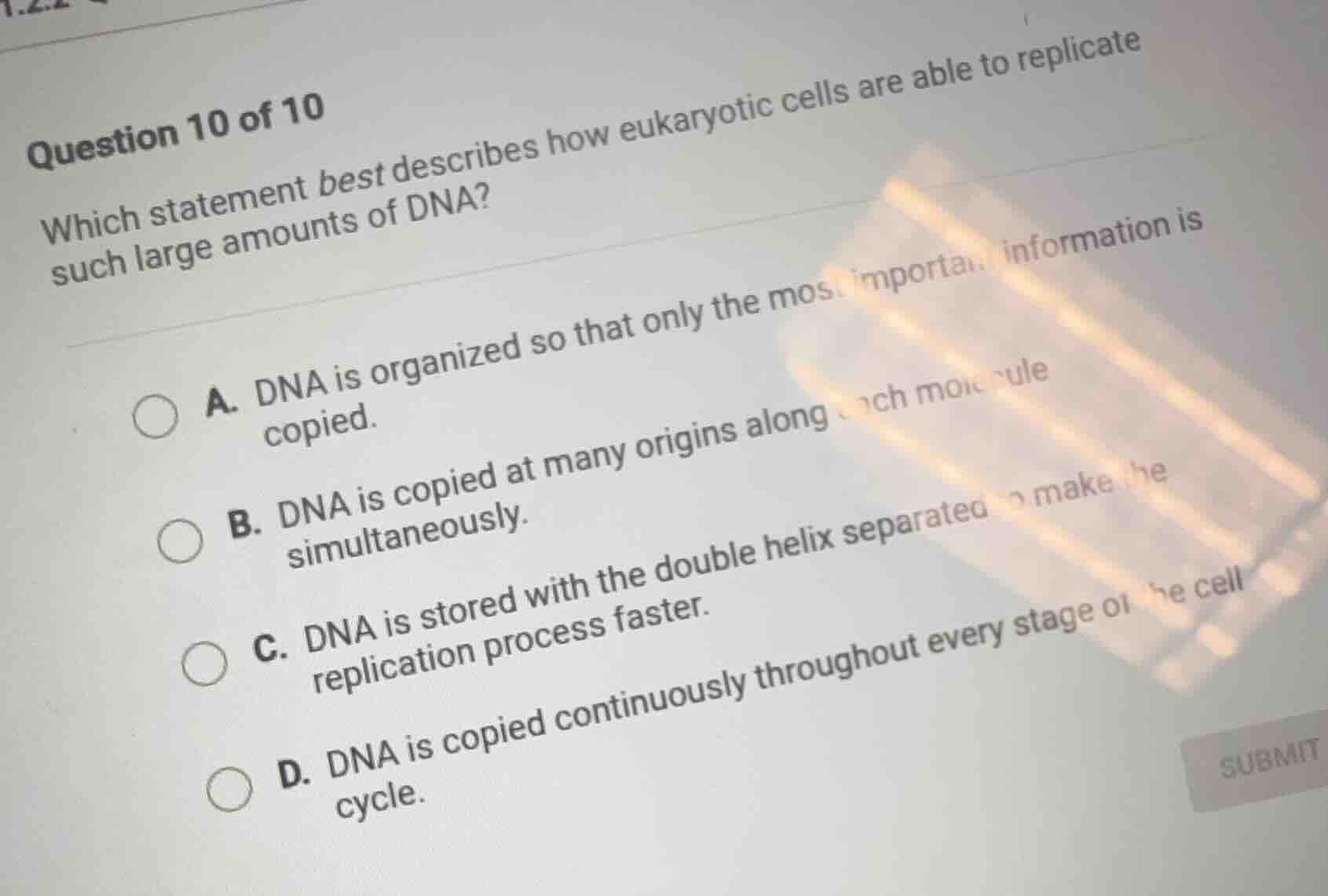
which statement best describes how eukaryotic cells are able to replicate such large amounts of dna?
a. dna is organized so that only the most important information is copied.
b. dna is copied at many origins along each molecule simultaneously.
c. dna is stored with the double helix separated to make the replication process faster.
d. dna is copied continuously throughout every stage of the cell cycle.
<pre_analysis>
{
"quality": "clear",
"question_count": 1,
"skills_matched": [
"direct_cot",
"multiple_choice_formatter",
"explain_then_answer",
"tutor"
],
"needs_drawing": false,
"concepts_used": [
"DNA Replication Purpose",
"DNA Replication Stages"
],
"new_concepts": [
"Eukaryotic DNA Replication",
"Origins of Replication"
],
"current_concepts": [
"DNA Replication Purpose",
"DNA Replication Stages",
"Eukaryotic DNA Replication",
"Origins of Replication"
]
}
</pre_analysis>
<reasoning>
Analyze the biological challenge
Eukaryotic genomes are extremely large and linear compared to smaller, circular prokaryotic genomes. Replicating billions of base pairs in a reasonable timeframe requires a highly efficient mechanism, as a single replication fork moving from one end to the other would take weeks to complete.
Evaluate the replication mechanism
To solve this speed constraint, eukaryotic cells initiate replication at multiple points along each chromosome. This process uses the DNA Replication Stages concept, specifically the initiation stage, where replication bubbles form at thousands of sites simultaneously.
Assess the given options
- Option A suggests only important information is copied. This is incorrect because the entire genome must be copied during the DNA Replication Purpose phase to ensure daughter cells receive complete genetic information.
- Option B states DNA is copied at many origins along each molecule simultaneously. This directly addresses how large volumes of DNA are replicated quickly in eukaryotes.
- Option C suggests DNA is stored with the double helix separated. This is incorrect; DNA is stored as a tightly wound double helix and only unwound locally during replication.
- Option D suggests DNA is copied continuously throughout every stage of the cell cycle. This is incorrect because replication is restricted to the S phase of interphase.
Select the correct statement
Option B is the only scientifically accurate statement that explains how eukaryotic cells manage to replicate such vast amounts of DNA efficiently.
</reasoning>
<answer>
<mcq-option>(A) DNA is organized so that only the most important information is copied.</mcq-option>
<mcq-correct>(B) DNA is copied at many origins along each molecule simultaneously.</mcq-correct>
<mcq-option>(C) DNA is stored with the double helix separated to make the replication process faster.</mcq-option>
<mcq-option>(D) DNA is copied continuously throughout every stage of the cell cycle.</mcq-option>
</answer>
<post_analysis>
{
"subject": "Natural Science",
"question_type": "Multiple Choice",
"knowledge_point": [
"Natural Science",
"Biology",
"DNA Replication"
]
}
</post_analysis>
Snap & solve any problem in the app
Get step-by-step solutions on Sovi AI
Photo-based solutions with guided steps
Explore more problems and detailed explanations
<pre_analysis>
{
"quality": "clear",
"question_count": 1,
"skills_matched": [
"direct_cot",
"multiple_choice_formatter",
"explain_then_answer",
"tutor"
],
"needs_drawing": false,
"concepts_used": [
"DNA Replication Purpose",
"DNA Replication Stages"
],
"new_concepts": [
"Eukaryotic DNA Replication",
"Origins of Replication"
],
"current_concepts": [
"DNA Replication Purpose",
"DNA Replication Stages",
"Eukaryotic DNA Replication",
"Origins of Replication"
]
}
</pre_analysis>
<reasoning>
Analyze the biological challenge
Eukaryotic genomes are extremely large and linear compared to smaller, circular prokaryotic genomes. Replicating billions of base pairs in a reasonable timeframe requires a highly efficient mechanism, as a single replication fork moving from one end to the other would take weeks to complete.
Evaluate the replication mechanism
To solve this speed constraint, eukaryotic cells initiate replication at multiple points along each chromosome. This process uses the DNA Replication Stages concept, specifically the initiation stage, where replication bubbles form at thousands of sites simultaneously.
Assess the given options
- Option A suggests only important information is copied. This is incorrect because the entire genome must be copied during the DNA Replication Purpose phase to ensure daughter cells receive complete genetic information.
- Option B states DNA is copied at many origins along each molecule simultaneously. This directly addresses how large volumes of DNA are replicated quickly in eukaryotes.
- Option C suggests DNA is stored with the double helix separated. This is incorrect; DNA is stored as a tightly wound double helix and only unwound locally during replication.
- Option D suggests DNA is copied continuously throughout every stage of the cell cycle. This is incorrect because replication is restricted to the S phase of interphase.
Select the correct statement
Option B is the only scientifically accurate statement that explains how eukaryotic cells manage to replicate such vast amounts of DNA efficiently.
</reasoning>
<answer>
<mcq-option>(A) DNA is organized so that only the most important information is copied.</mcq-option>
<mcq-correct>(B) DNA is copied at many origins along each molecule simultaneously.</mcq-correct>
<mcq-option>(C) DNA is stored with the double helix separated to make the replication process faster.</mcq-option>
<mcq-option>(D) DNA is copied continuously throughout every stage of the cell cycle.</mcq-option>
</answer>
<post_analysis>
{
"subject": "Natural Science",
"question_type": "Multiple Choice",
"knowledge_point": [
"Natural Science",
"Biology",
"DNA Replication"
]
}
</post_analysis>