QUESTION IMAGE
Question
question 1-12
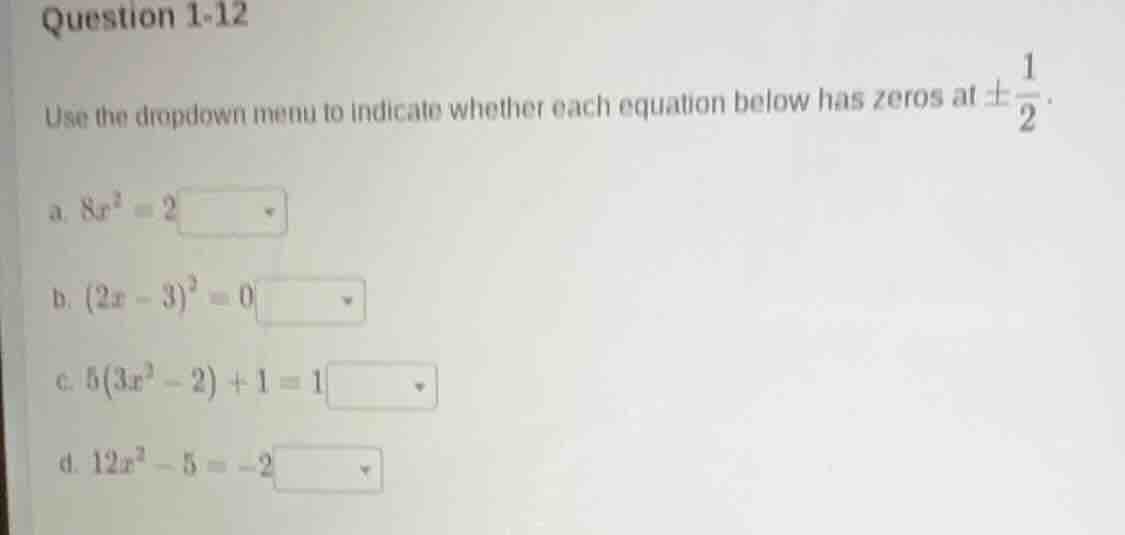
use the dropdown menu to indicate whether each equation below has zeros at \\(\pm \frac{1}{2}\\).
a. \\(8x^2 = 2\\)
b. \\((2x - 3)^2 = 0\\)
c. \\(5(3x^2 - 2) + 1 = 1\\)
d. \\(12x^2 - 5 = -2\\)
Part a: \( 8x^2 = 2 \)
Step 1: Solve for \( x^2 \)
Divide both sides by 8: \( x^2=\frac{2}{8}=\frac{1}{4} \)
Step 2: Solve for \( x \)
Take square roots: \( x = \pm\sqrt{\frac{1}{4}}=\pm\frac{1}{2} \)
So, this equation has zeros at \( \pm\frac{1}{2} \).
Part b: \( (2x - 3)^2 = 0 \)
Step 1: Take square root
\( 2x - 3 = 0 \) (since square of 0 is 0)
Step 2: Solve for \( x \)
\( 2x=3 \Rightarrow x=\frac{3}{2} \)
This is a single root \( \frac{3}{2} \), not \( \pm\frac{1}{2} \).
Part c: \( 5(3x^2 - 2)+1 = 1 \)
Step 1: Simplify equation
Subtract 1: \( 5(3x^2 - 2)=0 \)
Divide by 5: \( 3x^2 - 2 = 0 \)
Step 2: Solve for \( x^2 \)
\( 3x^2=2 \Rightarrow x^2=\frac{2}{3} \)
Step 3: Solve for \( x \)
\( x=\pm\sqrt{\frac{2}{3}}
eq\pm\frac{1}{2} \)
So, no.
Part d: \( 12x^2 - 5 = -2 \)

Snap & solve any problem in the app
Get step-by-step solutions on Sovi AI
Photo-based solutions with guided steps
Explore more problems and detailed explanations
s:
a. Yes (has zeros at \( \pm\frac{1}{2} \))
b. No (does not have zeros at \( \pm\frac{1}{2} \))
c. No (does not have zeros at \( \pm\frac{1}{2} \))
d. Yes (has zeros at \( \pm\frac{1}{2} \))