QUESTION IMAGE
Question
proving triangles similar using aa and proving triangles similar using sas pre
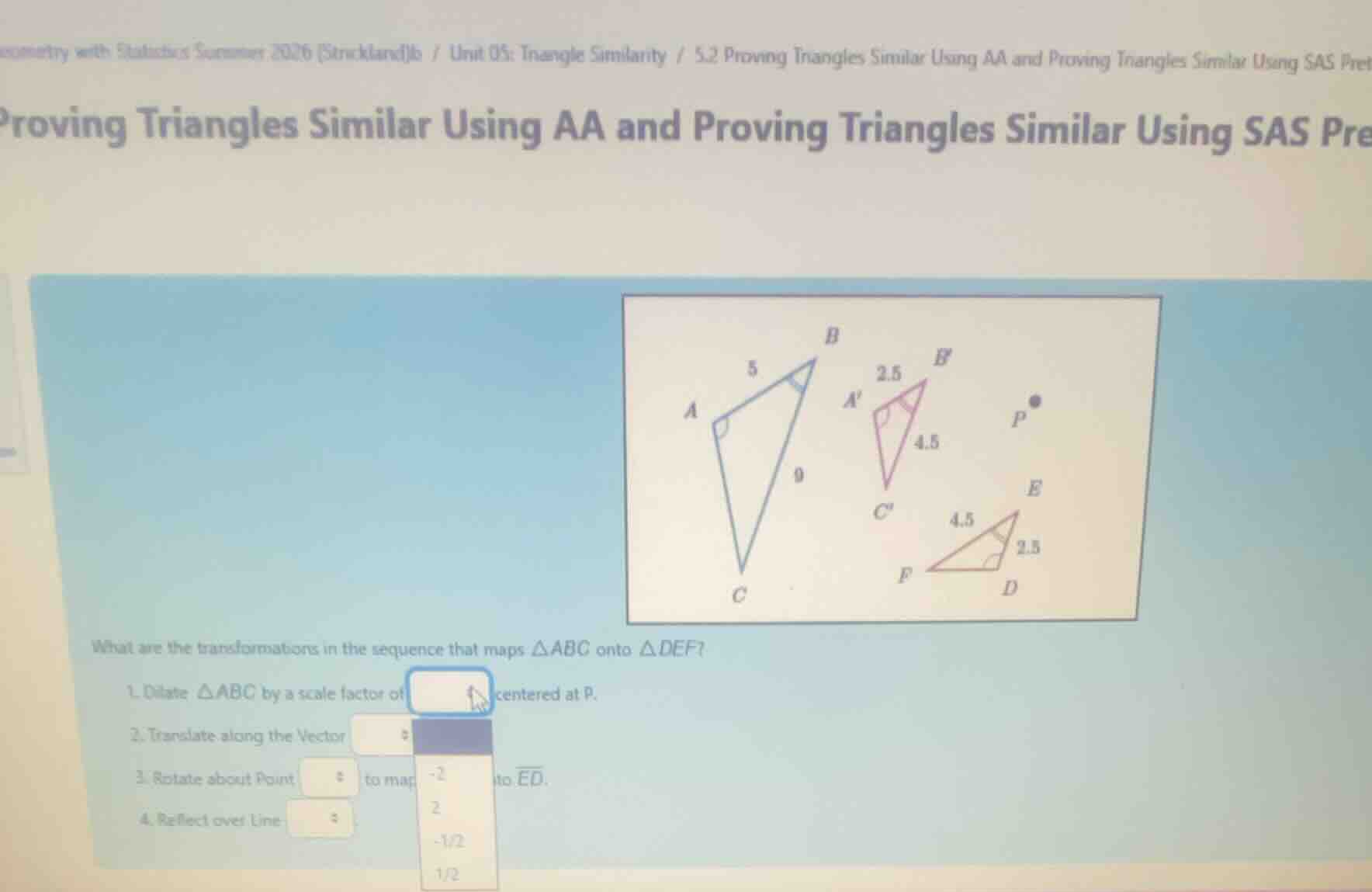
what are the transformations in the sequence that maps \\(\delta abc\\) onto \\(\delta def\\)?
- dilate \\(\delta abc\\) by a scale factor of centered at p.
- translate along the vector
- rotate about point to map to \\(\overline{ed}\\).
- reflect over line
🆕 New Concept Discovered: Similarity Transformations
Mapping figures using dilations and rigid motions.
Step 1: Find the scale factor of dilation
To find the scale factor \( k \) that maps \(\Delta ABC\) onto \(\Delta DEF\), we compare the corresponding side lengths of the original triangle \(\Delta ABC\) and the intermediate dilated triangle \(\Delta A'B'C'\) (which is centered at \(P\)).
Looking at the given side lengths:
- Side \(AB = 5\) corresponds to side \(A'B' = 2.5\).
- Side \(BC = 9\) corresponds to side \(B'C' = 4.5\).
Calculate the scale factor \( k \):
Step 2: Identify the remaining transformations
Once \(\Delta ABC\) is dilated by a scale factor of \(\frac{1}{2}\) centered at \(P\), it becomes \(\Delta A'B'C'\). Now we need to map \(\Delta A'B'C'\) onto \(\Delta DEF\):
- Translate: Move \(\Delta A'B'C'\) so that a vertex aligns with \(\Delta DEF\). Specifically, we translate along the vector from \(C'\) to \(F\) (or another corresponding pair of vertices).
- Rotate: Rotate the translated triangle about a point (such as the newly aligned vertex) to align the direction of the sides, mapping the segment corresponding to \(A'B'\) onto \(ED\).
- Reflect: Reflect across the line containing that aligned segment to perfectly match the orientation of \(\Delta DEF\).

Snap & solve any problem in the app
Get step-by-step solutions on Sovi AI
Photo-based solutions with guided steps
Explore more problems and detailed explanations
- Dilate \(\Delta ABC\) by a scale factor of \(1/2\) centered at \(P\).