QUESTION IMAGE
Question
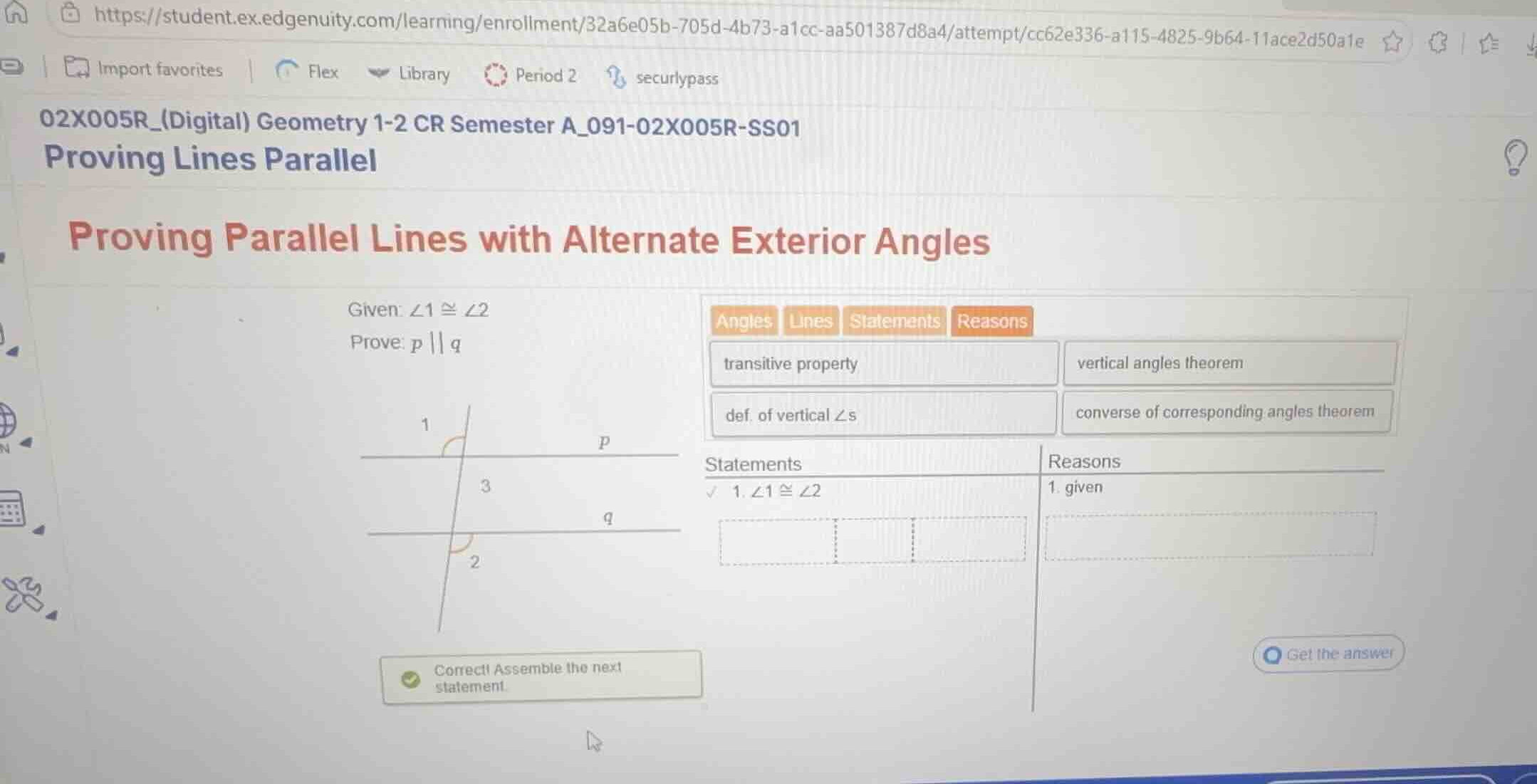
proving parallel lines with alternate exterior angles
given: \\(\angle 1 \cong \angle 2\\)
prove: \\(p \parallel q\\)
angles lines statements reasons
transitive property
vertical angles theorem
def. of vertical \\(\angle\\)s
converse of corresponding angles theorem
statements
- \\(\angle 1 \cong \angle 2\\)
reasons
- given
Identify the geometric relationships
We are given a geometric proof with:
- Given: \(\angle 1 \cong \angle 2\)
- Prove: \(p \parallel q\)
Looking at the diagram:
- \(\angle 1\) and \(\angle 3\) are vertical angles formed by the intersection of line \(p\) and the transversal.
- Therefore, \(\angle 1 \cong \angle 3\) by the Vertical Angles Theorem.
Determine the next logical step
The first statement is:
- \(\angle 1 \cong \angle 2\) (Reason: Given)
To connect \(\angle 2\) and \(\angle 3\), we first establish the relationship between \(\angle 1\) and \(\angle 3\):
- \(\angle 1 \cong \angle 3\) (Reason: vertical angles theorem)
Apply the transitive property
Once we have \(\angle 1 \cong \angle 2\) and \(\angle 1 \cong \angle 3\), we can conclude:
- \(\angle 3 \cong \angle 2\) (Reason: transitive property)
Complete the parallel lines proof
Since \(\angle 3\) and \(\angle 2\) are corresponding angles and they are congruent, we can prove:
- \(p \parallel q\) (Reason: converse of corresponding angles theorem)
Formulate the requested next statement
The prompt asks to "Assemble the next statement" (Statement 2).
The next logical statement is:
- Statement: \(\angle 1 \cong \angle 3\)
- Reason: vertical angles theorem
In the interactive interface, the statement boxes are split into three slots for the statement components:
- Left slot: \(\angle 1\)
- Middle slot: \(\cong\)
- Right slot: \(\angle 3\)
And the corresponding reason is:
- vertical angles theorem

Snap & solve any problem in the app
Get step-by-step solutions on Sovi AI
Photo-based solutions with guided steps
Explore more problems and detailed explanations
The next statement and reason to assemble in the proof are:
Statements: <blank>\(\angle 1 \cong \angle 3\)</blank>
Reasons: <blank>vertical angles theorem</blank>