QUESTION IMAGE
Question
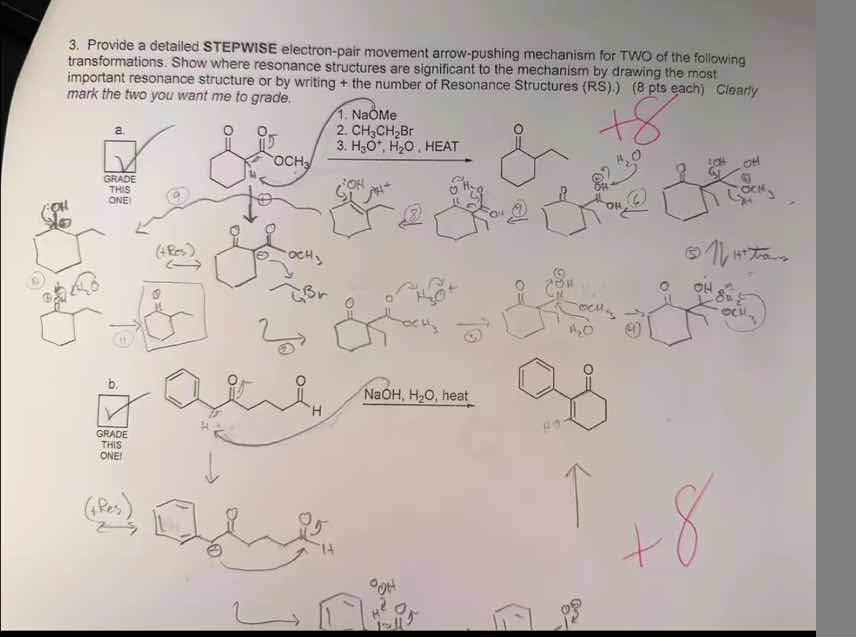
- provide a detailed stepwise electron-pair movement arrow-pushing mechanism for two of the following transformations. show where resonance structures are significant to the mechanism by drawing the most important resonance structure or by writing + the number of resonance structures (rs).) (8 pts each) clearly mark the two you want me to grade.
a.
- naome
- ch3ch2br
- h3o+, h2o, heat
b.
naoh, h2o, heat
Analyze reaction (a)
The starting material is methyl 2-oxocyclohexanecarboxylate, a $\beta$-keto ester.
- Deprotonation: Sodium methoxide ($\text{NaOMe}$) deprotonates the highly acidic $\alpha$-carbon between the two carbonyl groups to form a resonance-stabilized enolate.
- Alkylation: The enolate acts as a nucleophile in an $\text{S}_\text{N}2$ reaction, attacking ethyl bromide ($\text{CH}_3\text{CH}_2\text{Br}$) to attach an ethyl group at the $\alpha$-position.
- Hydrolysis: Aqueous acid ($\text{H}_3\text{O}^+$) hydrolyzes the methyl ester into a carboxylic acid.
- Decarboxylation: Heating the resulting $\beta$-keto acid promotes decarboxylation via a cyclic 6-membered transition state, yielding 2-ethylcyclohexanone after tautomerization.
Analyze reaction (b)
The starting material is 7-phenylheptane-2,6-dione (an unsymmetrical dicarbonyl compound).
- Deprotonation: Sodium hydroxide ($\text{NaOH}$) deprotonates the $\alpha$-carbon at $\text{C5}$ (adjacent to the $\text{C6}$ carbonyl) to form a nucleophilic enolate. Deprotonation at this position is favored because it allows for a stable 6-membered ring closure.
- Intramolecular Aldol Addition: The enolate carbon ($\text{C5}$) attacks the carbonyl carbon ($\text{C2}$), forming a 6-membered ring intermediate with an alkoxide at $\text{C2}$.
- Proton Transfer: The alkoxide is protonated by water to yield a $\beta$-hydroxy ketone.
- Dehydration (Condensation): Under heating conditions, base-catalyzed dehydration ($\text{E1cB}$ mechanism) occurs, eliminating water to form the conjugated $\alpha,\beta$-unsaturated ketone: 3-methyl-2-phenylcyclohex-2-en-1-one (or the corresponding phenyl-substituted cyclohexenone derivative shown in the product).
Formulate step-by-step mechanism for (a)
- Enolate Formation:
The negative charge is delocalized over both carbonyl oxygens (3 major resonance structures).
- Alkylation:
- Ester Hydrolysis:
- Decarboxylation:
Heating drives the loss of $\text{CO}_2$ through a cyclic transition state to form the enol, which tautomerizes to 2-ethylcyclohexanone.
Formulate step-by-step mechanism for (b)
- Enolate Formation:
- Intramolecular Attack:
The enolate carbon attacks the aldehyde carbonyl to form a 6-membered ring:
- Protonation:
The alkoxide abstracts a proton from water to form the aldol addition product ($\beta$-hydroxy ketone).
- Dehydration:
Hydroxide deprotonates the remaining $…

Snap & solve any problem in the app
Get step-by-step solutions on Sovi AI
Photo-based solutions with guided steps
Explore more problems and detailed explanations
Question 1: Mechanism for Transformation (a)
The transformation of methyl 2-oxocyclohexanecarboxylate to 2-ethylcyclohexanone proceeds via alkylation followed by ester hydrolysis and decarboxylation:
- Deprotonation:
The strong base methoxide ($\text{NaOMe}$) deprotonates the highly acidic $\alpha$-carbon between the two carbonyl groups:
(The negative charge is shared via resonance with both the ketone and ester carbonyl oxygens, giving 3 major resonance structures).
- Alkylation ($\text{S}_\text{N}2$):
The nucleophilic enolate carbon attacks ethyl bromide ($\text{CH}_3\text{CH}_2\text{Br}$), displacing the bromide leaving group:
- Acid-Catalyzed Hydrolysis:
Aqueous acid ($\text{H}_3\text{O}^+$) hydrolyzes the methyl ester group into a carboxylic acid:
- Decarboxylation:
Under heating conditions, the $\beta$-keto acid undergoes thermal decarboxylation via a cyclic six-membered transition state, releasing carbon dioxide ($\text{CO}_2$) to yield an enol intermediate, which rapidly tautomerizes to the stable ketone product:
---
Question 2: Mechanism for Transformation (b)
The intramolecular aldol condensation of the dicarbonyl compound to form the cyclic enone proceeds as follows:
- Enolate Formation:
Hydroxide ($\text{OH}^-$) deprotonates the $\alpha$-carbon at the position that allows for a stable 6-membered ring closure:
- Intramolecular Nucleophilic Attack:
The nucleophilic enolate carbon attacks the internal carbonyl group, closing the ring to form a cyclic alkoxide intermediate:
- Protonation:
The alkoxide intermediate abstracts a proton from water to form the neutral $\beta$-hydroxy ketone:
- Base-Catalyzed Dehydration ($\text{E1cB}$):
Hydroxide deprotonates the acidic $\alpha$-proton adjacent to the carbonyl, followed by the elimination of the hydroxide leaving group under heat to yield the conjugated $\alpha,\beta$-unsaturated ketone: