QUESTION IMAGE
Question
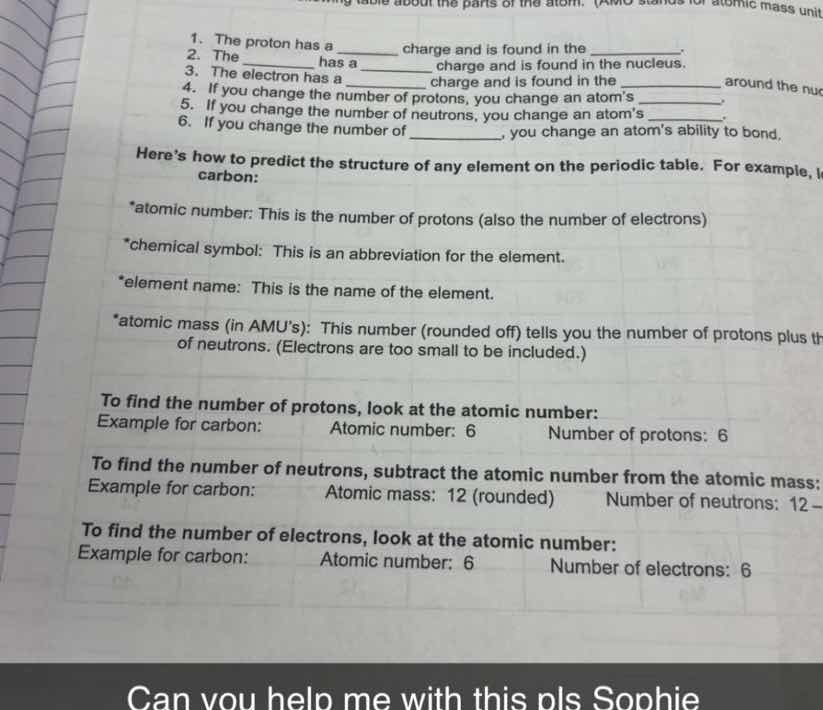
- the proton has a ______ charge and is found in the ______.
- the ______ has a ______ charge and is found in the nucleus.
- the electron has a ______ charge and is found in the ______ around the nucleus.
- if you change the number of protons, you change an atoms ________.
- if you change the number of neutrons, you change an atoms ________.
- if you change the number of ________, you change an atoms ability to bond.
Identify subatomic properties
Protons are positively charged subatomic particles located inside the nucleus of an atom.
Identify neutron properties
Neutrons are neutral subatomic particles (no charge) located inside the nucleus of an atom.
Identify electron properties
Electrons are negatively charged subatomic particles located in the electron cloud (or shells/orbitals) surrounding the nucleus.
Analyze changes in protons and neutrons
Changing the number of protons changes the atomic number, which defines the element's identity. Changing the number of neutrons changes the mass number, creating different isotopes of the element.
Analyze changes in electrons
Changing the number of electrons alters the net charge, creating ions, and directly affects the atom's chemical reactivity and ability to form chemical bonds.

Snap & solve any problem in the app
Get step-by-step solutions on Sovi AI
Photo-based solutions with guided steps
Explore more problems and detailed explanations
Question 1
- The proton has a <blank>positive</blank> charge and is found in the <blank>nucleus</blank>.
Question 2
- The <blank>neutron</blank> has a <blank>neutral (or zero)</blank> charge and is found in the nucleus.
Question 3
- The electron has a <blank>negative</blank> charge and is found in the <blank>electron cloud (or shells)</blank> around the nucleus.
Question 4
- If you change the number of protons, you change an atom's <blank>identity (or element)</blank>.
Question 5
- If you change the number of neutrons, you change an atom's <blank>mass (or isotope)</blank>.
Question 6
- If you change the number of <blank>electrons</blank>, you change an atom's ability to bond.