QUESTION IMAGE
Question
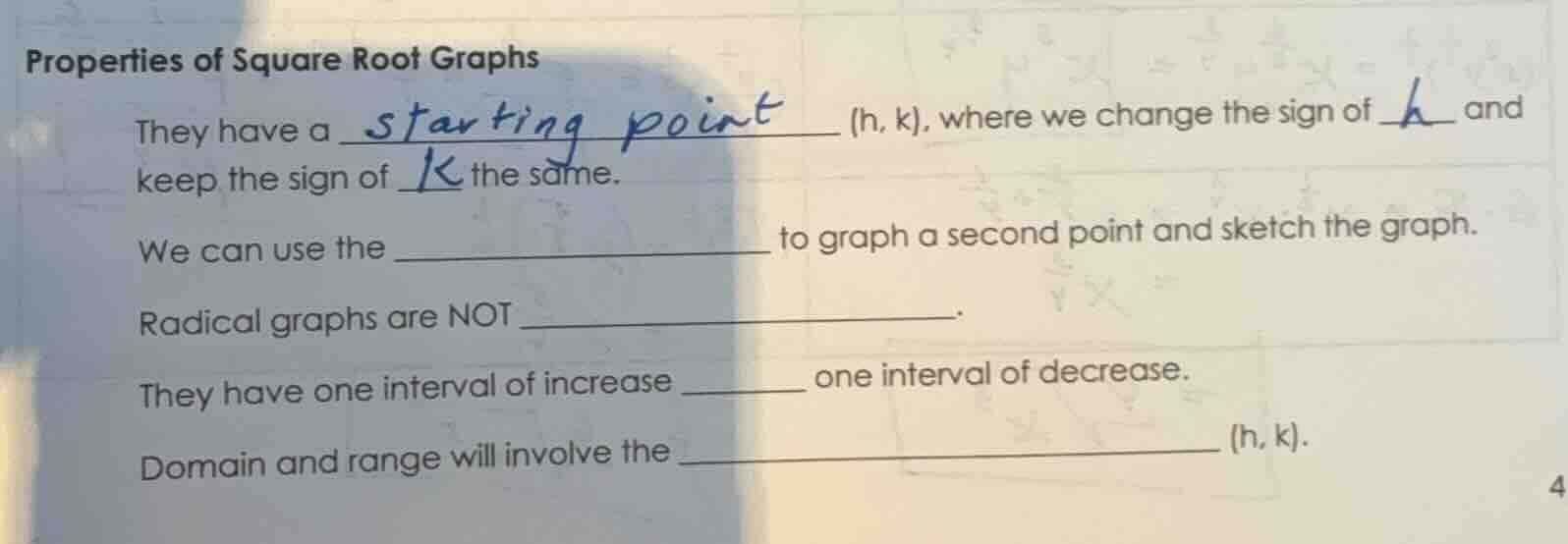
properties of square root graphs
they have a starting point \\((h, k)\\), where we change the sign of \\(h\\) and keep the sign of \\(k\\) the same.
we can use the \underline{\qquad\qquad\qquad\qquad\qquad\qquad} to graph a second point and sketch the graph.
radical graphs are not \underline{\qquad\qquad\qquad\qquad\qquad\qquad}.
they have one interval of increase \underline{\qquad\qquad\qquad} one interval of decrease.
domain and range will involve the \underline{\qquad\qquad\qquad\qquad\qquad\qquad} \\((h, k)\\).
🆕 New Concept Discovered: Graphing Square Root Functions
Analyzing key features, starting points, and behaviors of radical curves.
Step 1: Analyze the second statement
The statement is: "We can use the \_\_\_\_\_\_\_\_\_\_\_\_\_\_\_\_\_\_\_\_\_ to graph a second point and sketch the graph."
For a standard square root function in the form \( y = a\sqrt{x - h} + k \), the value of \( a \) acts as a vertical stretch, compression, or reflection factor. Starting from the vertex/starting point \( (h, k) \), moving \( 1 \) unit to the right results in a vertical change of \( a \) units. This vertical scaling factor is often referred to as the stretch factor (or vertical stretch/compression, or simply \( a \)-value).
- Filled blank: stretch factor (or \( a \)-value)
---
Step 2: Analyze the third statement
The statement is: "Radical graphs are NOT \_\_\_\_\_\_\_\_\_\_\_\_\_\_\_\_\_\_\_\_\_."
Unlike linear equations, quadratic parabolas, or absolute value graphs, square root graphs do not have a straight-line path, nor do they have symmetry across a vertical axis. Most importantly, they are curves that only go in one direction from their starting point, meaning they are not symmetric, or they are not straight lines. In the context of introductory algebra curriculum, this blank typically highlights that they are not linear or not symmetric. Given the contrast with other conic sections or polynomials, linear or symmetric are the standard terms.
- Filled blank: linear (or symmetric)
---
Step 3: Analyze the fourth statement
The statement is: "They have one interval of increase \_\_\_\_\_\_\_\_\_\_ one interval of decrease."
A square root function of the form \( y = a\sqrt{x-h} + k \) is either strictly increasing (if \( a > 0 \)) or strictly decreasing (if \( a < 0 \)) over its domain. It cannot do both. Therefore, it has one interval of increase or one interval of decrease.
- Filled blank: or
---
Step 4: Analyze the fifth statement
The statement is: "Domain and range will involve the \_\_\_\_\_\_\_\_\_\_\_\_\_\_\_\_\_\_\_\_\_ \( (h, k) \)."
The domain of \( y = a\sqrt{x-h} + k \) is \( x \ge h \) (or \( x \le h \)), and the range is \( y \ge k \) (or \( y \le k \)). The values \( h \) and \( k \) define the boundaries of the domain and range, which are the coordinates of the starting point.
- Filled blank: starting point (or vertex)

Snap & solve any problem in the app
Get step-by-step solutions on Sovi AI
Photo-based solutions with guided steps
Explore more problems and detailed explanations
Here are the completed sentences for the worksheet:
- They have a starting point \( (h, k) \), where we change the sign of \( h \) and keep the sign of \( k \) the same.
- We can use the stretch factor (or \( a \)-value) to graph a second point and sketch the graph.
- Radical graphs are NOT linear (or symmetric).
- They have one interval of increase or one interval of decrease.
- Domain and range will involve the starting point (or vertex) \( (h, k) \).