QUESTION IMAGE
Question
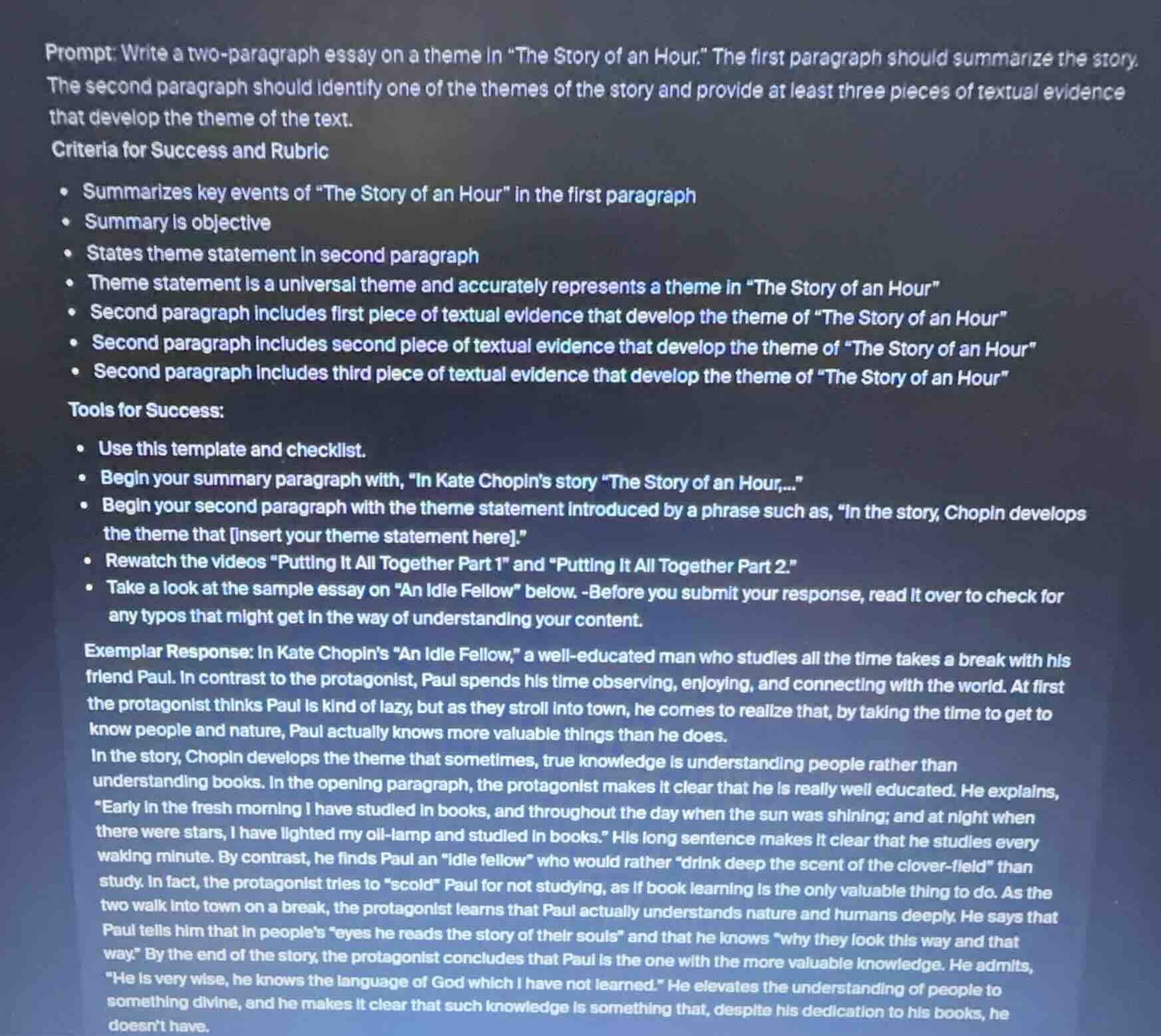
prompt: write a two-paragraph essay on a theme in \the story of an hour.\ the first paragraph should summarize the story. the second paragraph should identify one of the themes of the story and provide at least three pieces of textual evidence that develop the theme of the text.
criteria for success and rubric
- summarizes key events of \the story of an hour\ in the first paragraph
- summary is objective
- states theme statement in second paragraph
- theme statement is a universal theme and accurately represents a theme in \the story of an hour\
- second paragraph includes first piece of textual evidence that develop the theme of \the story of an hour\
- second paragraph includes second piece of textual evidence that develop the theme of \the story of an hour\
- second paragraph includes third piece of textual evidence that develop the theme of \the story of an hour\
tools for success:
- use this template and checklist.
- begin your summary paragraph with, \in kate chopins story \the story of an hour,...\
- begin your second paragraph with the theme statement introduced by a phrase such as, \in the story, chopin develops the theme that insert your theme statement here.\
- rewatch the videos \putting it all together part 1\ and \putting it all together part 2.\
- take a look at the sample essay on \an idle fellow\ below. -before you submit your response, read it over to check for any typos that might get in the way of understanding your content.
exemplar response: in kate chopins \an idle fellow,\ a well-educated man who studies all the time takes a break with his friend paul. in contrast to the protagonist, paul spends his time observing, enjoying, and connecting with the world. at first the protagonist thinks paul is kind of lazy, but as they stroll into town, he comes to realize that, by taking the time to get to know people and nature, paul actually knows more valuable things than he does.
in the story, chopin develops the theme that sometimes, true knowledge is understanding people rather than understanding books. in the opening paragraph, the protagonist makes it clear that he is really well educated. he explains, \early in the fresh morning i have studied in books, and throughout the day when the sun was shining; and at night when there were stars, i have lighted my oil-lamp and studied in books.\ his long sentence makes it clear that he studies every waking minute. by contrast, he finds paul an \idle fellow\ who would rather \drink deep the scent of the clover-field\ than study. in fact, the protagonist tries to \scold\ paul for not studying, as if book learning is the only valuable thing to do. as the two walk into town on a break, the protagonist learns that paul actually understands nature and humans deeply. he says that paul tells him that in peoples \eyes he reads the story of their souls\ and that he knows \why they look this way and that way.\ by the end of the story, the protagonist concludes that paul is the one with the more valuable knowledge. he admits, \he is very wise, he knows the language of god which i have not learned.\ he elevates the understanding of people to something divine, and he makes it clear that such knowledge is something that, despite his dedication to his books, he doesnt have.
Analyze the prompt requirements
The prompt asks for a two-paragraph essay on Kate Chopin's "The Story of an Hour."
- Paragraph 1 must be an objective summary of the story, starting with: "In Kate Chopin's story 'The Story of an Hour,'..."
- Paragraph 2 must identify a universal theme and provide at least three pieces of textual evidence. It must begin with: "In the story, Chopin develops the theme that [insert theme statement here]."
Select a theme and evidence
A prominent universal theme in "The Story of an Hour" is that the desire for personal freedom and self-assertion can outweigh the societal expectations of marriage.
- Evidence 1: Louise Mallard's realization of her freedom, repeating "free, free, free!"
- Evidence 2: Her contemplation of the years ahead belonging entirely to her ("There would be no one to live for her during those coming years; she would live for herself").
- Evidence 3: The description of her marriage as a "bend" of "will" even if it was sometimes backed by love ("And yet she had loved him—sometimes. Often she had not").
Draft the objective summary (Paragraph 1)
The summary must cover key events objectively:
- Louise Mallard is informed gently of her husband Brently's death in a railroad disaster.
- She weeps immediately and retires to her room alone.
- Looking out the window, she experiences a sudden realization of her independence and freedom.
- She emerges from her room, only for Brently to walk through the door alive and unharmed.
- Louise collapses and dies of "heart disease—of the joy that kills."
Draft the theme analysis (Paragraph 2)
The analysis must integrate the selected theme statement and the three pieces of evidence smoothly, explaining how they develop the theme.
Review against the rubric and constraints
- Paragraph 1 starts with the required phrase.
- Paragraph 1 is objective and summarizes key events.
- Paragraph 2 starts with the required phrase and states a universal theme.
- Paragraph 2 includes at least three distinct pieces of textual evidence.
- All explanations are kept concise and focused.

Snap & solve any problem in the app
Get step-by-step solutions on Sovi AI
Photo-based solutions with guided steps
Explore more problems and detailed explanations
In Kate Chopin's story "The Story of an Hour," Louise Mallard, a woman with a heart condition, is gently informed by her sister Josephine and her husband's friend Richards that her husband, Brently Mallard, has died in a railroad accident. Upon hearing the news, Louise weeps with sudden grief and retreats to her room alone. As she sits by her window looking out at the signs of spring and new life, she experiences a profound realization of her newfound independence. Though she grieves her husband, she feels a rush of excitement for the years ahead that will belong entirely to her. Eventually, she leaves her room and walks downstairs with her sister, only for Brently Mallard to walk through the front door, completely unaware of the accident. Upon seeing her husband alive, Louise collapses and dies, a death the doctors attribute to "heart disease—of the joy that kills."
In the story, Chopin develops the theme that the desire for personal freedom and self-assertion can outweigh the societal expectations of marriage. Initially, Louise struggles against her growing realization of independence, but she eventually yields to it, whispering, "free, free, free!" to herself in her room. This reaction highlights how the prospect of autonomy is more powerful than the grief of losing a spouse. Chopin further develops this theme as Louise contemplates her future, noting that "there would be no one to live for her during those coming years; she would live for herself." This reveals that marriage, by its nature, imposed a restrictive "bend" of "will" upon her, regardless of whether the relationship was loving. Finally, Louise's complex feelings are cemented when she reflects on her love for Brently, admitting, "And yet she had loved him—sometimes. Often she had not." This admission demonstrates that even a marriage with moments of love cannot satisfy the fundamental human need for self-determination, a need so vital that losing it once more proves fatal to her.