Sovi.AI - AI Math Tutor

Scan to solve math questions

QUESTION IMAGE

this progressive disorder causes degeneration of neurons in the part of…

Question

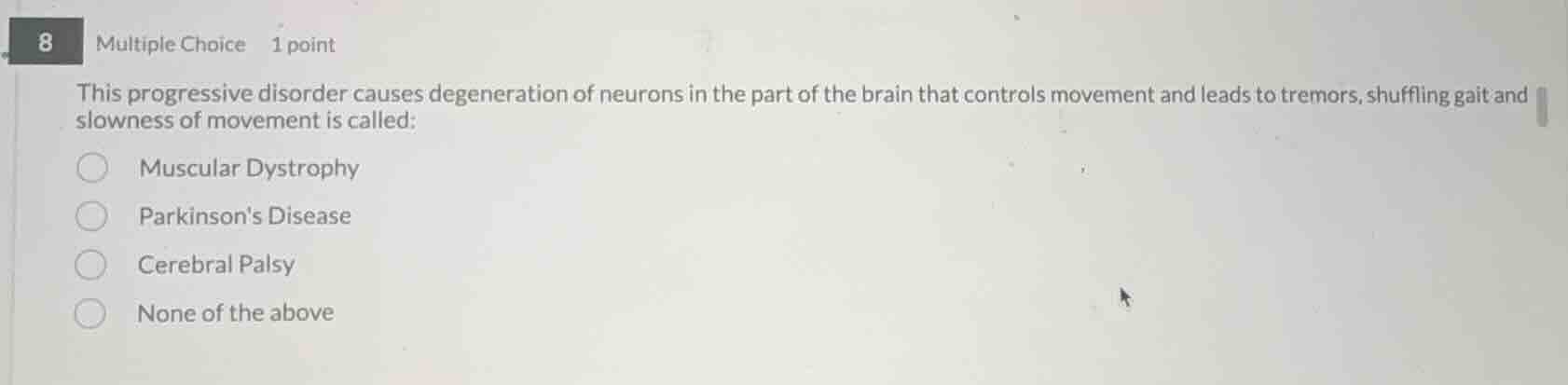
this progressive disorder causes degeneration of neurons in the part of the brain that controls movement and leads to tremors, shuffling gait and slowness of movement is called:

muscular dystrophy
parkinsons disease
cerebral palsy
none of the above

Explanation:

Response

<pre_analysis>
{
"quality": "clear",
"question_count": 1,
"skills_matched": [
"direct_cot",
"multiple_choice_formatter",
"explain_then_answer",
"tutor"
],
"needs_drawing": false,
"concepts_used": [
"Neurodegenerative Disorders"
],
"new_concepts": [
"Parkinsons Disease"
],
"current_concepts": [
"Neurodegenerative Disorders",
"Parkinsons Disease"
]
}
</pre_analysis>

<reasoning>

Analyze the clinical symptoms

The question describes a progressive disorder characterized by the degeneration of neurons in a brain region controlling movement. The key clinical signs presented are:

  • Tremors (resting tremors)
  • Shuffling gait (difficulty walking with short, dragging steps)
  • Slowness of movement (bradykinesia)

Match symptoms to neurodegenerative disorders

Using our knowledge of Neurodegenerative Disorders, we evaluate the options:

  • Muscular Dystrophy: A genetic muscle-wasting disease, not primarily a degeneration of brain neurons.
  • Parkinson's Disease: A progressive nervous system disorder affecting movement due to loss of dopamine-producing neurons in the substantia nigra. Classic symptoms include resting tremors, bradykinesia (slowness of movement), rigidity, and a characteristic shuffling gait.
  • Cerebral Palsy: A congenital, non-progressive movement disorder caused by abnormal brain development or damage before, during, or shortly after birth, rather than a progressive adult-onset degeneration.

Confirm the correct diagnosis

The clinical triad of tremors, shuffling gait, and bradykinesia is the hallmark presentation of Parkinson's disease. Therefore, the correct option is Parkinson's Disease.
</reasoning>

<answer>
<mcq-option>Muscular Dystrophy</mcq-option>
<mcq-correct>Parkinson's Disease</mcq-correct>
<mcq-option>Cerebral Palsy</mcq-option>
<mcq-option>None of the above</mcq-option>
</answer>

<post_analysis>
{
"subject": "Natural Science",
"question_type": "Multiple Choice",
"knowledge_point": [
"Natural Science",
"Medicine",
"Neurological Disorders"
]
}
</post_analysis>

Answer:

<pre_analysis>
{
"quality": "clear",
"question_count": 1,
"skills_matched": [
"direct_cot",
"multiple_choice_formatter",
"explain_then_answer",
"tutor"
],
"needs_drawing": false,
"concepts_used": [
"Neurodegenerative Disorders"
],
"new_concepts": [
"Parkinsons Disease"
],
"current_concepts": [
"Neurodegenerative Disorders",
"Parkinsons Disease"
]
}
</pre_analysis>

<reasoning>

Analyze the clinical symptoms

The question describes a progressive disorder characterized by the degeneration of neurons in a brain region controlling movement. The key clinical signs presented are:

  • Tremors (resting tremors)
  • Shuffling gait (difficulty walking with short, dragging steps)
  • Slowness of movement (bradykinesia)

Match symptoms to neurodegenerative disorders

Using our knowledge of Neurodegenerative Disorders, we evaluate the options:

  • Muscular Dystrophy: A genetic muscle-wasting disease, not primarily a degeneration of brain neurons.
  • Parkinson's Disease: A progressive nervous system disorder affecting movement due to loss of dopamine-producing neurons in the substantia nigra. Classic symptoms include resting tremors, bradykinesia (slowness of movement), rigidity, and a characteristic shuffling gait.
  • Cerebral Palsy: A congenital, non-progressive movement disorder caused by abnormal brain development or damage before, during, or shortly after birth, rather than a progressive adult-onset degeneration.

Confirm the correct diagnosis

The clinical triad of tremors, shuffling gait, and bradykinesia is the hallmark presentation of Parkinson's disease. Therefore, the correct option is Parkinson's Disease.
</reasoning>

<answer>
<mcq-option>Muscular Dystrophy</mcq-option>
<mcq-correct>Parkinson's Disease</mcq-correct>
<mcq-option>Cerebral Palsy</mcq-option>
<mcq-option>None of the above</mcq-option>
</answer>

<post_analysis>
{
"subject": "Natural Science",
"question_type": "Multiple Choice",
"knowledge_point": [
"Natural Science",
"Medicine",
"Neurological Disorders"
]
}
</post_analysis>