QUESTION IMAGE
Question
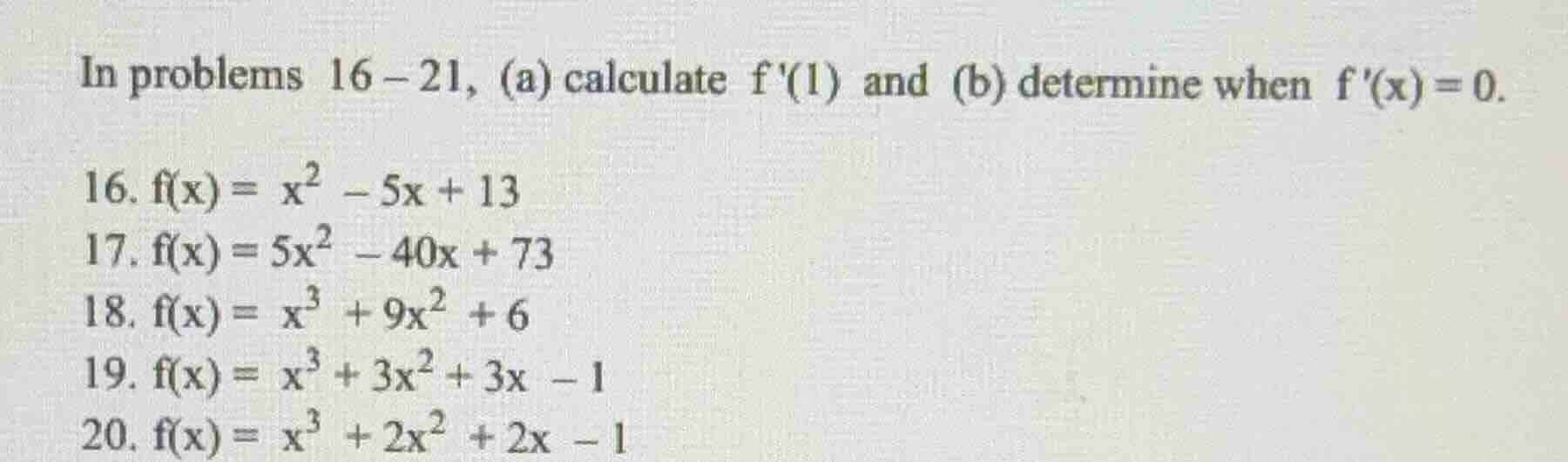
in problems 16-21, (a) calculate \\(f(1)\\) and (b) determine when \\(f(x) = 0\\).
- \\(f(x) = x^2 - 5x + 13\\)
- \\(f(x) = 5x^2 - 40x + 73\\)
- \\(f(x) = x^3 + 9x^2 + 6\\)
- \\(f(x) = x^3 + 3x^2 + 3x - 1\\)
- \\(f(x) = x^3 + 2x^2 + 2x - 1\\)
Find the derivative of each function
Using the Polynomial Functions knowledge point, we apply the power rule for differentiation, which states that if \(g(x) = x^n\), then \(g'(x) = n x^{n-1}\).
- For 16: \(f'(x) = 2x - 5\)
- For 17: \(f'(x) = 10x - 40\)
- For 18: \(f'(x) = 3x^2 + 18x\)
- For 19: \(f'(x) = 3x^2 + 6x + 3\)
- For 20: \(f'(x) = 3x^2 + 4x + 2\)
Evaluate the derivative at x = 1
We substitute \(x = 1\) into each derived function \(f'(x)\) to find \(f'(1)\).
- For 16: \(f'(1) = 2(1) - 5 = -3\)
- For 17: \(f'(1) = 10(1) - 40 = -30\)
- For 18: \(f'(1) = 3(1)^2 + 18(1) = 21\)
- For 19: \(f'(1) = 3(1)^2 + 6(1) + 3 = 12\)
- For 20: \(f'(1) = 3(1)^2 + 4(1) + 2 = 9\)
Solve for x when the derivative is zero
We set each derivative \(f'(x) = 0\) and solve the resulting equation for \(x\).
- For 16: \(2x - 5 = 0 \implies x = \frac{5}{2}\)
- For 17: \(10x - 40 = 0 \implies x = 4\)
- For 18: \(3x^2 + 18x = 0 \implies 3x(x + 6) = 0 \implies x = 0\) or \(x = -6\)
- For 19: \(3x^2 + 6x + 3 = 0 \implies 3(x + 1)^2 = 0 \implies x = -1\)
- For 20: \(3x^2 + 4x + 2 = 0\). The discriminant is \(\Delta = 4^2 - 4(3)(2) = 16 - 24 = -8 < 0\), so there are no real solutions.

Snap & solve any problem in the app
Get step-by-step solutions on Sovi AI
Photo-based solutions with guided steps
Explore more problems and detailed explanations
Question 16
(a) \(f'(1) = -3\)
(b) \(f'(x) = 0\) when \(x = \frac{5}{2}\)
Question 17
(a) \(f'(1) = -30\)
(b) \(f'(x) = 0\) when \(x = 4\)
Question 18
(a) \(f'(1) = 21\)
(b) \(f'(x) = 0\) when \(x = 0, -6\)
Question 19
(a) \(f'(1) = 12\)
(b) \(f'(x) = 0\) when \(x = -1\)
Question 20
(a) \(f'(1) = 9\)
(b) \(f'(x) = 0\) has no real solutions