QUESTION IMAGE
Question
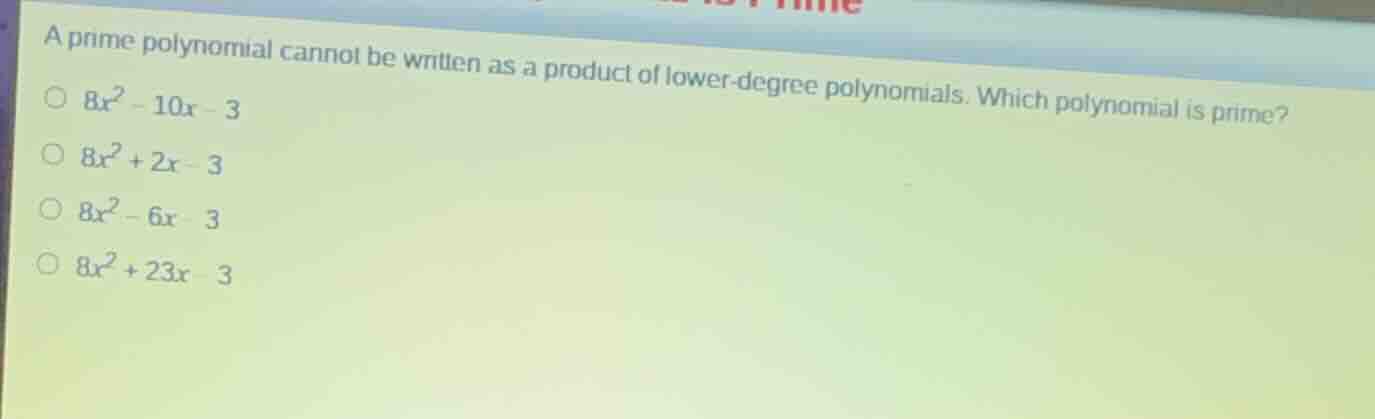
a prime polynomial cannot be written as a product of lower-degree polynomials. which polynomial is prime?
\\(8x^2 - 10x - 3\\)
\\(8x^2 + 2x - 3\\)
\\(8x^2 - 6x - 3\\)
\\(8x^2 + 23x - 3\\)
Analyze the factoring conditions for each quadratic polynomial
For a quadratic polynomial of the form \(ax^2 + bx + c\) to be factorable over the integers, we must find two integers that multiply to \(ac\) and add to \(b\). Here, \(a = 8\) and \(c = -3\), so the product is \(ac = 8 \times (-3) = -24\).
Test each option for integer factors
- For \(8x^2 - 10x - 3\): We need factors of \(-24\) that add to \(-10\). These are \(-12\) and \(2\). Thus, it is factorable:
$$8x^2 - 12x + 2x - 3 = 4x(2x - 3) + 1(2x - 3) = (4x + 1)(2x - 3)$$
- For \(8x^2 + 2x - 3\): We need factors of \(-24\) that add to \(2\). These are \(6\) and \(-4\). Thus, it is factorable:
$$8x^2 + 6x - 4x - 3 = 2x(4x + 3) - 1(4x + 3) = (2x - 1)(4x + 3)$$
- For \(8x^2 - 6x - 3\): We need factors of \(-24\) that add to \(-6\). The integer factor pairs of \(-24\) are:
$$(1, -24), (-1, 24), (2, -12), (-2, 12), (3, -8), (-3, 8), (4, -6), (-4, 6)$$
None of these pairs sum to \(-6\). Thus, this polynomial is prime.
- For \(8x^2 + 23x - 3\): We need factors of \(-24\) that add to \(23\). These are \(24\) and \(-1\). Thus, it is factorable:
$$8x^2 + 24x - x - 3 = 8x(x + 3) - 1(x + 3) = (8x - 1)(x + 3)$$
Identify the prime polynomial
The only polynomial that cannot be factored over the integers is \(8x^2 - 6x - 3\).

Snap & solve any problem in the app
Get step-by-step solutions on Sovi AI
Photo-based solutions with guided steps
Explore more problems and detailed explanations
- (A) \(8x^2 - 10x - 3\)
- (B) \(8x^2 + 2x - 3\)
- (C) \(8x^2 - 6x - 3\) (Correct answer)
- (D) \(8x^2 + 23x - 3\)