QUESTION IMAGE
Question
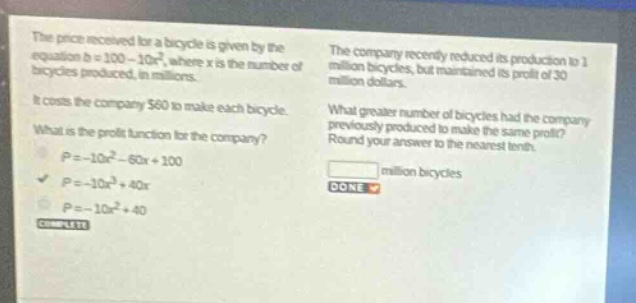
the price received for a bicycle is given by the equation (b = 100 - 10x^2), where (x) is the number of bicycles produced, in millions.
it costs the company $60 to make each bicycle.
what is the profit function for the company?
- (p = -10x^2 - 60x + 100)
- (p = -10x^3 + 40x)
- (p = -10x^2 + 40)
the company recently reduced its production to 1 million bicycles, but maintained its profit of 30 million dollars.
what greater number of bicycles had the company previously produced to make the same profit? round your answer to the nearest tenth.
million bicycles
🆕 New Concept Discovered: Profit Maximization and Modeling
Modeling profit by subtracting total cost from total revenue.
Step 1: Understand the variables and units
Let \( x \) be the number of bicycles produced, in millions.
The price per bicycle (in dollars) is:
The cost to make each bicycle is \( \$60 \). Since \( x \) is in millions of bicycles, the total cost \( C \) (in millions of dollars) is:
The total revenue \( R \) (in millions of dollars) is the price per bicycle multiplied by the number of bicycles (in millions):
The profit function \( P \) (in millions of dollars) is revenue minus cost:
This matches the selected option in the first part of the question.
Step 2: Set up the equation for the given profit
The company made a profit of \( 30 \) million dollars. We set the profit function equal to \( 30 \):
Divide the entire equation by \(-10\) to simplify:
Step 3: Solve the cubic equation
We are told that the company recently reduced its production to \( 1 \) million bicycles (\( x = 1 \)) while maintaining this profit. Let's verify if \( x = 1 \) is a root:
Yes, \( x = 1 \) is a root.
To find the other roots, we can factor out \( (x - 1) \) from the polynomial \( x^3 - 4x + 3 \) using polynomial division or synthetic division:
Step 4: Find the remaining roots
Set the quadratic factor to zero:
Use the quadratic formula \( x = \frac{-b \pm \sqrt{b^2 - 4ac}}{2a} \):
Since production quantity \( x \) must be positive:
Using the approximation \( \sqrt{13} \approx 3.6056 \):
Step 5: Round to the nearest tenth
Rounding \( 1.3028 \) to the nearest tenth gives:
This represents the greater previous production level of \( 1.3 \) million bicycles that yielded the same profit of \( 30 \) million dollars.

Snap & solve any problem in the app
Get step-by-step solutions on Sovi AI
Photo-based solutions with guided steps
Explore more problems and detailed explanations
1.3