QUESTION IMAGE
Question
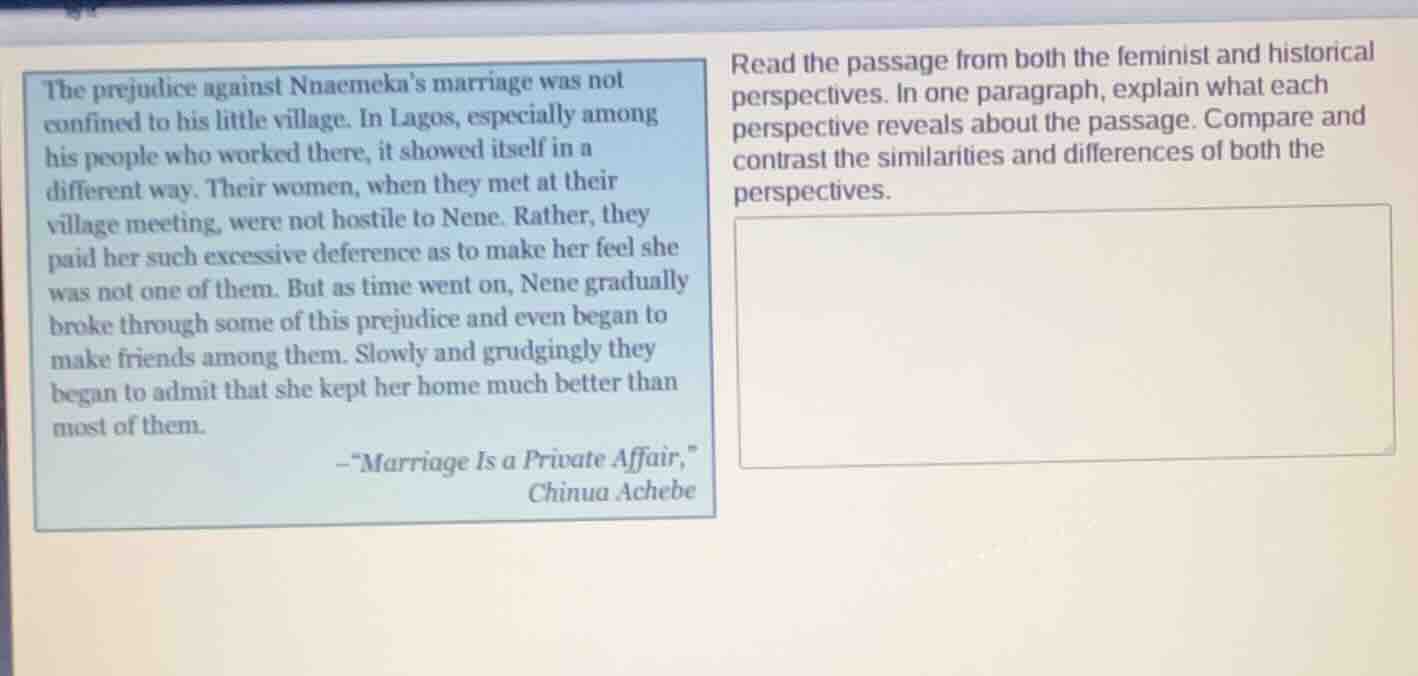
the prejudice against nnaemekas marriage was not confined to his little village. in lagos, especially among his people who worked there, it showed itself in a different way. their women, when they met at their village meeting, were not hostile to nene. rather, they paid her such excessive deference as to make her feel she was not one of them. but as time went on, nene gradually broke through some of this prejudice and even began to make friends among them. slowly and grudgingly they began to admit that she kept her home much better than most of them.
-\marriage is a private affair,\ chinua achebe
read the passage from both the feminist and historical perspectives. in one paragraph, explain what each perspective reveals about the passage. compare and contrast the similarities and differences of both the perspectives.
From a historical perspective, the passage reflects the rigid ethnic and cultural hierarchies in mid-20th century Nigerian society, where intercultural marriages (implied by Nene's exclusion) faced informal social shunning, even in urban Lagos; the slow acceptance tied to domestic competence also highlights the era's strict gendered expectations for women's roles. From a feminist perspective, the text exposes how women in the community enforced patriarchal and cultural norms through passive-aggressive exclusion, but also shows small, incremental acts of resistance as Nene gains acceptance on her own terms, though this acceptance is still rooted in her adherence to traditional domestic standards, revealing the limits of female agency in that context. Both perspectives recognize the power of cultural norms to police relationships, but the historical view centers on the era's structural social constraints, while the feminist view focuses on gendered dynamics of enforcement and limited resistance among women.

Snap & solve any problem in the app
Get step-by-step solutions on Sovi AI
Photo-based solutions with guided steps
Explore more problems and detailed explanations
The historical perspective reveals mid-20th century Nigerian cultural hierarchies and gendered domestic expectations that shaped responses to intercultural marriage, while the feminist perspective highlights how women enforced patriarchal norms through exclusion, alongside small acts of female agency in Nene's gradual acceptance (tied to domestic skill). Similarities include recognition of cultural norms policing relationships; differences lie in the historical focus on structural era-specific constraints versus the feminist focus on gendered power dynamics among women.