QUESTION IMAGE
Question
practice passage 2
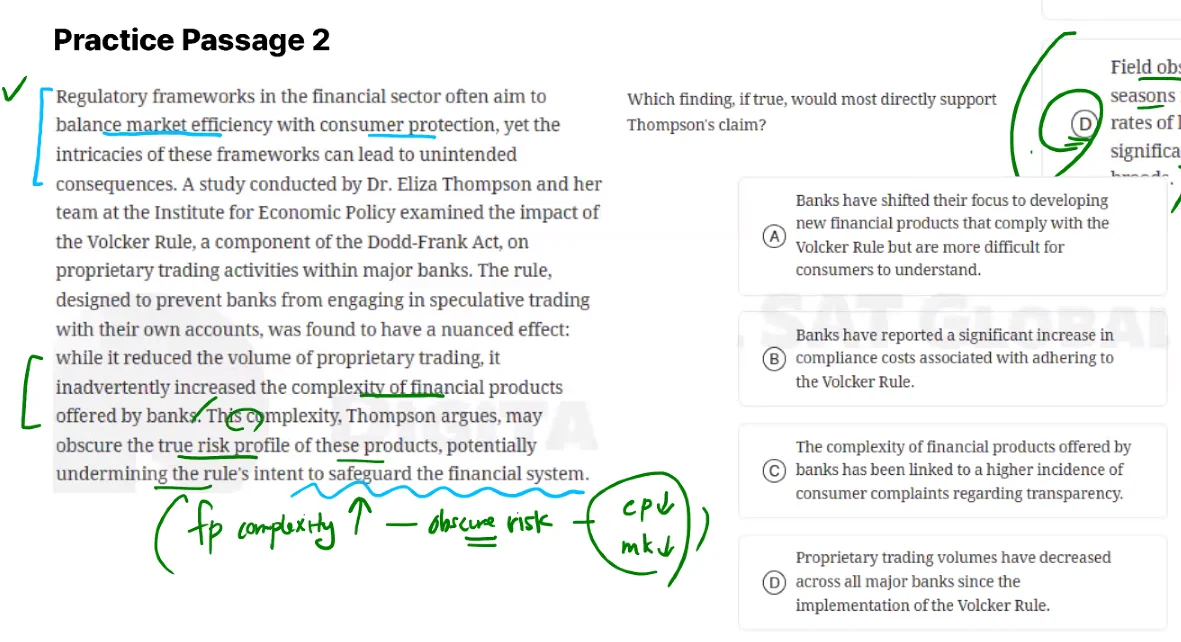
regulatory frameworks in the financial sector often aim to balance market efficiency with consumer protection, yet the intricacies of these frameworks can lead to unintended consequences. a study conducted by dr. eliza thompson and her team at the institute for economic policy examined the impact of the volcker rule, a component of the dodd - frank act, on proprietary trading activities within major banks. the rule, designed to prevent banks from engaging in speculative trading with their own accounts, was found to have a nuanced effect: while it reduced the volume of proprietary trading, it inadvertently increased the complexity of financial products offered by banks. this complexity, thompson argues, may obscure the true risk profile of these products, potentially undermining the rules intent to safeguard the financial system.
which finding, if true, would most directly support thompsons claim?
a banks have shifted their focus to developing new financial products that comply with the volcker rule but are more difficult for consumers to understand.
b banks have reported a significant increase in compliance costs associated with adhering to the volcker rule.
c the complexity of financial products offered by banks has been linked to a higher incidence of consumer complaints regarding transparency.
d proprietary trading volumes have decreased across all major banks since the implementation of the volcker rule.
To support Thompson's claim, we need to find evidence related to the Volcker Rule's impact on financial product complexity obscuring risk profiles (undermining consumer protection/market safety). Let's analyze each option:
- Option A: Talks about new products complying with the rule but being complex for consumers. However, Thompson's claim is about obscuring risk profiles (not just consumer understanding) to undermine the rule's intent. This is not direct support.
- Option B: Discusses increased compliance costs for banks. Thompson’s claim is about financial product complexity and risk profiles, not compliance costs. Irrelevant.
- Option C: Links financial product complexity to more consumer complaints about transparency. Thompson argues complexity obscures risk profiles (which relates to transparency/consumer protection) and undermines the rule’s intent. This directly connects complexity to a negative outcome (consumer complaints) related to transparency, supporting the idea that complexity undermines the rule’s goal.
- Option D: States proprietary trading volumes decreased. Thompson’s claim is about financial product complexity, not proprietary trading volume (the rule already reduced trading volume, but the issue is complexity). This is a known effect, not support for her claim about complexity undermining intent.

Snap & solve any problem in the app
Get step-by-step solutions on Sovi AI
Photo-based solutions with guided steps
Explore more problems and detailed explanations
C. The complexity of financial products offered by banks has been linked to a higher incidence of consumer complaints regarding transparency.