QUESTION IMAGE
Question
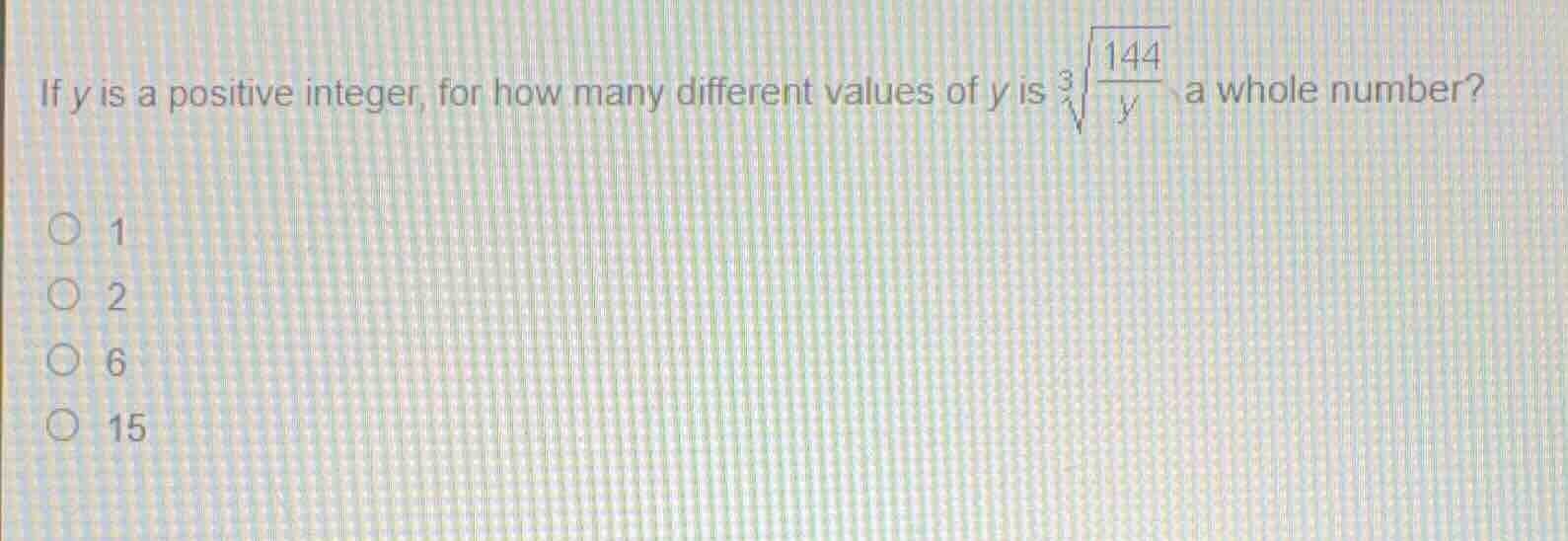
if y is a positive integer, for how many different values of y is \\(\sqrt3{\frac{144}{y}}\\) a whole number?
1
2
6
15
<pre_analysis>
{
"quality": "clear",
"question_count": 1,
"skills_matched": [
"step_cot",
"multiple_choice_formatter",
"explain_then_answer",
"tutor",
"mastery_adaptive_brevity"
],
"needs_drawing": false,
"concepts_used": [
"Integer Divisibility"
],
"new_concepts": [
"Perfect Cubes",
"Divisibility of Perfect Cubes"
],
"current_concepts": [
"Integer Divisibility",
"Perfect Cubes",
"Divisibility of Perfect Cubes"
]
}
</pre_analysis>
<reasoning>
Set up the condition for a whole number
Using the Integer Divisibility knowledge point
\[
\]
Analyze constraints on the integer variables
Since \(y\) must be a positive integer, we have:
\[
\]
Find perfect cube divisors of 144
We find all positive integers \(k\) such that \(k^3\) divides \(144\).
First, find the prime factorization of \(144\):
\[
144 = 12^2 = (2^2 \cdot 3)^2 = 2^4 \cdot 3^2
\]
For \(k^3\) to divide \(2^4 \cdot 3^2\), the prime factorization of \(k^3\) can only contain primes \(2\) and \(3\) with exponents less than or equal to those in \(144\):
\[
\]
Count the valid values of y
There are exactly \(2\) positive integer values of \(y\) (\(144\) and \(18\)) that satisfy the condition.
</reasoning>
<answer>
<mcq-option>(A) 1</mcq-option>
<mcq-correct>(B) 2</mcq-correct>
<mcq-option>(C) 6</mcq-option>
<mcq-option>(D) 15</mcq-option>
</answer>
<post_analysis>
{
"subject": "Mathematics",
"question_type": "Multiple Choice",
"knowledge_point": [
"Mathematics",
"Number Theory",
"Integer Divisibility"
]
}
</post_analysis>
Snap & solve any problem in the app
Get step-by-step solutions on Sovi AI
Photo-based solutions with guided steps
Explore more problems and detailed explanations
<pre_analysis>
{
"quality": "clear",
"question_count": 1,
"skills_matched": [
"step_cot",
"multiple_choice_formatter",
"explain_then_answer",
"tutor",
"mastery_adaptive_brevity"
],
"needs_drawing": false,
"concepts_used": [
"Integer Divisibility"
],
"new_concepts": [
"Perfect Cubes",
"Divisibility of Perfect Cubes"
],
"current_concepts": [
"Integer Divisibility",
"Perfect Cubes",
"Divisibility of Perfect Cubes"
]
}
</pre_analysis>
<reasoning>
Set up the condition for a whole number
Using the Integer Divisibility knowledge point
\[
\]
Analyze constraints on the integer variables
Since \(y\) must be a positive integer, we have:
\[
\]
Find perfect cube divisors of 144
We find all positive integers \(k\) such that \(k^3\) divides \(144\).
First, find the prime factorization of \(144\):
\[
144 = 12^2 = (2^2 \cdot 3)^2 = 2^4 \cdot 3^2
\]
For \(k^3\) to divide \(2^4 \cdot 3^2\), the prime factorization of \(k^3\) can only contain primes \(2\) and \(3\) with exponents less than or equal to those in \(144\):
\[
\]
Count the valid values of y
There are exactly \(2\) positive integer values of \(y\) (\(144\) and \(18\)) that satisfy the condition.
</reasoning>
<answer>
<mcq-option>(A) 1</mcq-option>
<mcq-correct>(B) 2</mcq-correct>
<mcq-option>(C) 6</mcq-option>
<mcq-option>(D) 15</mcq-option>
</answer>
<post_analysis>
{
"subject": "Mathematics",
"question_type": "Multiple Choice",
"knowledge_point": [
"Mathematics",
"Number Theory",
"Integer Divisibility"
]
}
</post_analysis>