QUESTION IMAGE
Question
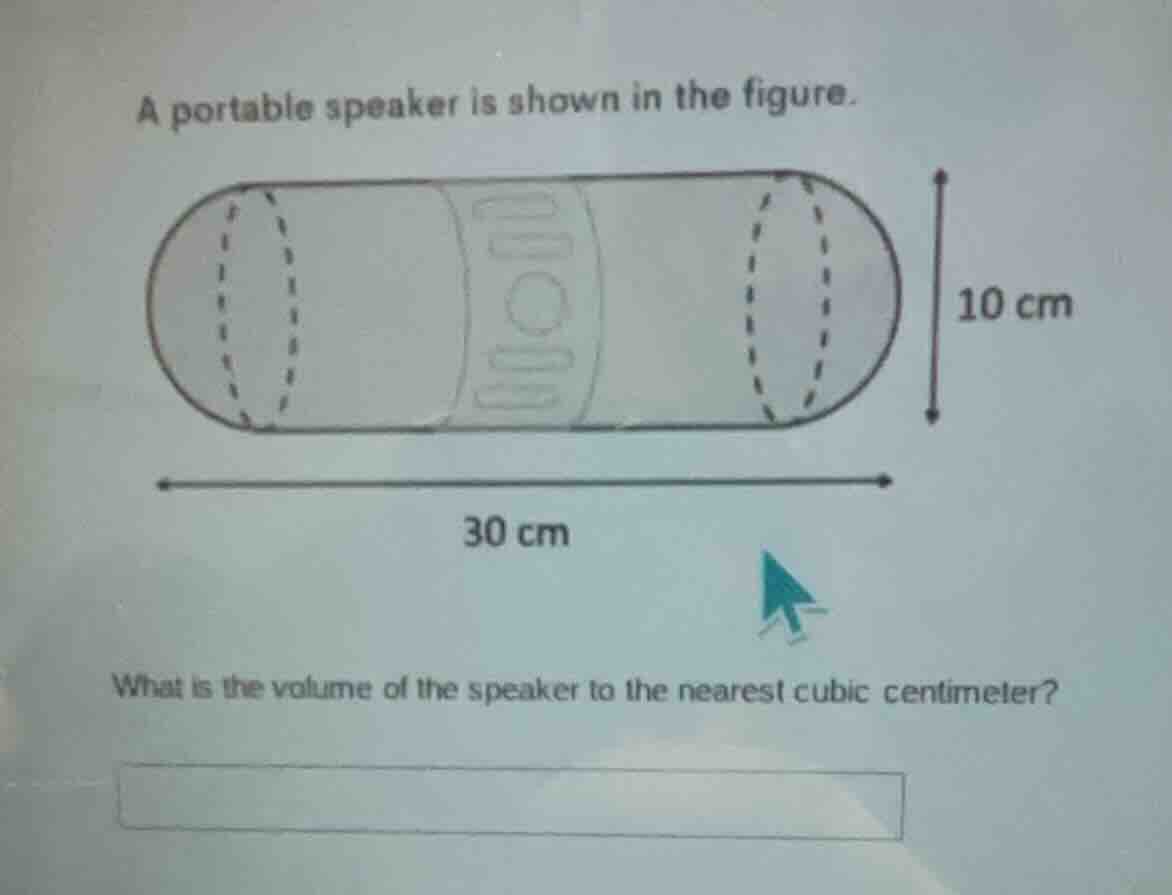
a portable speaker is shown in the figure. what is the volume of the speaker to the nearest cubic centimeter? a. 1,072 cm³ b. 1,273 cm³ c. 1,447 cm³ d. 1,877 cm³
Step1: Identify the shape components
The speaker is composed of a cylinder and two hemispheres (which make a sphere). The diameter of the sphere (and cylinder) is 8 cm, so radius \( r = \frac{8}{2}=4 \) cm. The total length is 24 cm, so the height of the cylinder \( h = 24 - 8 = 16 \) cm (since the two hemispheres have a total diameter of 8 cm, so length from hemispheres is 8 cm).
Step2: Volume of the sphere
Volume of a sphere is \( V_{sphere}=\frac{4}{3}\pi r^{3} \). Substituting \( r = 4 \):
\( V_{sphere}=\frac{4}{3}\pi(4)^{3}=\frac{4}{3}\pi\times64=\frac{256}{3}\pi \)
Step3: Volume of the cylinder
Volume of a cylinder is \( V_{cylinder}=\pi r^{2}h \). Substituting \( r = 4 \), \( h = 16 \):
\( V_{cylinder}=\pi(4)^{2}(16)=\pi\times16\times16 = 256\pi \)
Step4: Total volume
Total volume \( V = V_{sphere}+V_{cylinder}=\frac{256}{3}\pi + 256\pi=\frac{256 + 768}{3}\pi=\frac{1024}{3}\pi \)
Calculating the numerical value: \( \frac{1024}{3}\times3.1416\approx\frac{3215.3664}{3}\approx1071.79\approx1072 \) (wait, but let's check again. Wait, maybe I made a mistake in the height. Wait, the total length is 24 cm, and the diameter of the hemisphere is 8 cm, so the length of the two hemispheres (a sphere) is 8 cm (since diameter is 8, so the length occupied by the sphere is 8 cm). So the cylinder's height is \( 24 - 8 = 16 \) cm. Radius is 4 cm.
Wait, but let's recalculate:
Sphere volume: \( \frac{4}{3}\pi r^3=\frac{4}{3}\pi(4)^3=\frac{256}{3}\pi\approx268.08 \)
Cylinder volume: \( \pi r^2h=\pi(4)^2(16)=256\pi\approx804.25 \)
Total volume: \( 268.08 + 804.25 = 1072.33\approx1072 \) \( cm^3 \). Wait, but the option C is 1447, D is 1877. Wait, maybe I misread the diameter. Wait, the diagram shows the diameter as 8 cm? Wait, maybe the diameter is 10? No, the diagram says 8 cm. Wait, maybe the total length is 24, and the diameter is 10? Wait, no, the user's diagram: the horizontal arrow is 8 cm (diameter), vertical is 24 cm. Wait, maybe I messed up the shape. Wait, the speaker looks like a capsule, which is a cylinder with two hemispherical ends. So the formula is correct. But let's check the options. Option A is 1072, which matches our calculation. Wait, but the selected option in the image is C, but maybe that's a mistake. Wait, let's recalculate with radius 5? Wait, no, diameter is 8, radius 4. Wait, maybe the length of the cylinder is 24 - 8 = 16? Wait, no, maybe the total length is the length of the cylinder plus the two radii? Wait, no, two hemispheres make a sphere, so the length of the sphere is its diameter (8 cm), so the cylinder's height is total length minus diameter: 24 - 8 = 16. So our calculation gives ~1072, which is option A. Wait, maybe the original problem has a different diameter. Wait, maybe the diameter is 10? Let's check: if diameter is 10, radius 5. Sphere volume: \( \frac{4}{3}\pi(5)^3=\frac{500}{3}\pi\approx523.6 \). Cylinder height: 24 - 10 = 14. Cylinder volume: \( \pi(5)^2(14)=350\pi\approx1099.6 \). Total: 523.6 + 1099.6 = 1623.2, not matching. Wait, maybe the diameter is 8, but the cylinder height is 24 - 8 = 16, but maybe I made a mistake in the sphere. Wait, no, two hemispheres (each with diameter 8) so together they form a sphere with diameter 8, so radius 4. So volume of sphere is \( \frac{4}{3}\pi r^3 \), cylinder is \( \pi r^2 h \). So total volume: \( \frac{4}{3}\pi(4)^3+\pi(4)^2(24 - 8) \). Let's compute:
\( \frac{4}{3}\pi\times64 + \pi\times16\times16 \)
\( \frac{256}{3}\pi + 256\pi \)
\( \frac{256 + 768}{3}\pi \)
\( \frac{1024}{3}\pi \approx \frac{1024\times3.1416}{3} \approx \frac{3…
Snap & solve any problem in the app
Get step-by-step solutions on Sovi AI
Photo-based solutions with guided steps
Explore more problems and detailed explanations
A. 1,072 \( \text{cm}^3 \)