QUESTION IMAGE
Question
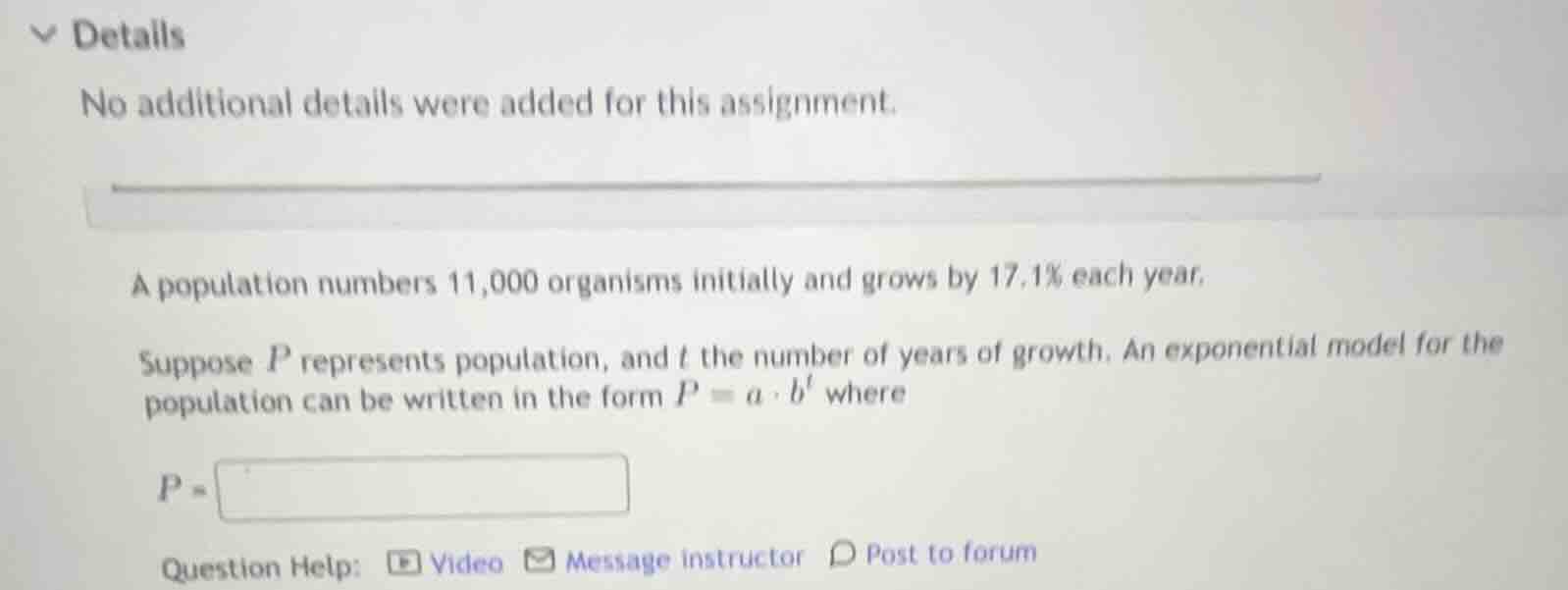
a population numbers 11,000 organisms initially and grows by 17.1% each year.
suppose \\(p\\) represents population, and \\(t\\) the number of years of growth. an exponential model for the population can be written in the form \\(p = a \cdot b^t\\) where
\\(p = \\)
⚡ Using what you learned: exponential growth and decay_model growth
Step 1: Identify the initial value
The initial population is given as \( 11,000 \) organisms. In the exponential model \( P = a \cdot b^t \), the parameter \( a \) represents the initial value when \( t = 0 \).
Step 2: Determine the growth factor
The population grows by \( 17.1\% \) each year. Convert the percentage growth rate \( r \) to a decimal:
The growth factor \( b \) is calculated as:
Step 3: Write the exponential model
Substitute \( a \) and \( b \) into the general formula \( P = a \cdot b^t \):

Snap & solve any problem in the app
Get step-by-step solutions on Sovi AI
Photo-based solutions with guided steps
Explore more problems and detailed explanations