QUESTION IMAGE
Question
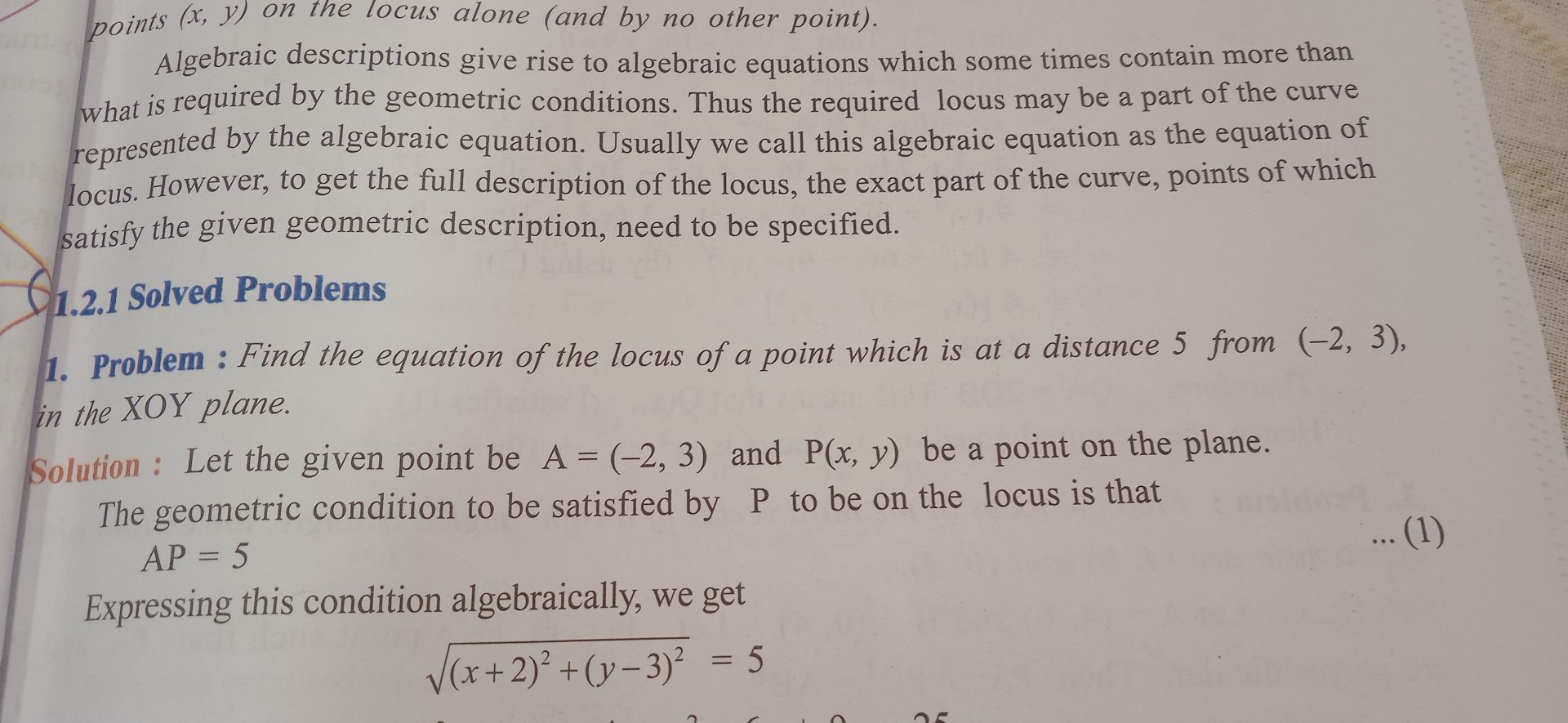
points \\((x, y)\\) on the locus alone (and by no other point).
algebraic descriptions give rise to algebraic equations which some times contain more than what is required by the geometric conditions. thus the required locus may be a part of the curve represented by the algebraic equation. usually we call this algebraic equation as the equation of locus. however, to get the full description of the locus, the exact part of the curve, points of which satisfy the given geometric description, need to be specified.
1.2.1 solved problems
- problem : find the equation of the locus of a point which is at a distance 5 from \\((-2, 3)\\), in the \\(xoy\\) plane.
solution : let the given point be \\(a = (-2, 3)\\) and \\(p(x, y)\\) be a point on the plane.
the geometric condition to be satisfied by \\(p\\) to be on the locus is that
\ap = 5\\
expressing this condition algebraically, we get
\\\sqrt{(x+2)^2 + (y-3)^2} = 5\\
🆕 New Concept Discovered: Equation of a Locus
Finding the path traced by a moving point satisfying a geometric condition.
Step 1: Identify the geometric condition
Let the moving point on the locus be \( P(x, y) \).
The fixed point is given as \( A(-2, 3) \).
The geometric condition states that the distance from \( P \) to \( A \) must always be equal to \( 5 \).
Step 2: Apply the distance formula
The distance between two points \( (x_1, y_1) \) and \( (x_2, y_2) \) is given by:
Substituting our points \( P(x, y) \) and \( A(-2, 3) \) into this formula gives:
Simplifying the signs inside the parenthesis:
Step 3: Square both sides to eliminate the square root
To simplify the equation, we square both sides:
Step 4: Expand and simplify the algebraic equation
Now, expand the squared terms using the identities \( (a+b)^2 = a^2 + 2ab + b^2 \) and \( (a-b)^2 = a^2 - 2ab + b^2 \):
Group the terms together:
Subtract \( 25 \) from both sides to set the equation to zero:

Snap & solve any problem in the app
Get step-by-step solutions on Sovi AI
Photo-based solutions with guided steps
Explore more problems and detailed explanations